Share on Facebook
 Share on X
 Share by Email
 Share on Google Classroom
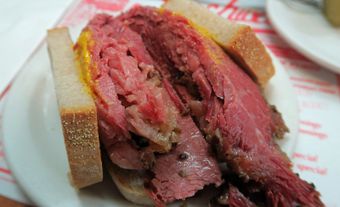
Peameal bacon (or cornmeal back bacon) is a Canadian dish made of cured ― but not smoked ― pork loin coated in cornmeal. It has a distinct yellow crust. When served in a sandwich, peameal bacon is grilled and placed hot on a soft bun. It’s often dressed with mustard. It is a regional specialty from Ontario, notably linked to Toronto’s historical nickname, “Hogtown.” In 2016, the city declared the peameal bacon sandwich as its signature dish.
Ingredients and Preparation
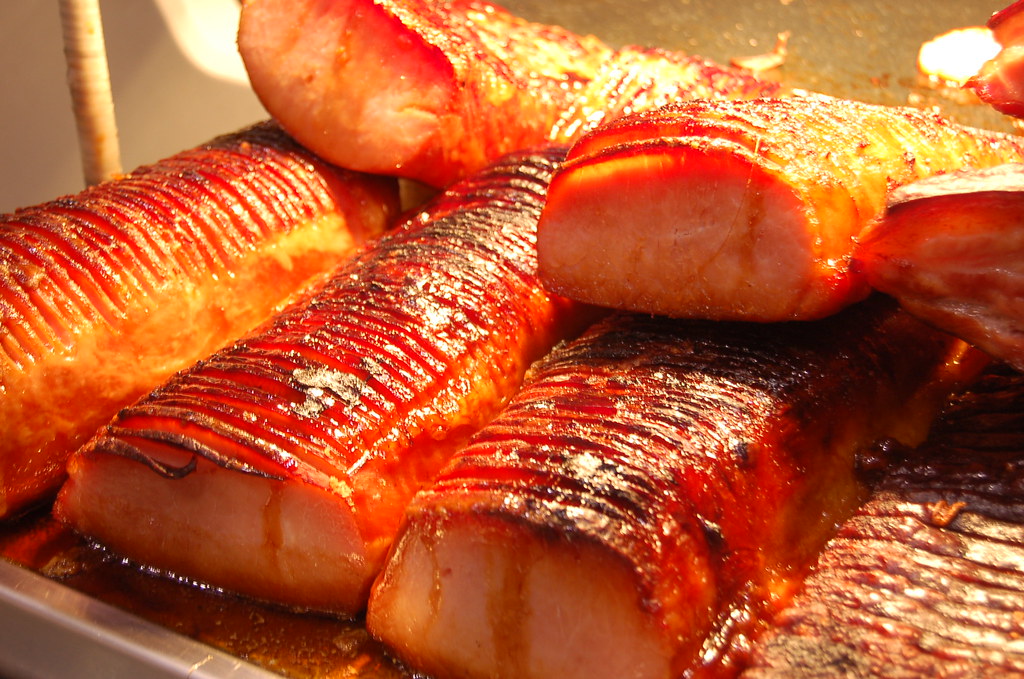
Peameal bacon is mainly found in Ontario and Eastern Canada. Unlike the more common side bacon, which comes from pork belly, peameal bacon is made from the same cut of pork meat as back bacon (the loin).Peameal bacon is cured in a wet brine ― a salt, sugar and spice solution. Unlike traditional bacon, peameal bacon is rolled in cornmeal, creating a yellow coating to keep it from spoiling. It is never smoked, giving it a milder, ham-like flavour.
Did you know?
The term “peameal” comes from peas, which are usually used to feed pigs. As a preservative, the peas are dried, ground and used to coat meat. The coating helped protect the meat and keep it moist. Today, cornmeal is used instead, but the name peameal remains.
Peameal bacon is commonly sliced thin, fried on a griddle and served in a sandwich with mustard. Peameal bacon is also sold as is. Notably, it is leaner and has lower but still high levels of sodium content than the typical side bacon.
Historical Background
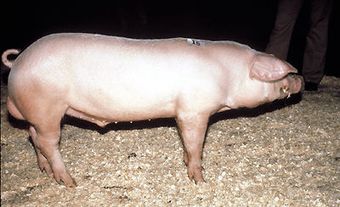
While its exact origins are unknown, peameal bacon can be traced back to English curing methods brought to Canada by 19th-century immigrants. Before refrigeration, meat preservation relied on brining, smoking or drying. British-style back bacon is traditionally dry-cured with salt and spices. Canadian butchers, however, opted for wet curing. This allowed for faster curing times suitable for large-scale production. (See Pig Farming.)
Peameal bacon is widely attributed to William Davies, who likely popularized it. Born in Wallingford, England in 1831, Davies spent his teenage years working in groceries and learning the business of cured meats. At 23 years old, he immigrated to Canada with his wife and child. In 1854, he started a business in Toronto selling food at the East Market Square (now St. Lawrence Market). In 1860, he sent his first shipment of cured pork meat and other products to relatives in England.
Davies increasingly focused on producing cured meat. Soon, he bought his own live hogs to help standardize his offering. In 1874, as his trade grew, Davies opened the William Davies Meat Packers plant at the southwest corner of Frederick and Front streets.
In 1879, William Davies built a new plant near the Don River, where he began slaughtering and processing hogs. His company packed crates of cured bacon to then ship unrefrigerated to England. There, the product became hugely popular. Pork from Toronto became an export commodity, earning the city the nickname “Hogtown.”
In 1891, after the death of his sons, William Davies stopped running the enterprise. At around that time, Peterborough-born financier Joseph Flavelle joined the firm. The company was reorganized as the William Davies Company Limited, with Flavelle assuming control. Under Flavelle’s leadership, the company prospered, expanding its operations. At its peak, the pork packing plant slaughtered 500,000 hogs annually, claiming to be the largest of its kind in the British Empire. However, by the early 1900s, cheaper Danish bacon had displaced Canadian exports. In 1919, Davies’ grandson, Edward Carey Fox, bought the company, but it later faltered. In 1927, the William Davies Company merged with similar businesses into Canada Packers. They formed the food processing company that became known as Maple Leaf Foods.
Nevertheless, peameal bacon remained popular as a breakfast item in Canada throughout the 20th century. Traditionally, people cooked it as a whole roast with maple syrup or mustard. (See also Maple Syrup Industry.)
Over time, due to the availability of corn, cornmeal replaced peas as the coating ingredient in peameal bacon.
Peameal Bacon Sandwich
Today, the peameal bacon sandwich is a popular way of having peameal bacon. The dish was likely created by the Biancolin family.
In the 1950s, Elso Biancolin worked as a merchant at Brown Brothers Limited, a butcher shop. There, he learned how to cure meat.
In 1969, Elso Biancolin and business partner Joseph Homer bought the Carousel Bakery at the St. Lawrence Market. At the butcher store they also owned, they knew that customers preferred the center cuts of pork loins, leaving other pieces unsold. To avoid meat waste, Biancolin cooked the butt ends on a small griddle to make a back bacon sandwich. The Biancolin family decided to make the peameal bacon sandwich a feature of their bakery stall. It became a subject of local news and food columns, which celebrated it as a market staple.
Legacy and Influence
Over time, peameal bacon became a regional dish for Toronto. It continued to evolve and helped define Canadian cuisine. By the 2000s, it drew increased international media attention.
In 2016, Mayor John Tory formally declared the peameal bacon sandwich as Toronto’s signature dish during a food festival. He stated that the sandwich was “very Canadian” and “very Toronto.”
In July 2025, the Biancolin brothers retired from business operations. That same year, Mayor Olivia Chow honoured the Carousel Bakery co-owners. She granted them the Key to the City for preserving this culinary heritage.
While peameal bacon’s popularity is particularly strong in Toronto, other parts of Eastern Canada have also found it appealing. Peameal bacon is used as a versatile ingredient for various dishes, such as on pizza or on nachos. Peameal bacon can even be added as a meaty component in a soup.