Share on Facebook
 Share on X
 Share by Email
 Share on Google Classroom
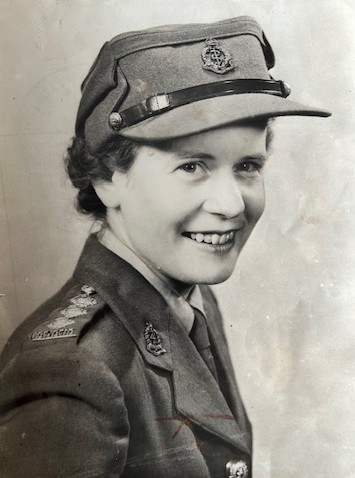
Marion Ross, MD, physician, military officer (born 10 July 1909 in Barrie, ON; died 31 August 2000 in Toronto, ON). Ross was one of the first female physicians commissioned into the Royal Canadian Army Medical Corps (RCAMC). She was also one of the few to serve in a campaign, in her role as bacteriologist with No. 15 Canadian General Hospital in North Africa and Italy (see Canada and the Italian Campaign). After the Second World War, Ross was on the medical staff of Sunnybrook Veterans Hospital and taught at the University of Toronto.
Early Life and Family
Marion Ross was born to lawyer Donald Ross and his wife, Emmeline (or Emma) Harper. In 1902, Donald Ross became a town councilor and in 1905, he was elected mayor of Barrie. He then returned to his law career, although he remained connected to politics and was a friend of William Lyon Mackenzie King.
Marion was the youngest child of the family, after sisters Helen and Margaret. Her mother died in 1923, but her father remained active in his practice and the community until his death in December 1929. At the time, Marion was a student at the University of Toronto.
Education
Marion Ross specialized in medical microbiology and graduated from the University of Toronto in 1934. She interned at Toronto General Hospital in 1934–35, then worked as a bacteriologist with the University of Toronto (1935–37) and Toronto General (1937–38). In 1938, she left Canada for England, where she completed postgraduate training in bacteriology at the University of London (1938–39).
Second World War
In May 1939, Marion Ross embarked on an extended European holiday with her sister Margaret. The two were in Germany when Britain declared war on 3 September. The Canadian embassy in Germany quickly evacuated them; they travelled together by train from Leipzig to Amsterdam and then sailed to England. Margaret returned to Canada on the first passenger ship to sail after SS Athenia, which had been sunk on 3 September by a German U-boat with heavy loss of life. Marion stayed in England, where she worked as a bacteriologist with the Medical Research Council in London from 1939 to 1942.
RCAMC
At the beginning of the Second World War, the Royal Canadian Army Medical Corps (RCAMC) wasn’t open to women doctors. This changed, however, in June 1942 when an Order in Council was passed permitting female physicians to enlist. Physicians like Geraldine Maloney and Lillian Chase quickly signed up; some would eventually serve overseas. Marion Ross also applied and was commissioned into the RCAMC in November 1942. As she was already overseas, she was assigned as bacteriologist to No. 15 Canadian General Hospital (CGH), which was then stationed in England. She was the only female physician on staff, although the hospital had a large female nursing staff, and was promoted captain on 2 March 1943.
No. 15 Canadian General Hospital
In July 1943, Marion Ross and the rest of No. 15 CGH embarked for North Africa as part of the support team for Operation Husky, the Allied assault on Sicily (see Canada and the Italian Campaign). Later that month she was appointed acting major. To avoid having to send Canadian casualties to a hospital in the Middle East, it was decided to establish the 1,200-bed No. 15 General Hospital, as well as No.1 Convalescent Depot, in North Africa.
No. 15 CGH was assigned at a site near El Arrouch, Algeria, about 34 km inland. The staff quickly set up their new home – a site which had no permanent buildings and was entirely under canvas. Although their first patients were British soldiers recovering from malaria, they soon started receiving Canadian casualties. By the end of August, the hospital had admitted 2,226 patients in total, including 1,386 Canadians.
No. 15 CGH remained at El Arrouch until early 1944, when it moved to Italy. It opened on 6 February at Caserta. One of the most pressing problems at No. 15 CGH, whether in North Africa or Italy, was dysentery. As the hospital’s bacteriologist, this was a major concern for Ross.
Ross remained with No. 15 CGH until April 1945, when she was sent back to England. She was confirmed as a major in May, appointed acting lieutenant-colonel in November and employed at Canadian military hospitals and laboratories in the UK until May 1946. By 21 June 1946, she had returned to Canada and been released from active service.
In total, Ross served 42 months overseas with the RCAMC: 18 months as a bacteriologist, 17 months as a pathologist and seven months as a serologist. This does not include the time she spent working for the British from 1939 to 1942.
Sunnybrook Veterans Hospital
Soon after her return to Toronto, Marion Ross joined the medical staff at Christie Street Veterans Hospital, which had become infamous for overcrowding by 1944. She then joined Sunnybrook Veterans Hospital, which replaced it. (The first patients were transferred to Sunnybrook in September 1946.) By 1950, Ross was director of bacteriology and serology at the hospital.
During the Korean War, she contributed a report on dysentery to the Official History of the Canadian Medical Service, 1939-45, Volume Two (1953). The following year, “chief bacteriologist, vivacious Dr. Marion Ross” was mentioned in a Maclean’s article about Hugh McKeown, a veteran of the Korean War who was receiving treatment at Sunnybrook.
Ross was on the medical staff at Sunnybrook for many years and taught at the University of Toronto. She died on 31 August 2000 in her 92nd year.