Share on Facebook
 Share on X
 Share by Email
 Share on Google Classroom
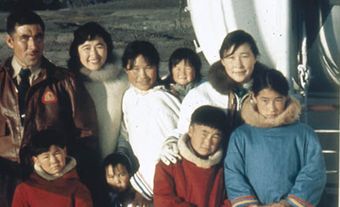
Larry Audlaluk, CM, community leader, activist, writer (born 6 October 1950 in Uugaqsiuvik, QC). Larry Audlaluk is a respected Inuit leader who has worked for the recognition of High Arctic Exiles like himself (see Inuit High Arctic Relocations in Canada). As a young child, his family was moved by the RCMP from Nunavik to a remote, barren location on southern Ellesmere Island to uphold sovereignty. They lived in abject poverty, abandoned to a life on the land without much wildlife to sustain them. Their suffering propelled him to successfully lobby the federal government to acknowledge the reason for the relocation and recognize the trauma it caused. Audlaluk’s memoir, What I Remember, What I Know: The Life of a High Arctic Exile, was shortlisted for a Governor General’s Literary Award in 2021.
Early Years
Larry Audlaluk was born in the traditional settlement of Uugaqsiuvik, 35 km from Inukjuak in the Nunavik region of Quebec. In 1953, an RCMP officer visited his father, Isakalluk Aqiatushuk, on numerous occasions to convince him to move his family to the High Arctic (see Inuit High Arctic Relocations in Canada). The officer promised a better life, claiming animals were abundant there and saying they could return to Inukjuak after two years if they wanted to. Isakalluk eventually agreed to go.
Before his third birthday, Audlaluk’s family, along with six other families from the Inukjuak area, boarded the government ship CD Howe and headed north. His family was one of three families relocated to Craig Harbour on southeastern Ellesmere Island. To prevent the people from depending on the RCMP post there, they were then taken 56 km west by boat to Lindstrom Peninsula. They were left on an inhospitable gravel beach at the base of massive cliffs with no housing, food or clothing.
With not enough snow to build igluit (igloos), the families spent that first winter living in canvas tents lined with buffalo hides provided by the RCMP. Compared to Inukjuak with its 50 varieties of food — birds, land and marine animals — there were only three or four at Lindstrom Peninsula. They were expected to live off the land, but they struggled to survive.
Their requests to return to Inukjuak were denied. Within 10 months, Audlaluk’s father died of a heart attack, aggravated by the harsh living conditions and trauma of the relocation.
In 1957, the families moved farther west to a site with flatter ground where they could build small, wooden houses. In 1962, everyone moved to the new settlement of Grise Fiord, which included a police post and Federal Day School (see Indian Day Schools in Canada). The people’s wooden homes were so small that they were moved to the new community on dog sleds. These shacks were replaced with southern-style prefab houses a few years later, and electricity was provided.
When Audlaluk was four, he ran into a tent rope and seriously injured his right eye. He finally had his first eye surgery in 1963, but he suffered from the injury his entire life. When he was eight, Audlaluk was diagnosed with tuberculosis (TB) and flown south to a hospital in Quebec City. He was almost 10 when he returned home. The TB flared up again when he was a teenager attending the Churchill Vocational Centre (CVC) residential school, and he was sent to St. Boniface Hospital in Winnipeg for treatment.
Audlaluk graduated in 1969 from CVC. After spending a year at business college in Ottawa, he moved to Iqaluit and worked as an interpreter/translator for Northern Economic Development. In Iqaluit, he met Annie Manomie, from Kinngait (Cape Dorset), who would become his life companion. When Audlaluk’s mother became ill, he, Annie and their two-month-old daughter moved to Grise Fiord. He worked as assistant manager at the Arctic Co-op and then for the hamlet.
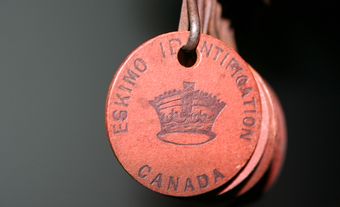
In 1970, the federal government initiated Project Surname. This project aimed to replace Inuit disc numbers with surnames. Inuit could choose their own last names, and Larry chose his birth name, Audlaluk.
Champion for the relocatees
In 1978, Larry Audlaluk joined other relocatees from Inukjuak and Pond Inlet, and, with Makivik Corporation’s support, they lobbied the Government of Canada to investigate the relocation. That year, Audlaluk visited Inukjuak for the first time since he left in 1953.
The federal government finally financed the return of relocatees to Inukjuak in 1987. Forty people moved back to Inukjuak. Audlaluk’s brothers Samwillie and Elijah and their families opted to return as well. For Audlaluk, Grise Fiord was the only home he’d known. He didn’t want to move and uproot his family.
For 18 years, Audlaluk lobbied the government to recognize the service the relocatees had provided, upholding sovereignty by living in the High Arctic. He sought compensation for the traumatic circumstances of their forced relocation and what they had suffered. As part of his work to raise awareness about the relocations, Audlaluk contributed to two films, Broken Promises – The High Arctic Relocation and Martha of the North.
Broken Promises - The High Arctic Relocation, Patricia Tassinari, provided by the National Film Board of Canada
In 1993, all relocatees were flown to Ottawa to participate in the Royal Commission on Aboriginal Peoples hearings. Audlaluk testified, telling his family’s story and what his parents had endured. In 1996, after the commission’s report had been published, the federal government provided a $10 million trust as a settlement.
However, it wasn’t until 2010 that the Government of Canada apologized for the relocation. That same year, two carved statues — one in Resolute Bay, the other in Grise Fiord — were unveiled in commemoration of those relocated.
Audlaluk is a devout Christian. In 1996, he made the first of several visits to Israel. He appeared on television there and was described as “the Holy Land’s best-known Inuk.”
Audlaluk has also acted on screen. He appeared in the 1998 film Glory and Honor, and he has participated in episodes of the 2020 CBC television show High Arctic Haulers.
Audlaluk ran unsuccessfully in the 2004 Nunavut General Election for the Quttiktuq electoral district.
In October 2007, Audlaluk was named a Member of the Order of Canada in recognition of his leadership in his community, his work as an ambassador for the High Arctic and for “preserving and promoting the rich heritage of his region.” He was invested a year later by Governor General Michaëlle Jean. He also received a Queen Elizabeth II’s Diamond Jubilee Medal in 2012 and a King Charles III Coronation Medal in 2025.
His memoir, What I Remember, What I Know: The Life of a High Arctic Exile, was shortlisted for the Governor General’s Literary Award for English-language non-fiction in 2021.
Audlaluk and his wife Annie live in Grise Fiord, Nunavut. They have six children, 11 grandchildren and six great-grandchildren. He is the longest-living resident of Grise Fiord.