Share on Facebook
 Share on X
 Share by Email
 Share on Google Classroom
Interculturalism is Quebec’s approach to integrating immigrants and ethnocultural minorities into Quebec society. It is a response to the Canadian model: multiculturalism. The goal of interculturalism is to allow all cultural groups in Quebec to live together on the basis of equality. According to interculturalism, Quebec values must be respected. To achieve this, Quebec must prioritize the French language and secularism in public spaces. Secularism is the distinct separation between the state and religions. No religion should be promoted by the state. The Charter of the French Language and the report of the Bouchard-Taylor Commission are key foundations on which Quebec interculturalism is based.
This article is a plain-language summary of Interculturalism. If you are interested in reading about this topic more in depth, please see our full-length entry, Interculturalism.
Historical Background
In the 1950s, there was talk of a bicultural Canada. Bicultural means that there are two main cultures. In Canada, these are the two European "founding" groups: the anglophone and the francophone communities.

Over the years, immigration increased significantly. Canadian society became increasingly diverse. In 1971, Canada adopted the Canadian Multiculturalism Act. The government sought to recognize the equality of all communities, and not just equality between francophones and anglophones. Multiculturalism views Canadian identity as defined by its cultural diversity. This diversity must also exist within the framework of its two official languages: English and French. (See Language Policy in Canada.)
This approach was unpopular in Quebec, which is the only official francophone province in Canada. Many francophones in Quebec did not want to be considered equal with other ethnocultural groups. Quebec nationalists were primarily concerned with promoting francophone culture and language. Some people even thought that multiculturalism was a political strategy to erase French-speaking Quebec culture. In general, Quebec political parties, both separatist and federalist, were opposed to multicultural ideology. They rejected the idea of a uniform pan-Canadian identity across the country that did not consider Quebec’s cultural uniqueness.
At the same time, in the early 1970s, the concept of interculturalism became increasingly popular.
The Quebec government took concrete steps to make the province stand out from the rest of the country. In 1981, the René Lévesque’s government published the action plan Autant de façons d’être Québécois (Many Ways of Being a Quebecer). In this document, the principles of Canadian multiculturalism were clearly rejected. The plan recognized the diversity of the cultural communities that make up Quebec, but above all promoted a Quebec society where francophone culture remained a priority.
Between 2006 and 2007, certain controversies raised the issue of coexistence between religious minorities and the majority Quebec society. Public debates arose on the "reasonable accommodations" granted to ethnocultural minorities. These discussions dominated media coverage related to immigration.
In 2007 and 2008, Quebec established the Bouchard-Taylor Commission, a committee examining accommodation practices related to cultural differences. The survey was led by philosopher Charles Taylor and sociologist Gérard Bouchard. The Commission spurred a debate on interculturalism as an alternative to multiculturalism in Quebec public policy.
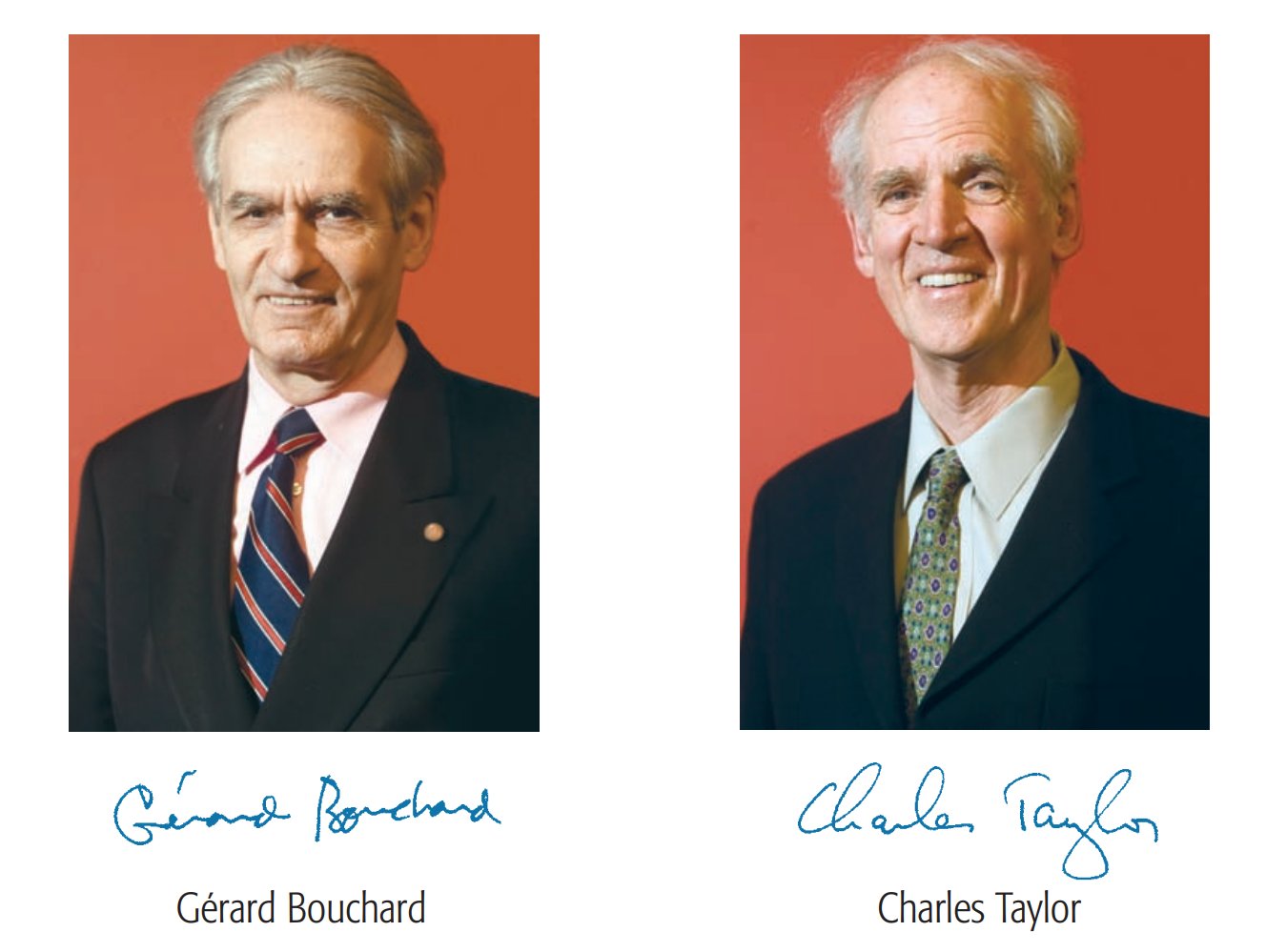
Bouchard is a prominent thinker on interculturalism. According to him, the Quebec approach is different from other models of integration because it takes into account the relationships between the Franco-Quebecois majority society and minorities. The goal is to integrate immigrants into the Quebec nation. In contrast, multiculturalism perceives that a nation is made up of all kinds of different equal cultures.

For Bouchard, the intercultural approach does not seek to erase the individual cultural identities. Rather, it aims to promote harmonious coexistence. Interculturalism encourages dialogue between the majority society and minority groups from diverse backgrounds. To achieve this, the predominance of French as a common language is particularly important.
Assessment of the Quebec Model
Interculturalism continues to influence many policy decisions on reasonable accommodation and immigration policies.
French Language
Interculturalism is based on the Charter of the French Language (Bill 101), adopted in 1977. This law protects the French language by giving it priority in public spaces. It applies to courts, public services, the workplace, education and public displays.
Policies on French language also apply to immigrants and their children. They must generally go to school in French. In addition, following a reform of the law in 2022, people arriving in Quebec have six months to learn French to be able to communicate with government services. (See Quebec Language Policy.)
Secularism
In 2008, the Bouchard-Taylor Commission published its report with its recommendations. Over the years, debates on reasonable accommodation and secularism have intensified. (See Québec Values Charter.)


In 2019, the Coalition Avenir Québec government passed the Act Respecting the Laicity of the State (Bill 21). This act seeks to strengthen secularism in Quebec. It prohibits some government employees from wearing religious symbols. This applies particularly to police, judges and teaching staff.
In October 2025, the National Assembly adopted Bill 94. All school staff are now prohibited from wearing religious symbols. In addition, it is forbidden to use school premises for religious purposes. The new law no longer allows meals adapted to religious dietary restrictions or absences related to religious celebrations.
These measures on secularism have divided opinion in Quebec society. Some critics argue that this law undermines freedom of religion.