Share on Facebook
 Share on X
 Share by Email
 Share on Google Classroom
Howard Joseph Adams, academic, educator, author, Indigenous rights advocate (born 8 September 1921 in St. Louis, SK; died 8 September 2001 in Vancouver, BC). Howard Adams was a renowned academic and Indigenous rights advocate who was the first Métis person in Canada to earn a PhD.
Early Days
Howard Adams was born on 8 September 1921 in the village of St. Louis, Saskatchewan, 30 km south of Prince Albert. Adams grew up in an impoverished family. His mother, Olive McDougall, was a French Métis and his father, William Robert Adams, was an Anglo Métis. His great-grandfather was Maxime Lépine, a Métis leader and compatriot of Louis Riel in the Red River and North-West resistances.
As a boy, Adams witnessed many racist and discriminatory acts perpetrated against his family and community. His experience later helped him to understand how racism creates stereotypes within Indigenous communities and can stifle ambition.
In 1940, Adams became a Royal Canadian Mounted Police constable and later worked as a school liaison counsellor in Vancouver.
Academic Career
While in Vancouver, Howard Adams earned a Bachelor of Arts in Sociology at the University of British Columbia. In 1957, he earned a teaching diploma at the University of Toronto. Returning to British Columbia from 1957 to 1962, he taught at a Coquitlam secondary school.
Adams moved to the United States to attend the University of California, Berkeley. In 1966, he earned his doctorate for work on the history of education, becoming the first Métis person from Canada to earn a PhD.
Adams taught in the College of Education at the University of Saskatchewan before going to the University of California at Davis, where he taught from the mid-1970s until his retirement in the late 1980s.
Indigenous Rights Advocate
While teaching at the University of Saskatchewan, Howard Adams co-founded the Saskatchewan Native Action Committee and served as president of the Métis Society of Saskatchewan (now Métis Nation-Saskatchewan) from 1969 to 1970.
Adams wrote three books that addressed problems facing Canada and Indigenous peoples: The Education of Canadians 1800–1867: The Roots of Separatism (1968), Prison of Grass: Canada from a Native Point of View (1975) and A Tortured People: The Politics of Colonization (1995). He also founded the Métis-specific New Breed Magazine.
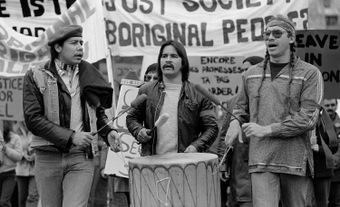
He was an important voice in the 1960s and 1970s Red Power movement in which Indigenous leaders demanded change. Adams argued that systemic racism based on centuries-long colonization and the ongoing colonizer’s ideology lay at the heart of issues facing Indigenous peoples (see Colonialism in Canada). He offended some people with blunt language and assessments of the problems that needed to be solved. He said, “But I am reminded that my language is too political, pejorative and rhetorical. I do not apologize. My language is in harmony with my race/class and colonization.”
While chastising the federal and provincial governments for their actions and attitudes he was also critical of Indigenous political organizations. He wrote that a “collaborator class” of Métis, Inuit and First Nations leaders had been created by “massive government grants” to organizations that led too many Indigenous leaders and organizations to “harmonize their lives and goals to the political culture of the colonizer.” Adams said it was a compliment to be called a radical.
The Government of Saskatchewan asked him to serve as deputy minister of Indian and Métis Affairs. Adams refused. In 1999, Adams earned the National Aboriginal Achievement Award for education (now Indspire Awards).