Share on Facebook
 Share on X
 Share by Email
 Share on Google Classroom
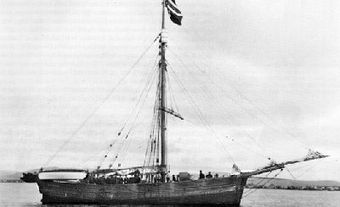
Henry Asbjorn Larsen, Arctic explorer, author, Royal Canadian Mounted Police officer (born 30 September 1899 in Hvaler, Norway; died 29 October 1964 in Vancouver, British Columbia). Larsen was captain and navigator of the RCMP ship St. Roch from 1927 until 1954 and head of the RCMP’s Arctic Division from 1948 until 1961. He was the first person to circumnavigate the North American continent, traverse the Northwest Passage from west to east and traverse the Northwest Passage in a single season.

Early Life
Henry Larsen was the son of Otto Ludvig Larsen Bruun (1859–1934) and Olava Severine Olsen (1869–1938). His parents were not married to one another, and he was raised by a maternal uncle and aunt in Varmland, Sweden, before returning to his birthplace around 1906 to attend school. As a child, Larsen excelled at history and geography and read widely. He later wrote in his memoir, The Big Ship, “I was immediately fascinated by the books written by such people as Fridtjof Nansen, Roald Amundsen and Otto Sverdrup, and of course Vilhjalmar Stefansson. When I read about the courage of [Martin] Frobisher and the tragedy that was [Sir John] Franklin’s, I wished that I could follow in the footsteps of these brave men.”
Seafarer
When Henry Larsen was 14, he joined the crew of a herring fishing boat, Anna, captained by one of his uncles. During the First World War, he was part of the crew of the Baunen, a Norwegian sailing vessel engaged in trans-Atlantic trade.
From 1919 to 1920, Larsen studied at the navigation school in Christiana (now Oslo), Norway, then performed two years of compulsory military service in the Norwegian navy. In 1922, Larsen became fourth mate on the steamer Theodore Roosevelt of the Fred Olsen shipping line; he met Roald Amundsen when he boarded the ship in Seattle. From 1924 to 1927, he served as a navigator of The Maid of Orleans in the Arctic for the Danish-American trader Christian Klengenberg.
The St. Roch
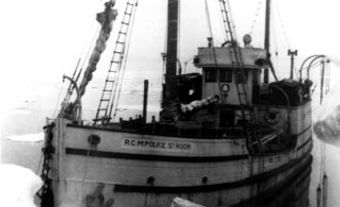
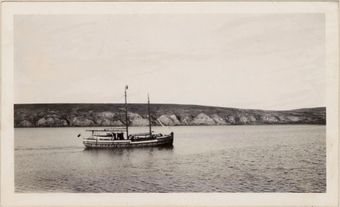
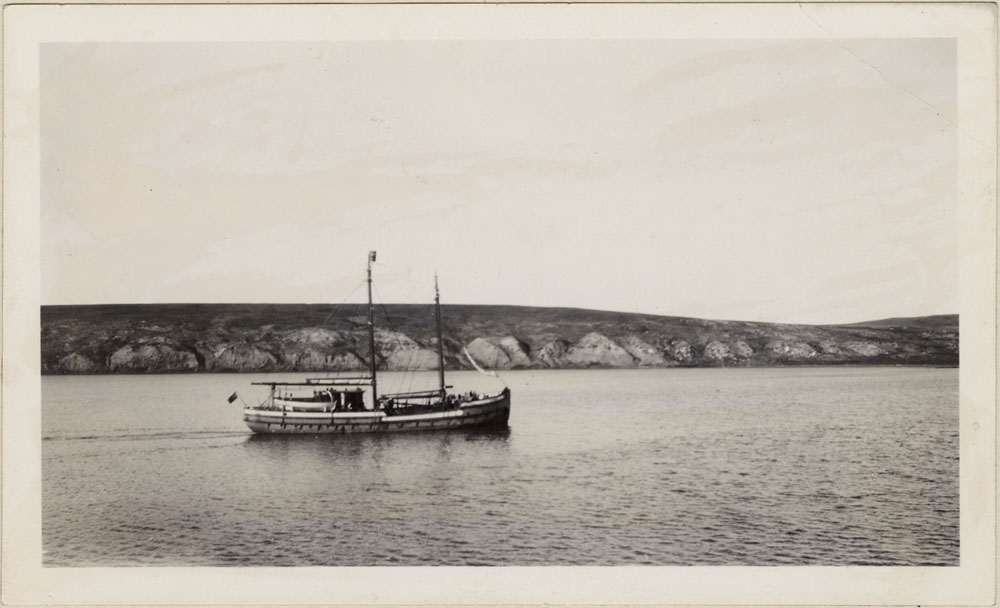
In 1927, Henry Larsen became a British citizen in Canada, which allowed him to join the RCMP; he became a Canadian citizen in 1947. Although he was the most junior member of the RCMP at the time, his Arctic experience resulted in his appointment as skipper and navigator of the newly commissioned St. Roch, the first Canadian police ship for Arctic patrols. Larsen nicknamed the 104-foot, round-hulled boat the “ugly duckling” and recalled in his memoirs, “For a brand-new polar ship like St. Roch, the equipment was surprisingly inadequate.”
Between 1928 and 1948, the St. Roch made 10 voyages to the Arctic, spending the winter in the north almost every year. In contrast to Roald Amundsen’s voyage through the Northwest Passage, which had scientific objectives, Larsen and his crew focused on establishing and reinforcing Canadian sovereignty in the Arctic. This included collecting taxes, enforcing hunting laws, transporting supplies and mail to remote communities, conducting censuses and transporting children to school, patients to hospital and accused criminals to court. Larsen later recalled that sailors on other ships called the seven-to-nine-man crew of the St. Roch “horse-sailors” because “we had to wear the Mounted Police uniform as much as possible on board.” In 1937, Larsen gave Governor General Lord Tweedsmuir a tour of the St. Roch in Coppermine (now Kugluktuk, Nunavut).
The Inuit
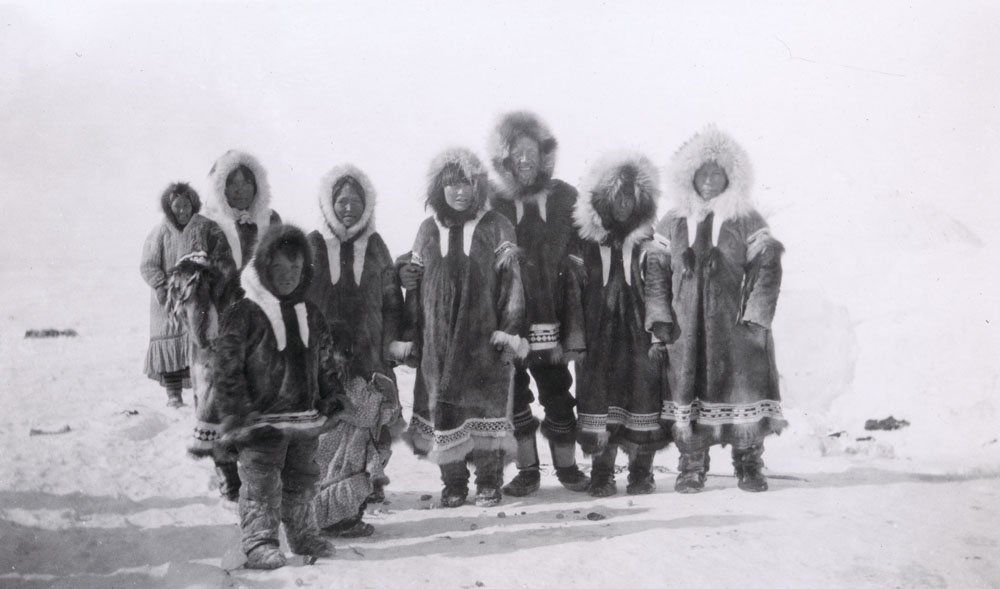
Henry Larsen respected Inuit culture and admired the resourcefulness, good humour and hospitality of the Inuit people he met on his voyages. He was concerned about the impact enforcing Canadian law on traditional practices, writing in his memoirs, “During my years in the Arctic, I often felt that it really was a crime that these children of Nature couldn’t have been left alone to live their lives according to the customs and rules their forefathers had followed through generations.” Larsen’s respect for local customs endeared him to the Inuit, who nicknamed him “Hanorie Umiarjuaq” or “Henry with the Big Ship.”
Marriage and Children
On 7 February 1935, Henry Larsen married Mary Hargreaves (1909–2000). They had three children, Karen Doreen, Gordon and Beverly, and a home in Victoria, British Columbia, which Larsen described as “the most beautiful city in Canada.” In 2000, Larsen’s children unveiled a bust of their father in his birthplace of Hvaler, Norway.
The Northwest Passage
In 1940–42, Henry Larsen and the St. Roch crew became the first expedition to travel through the Northwest Passage from west to east. (Roald Amundsen and his crew aboard the Gjoa had traveled through the passage from east to west from 1903 to 1906). Larsen wrote, “Canada was at war and the government had realised the need to demonstrate Canada’s sovereignty over the Arctic Islands.” The journey was lengthened by inclement weather and Arctic patrol duties necessitated by the shortage of Canadian ships in the Arctic during the Second World War. Larsen and all eight members of his crew (including, posthumously, Albert “Frenchy” Chartrand, who had died of heart failure during the voyage) received the Polar Medal from King George VI for their achievement in 1942.
In 1944, Larsen was promoted to RCMP Inspector. That year, he became the first sea captain to lead an expedition through the Northwest Passage in a single season, travelling through Lancaster Sound west to Melville Island, then across McClure Strait to Prince of Wales Strait, reaching Vancouver in 86 days. Larsen wrote in his memoir, The Big Ship, “I was sure that this would become the northern route of the future. The main thing was for someone to try it, and if it could be proved that a small ship like the St. Roch could make it, then others would surely follow.” Larsen’s achievement received little attention at the time because of the circumstances of the Second World War, but his route would become strategically significant as climate change made the Northwest Passage more navigable for shipping routes.
Secret Mission
During the 1990s, documents in the RCMP archives revealed that Henry Larsen had been ordered to undertake a classified wartime mission after traversing the Northwest Passage. The Canadian government was concerned that Nazi Germany would occupy Greenland and attack trans-Atlantic shipping lanes with U-boats sheltered in Greenland’s fjords. A German occupation of Greenland would also cut off the supply of cryolite (a mineral essential to the making of aluminum) to the Aluminum Company of Canada (Alcan), which supplied aluminum to the Allied powers to produce fighter planes. The mines in Invittuut, near Cape Desolation in Greenland, contained the world’s largest reserve of naturally occurring cryolite.
Larsen received his instructions from Stuart Taylor Wood, the commissioner of the RCMP, in 1940. After traversing the Northwest Passage, Larsen and his crew were to join an advance party known as “Force X,” which would arrive in Greenland ahead of a 250-person Canadian occupying force. By the time the St. Roch emerged from the Northwest Passage in 1942, however, the United States had entered the war, and a Canadian occupation of Greenland was no longer necessary. The St. Roch instead sailed for Halifax.
Writing
In 1948, Henry Larsen published an account of his wartime voyages through the Northwest Passage, The North-West Passage, 1940–1942 and 1944. He also wrote articles about these voyages for RCMP Quarterly in 1945 and Geographical Journal in 1947. Larsen’s autobiography, The Big Ship, was published posthumously in 1967. In the book, Larsen discussed his Inuit friends and their way of life in detail.
Later Life
After the war, Henry Larsen became the first person to circumnavigate North America. Larsen sailed the St. Roch through the Panama Canal from Vancouver to Halifax in 1949 and from Halifax to Vancouver in 1954 on the ship’s final voyage.
In 1957, Larsen represented Canada at the unveiling of a monument to Otto Sverdrup in Steinkjer by the future King Olav V of Norway. It was his first time in Norway in 34 years. In 1959, he became the first recipient of the Massey Medal of the Royal Canadian Geographic Society; he also received the patron’s gold medal from the Royal Geographical Society in Britain for outstanding personal achievement. In 1962, he discussed his voyages aboard the St. Roch in a National Film Board of Canada documentary. Larsen retired from the RCMP in 1961 at the rank of superintendent and died of bone cancer in 1964, writing to a friend shortly before his passing that he would “soon be setting out on that last, great sled patrol.”
Legacy
Henry Larsen Elementary School in Ottawa and Larsen Sound in Nunavut are named for Henry Larsen. The St. Roch and a statue of Larsen are part of the collection of the Vancouver Maritime Museum. The sea shanty “Take It Day to Day” by Stan Rogers also refers to Larsen: “The pack-ice'round us cracks and groans;/The old St. Roch, she creaks and moans… We're as far North now as I want to come/But Larsen's got us under his thumb.”
In 1987, the Canadian Coast Guard named an icebreaker the CCGS Henry Larsen. In 2000, the RCMP renamed one of its ships the St. Roch II and recreated Larsen’s first voyage in honour of the new millennium. Daphne Bramham wrote an article in the Vancouver Sun in 2016, “Forget Franklin, Henry Larsen is Canada’s True Arctic Hero.”