Share on Facebook
 Share on X
 Share by Email
 Share on Google Classroom
Garrison mentality is a concept in Canadian literary theory and criticism. It was first put forth by critic and scholar Northrop Frye in the mid-1960s. It argues that early Canadian identity was shaped by the fear of a hostile landscape. Communities had to defend themselves from overwhelming forces. Frye believed that the threat of Canada’s wilderness — a “huge, unthinking, menacing, and formidable physical setting” — led to a desire among Canadians to retreat into safety. This in turn shaped their values as a group. Frye argued that the environment’s impact on Canada’s national psyche was revealed through recurring themes in Canadian art and culture. As a literary theory, the garrison mentality has inspired both supporters and detractors. Frye argued that it could be a limiting factor in the development of the arts in Canada. Others have argued that the mentality has merit, and that it resists the hyper-individualism of modern life.

Background: Northrop Frye
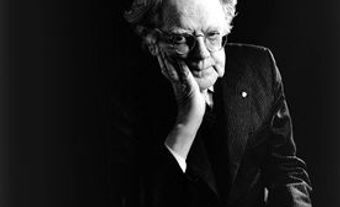
Northrop Frye was a Canadian literary critic, essayist, editor and university professor. He was arguably the most important Canadian literary critic of the 20th century. Frye has been credited with defining the 20th-century Canadian imagination. His major work was Anatomy of Criticism: Four Essays (1957). It put him on the map as a leading figure in literary criticism. Frye is credited with outlining the first comprehensive take on the Canadian literary tradition.
Prior to defining his concept of the garrison mentality, Frye described Canadians’ main distinguishing cultural feature as “some feeling for the immense searching distance, with the lines of communication extended to the absolute limit, which is a primary geographical fact about Canada and has no real counterpart elsewhere.”
Garrison Mentality
In the conclusion to his Literary History of Canada (1965), Frye described what he thought was the defining characteristic of Canadian writing up to that point.
“Small and isolated communities surrounded with a physical or psychological ‘frontier,’ separated from one another and from their American and British cultural sources: communities that provide all that their members have in the way of distinctively human values, and that are compelled to feel a great respect for the law and order that holds them together, yet confronted with a huge, unthinking, menacing and formidable physical setting — such communities are bound to develop what we may provisionally call a garrison mentality. In the earliest maps of the country the only inhabited centres are forts, and that remains true of the cultural maps for a much later time. Frances Brooke, in her eighteenth-century Emily Montague, wrote of what was literally a garrison; novelists of our day studying the impact of Montreal on Westmount write of a psychological one.”
Emily Montague refers to Frances Brooke’s The History of Emily Montague. Published in 1769, it is believed to be the first Canadian novel. “The impact of Montreal on Westmount” is a reference to class and cultural divisions in Montreal in the 1960s. At that time, Montreal was both Canada’s biggest city and the epicentre of the Quebec separatist movement. Westmount at the time was seen as a bastion of old-world English Canadian wealth and tradition. Montreal, on the other hand, was modern, working class and embracing a new Québécois cultural identity. (See also Quebec Cultural Policies.)
Frye argued that the Canadian imagination was defined by the garrison mentality. This was the idea that Canada’s early settlers saw themselves as vulnerable, isolated, cut off from the cultures and societies they came from, and menaced on all sides by threats both real and imagined, from other people and from nature itself. (See also Garrison Towns.) This ethos, Frye believed, shaped much of Canadian literature until the middle decades of the 20th century. (See also Literature in English; Literature in French: Theory and Criticsm; Acadian Literature.) It was because of this background that non-Indigenous Canadians, Frye argued, tended to tell tales not of heroism, conquest or individualism but rather of communal bonds, traditionalism and endurance. This was not something Frye approved of. He believed the garrison mentality had a limiting effect on the Canadian imagination. He also argued that the art this mentality produced was often constrained or even didactic in nature.
Frye believed that the non-Indigenous Canadian mentality was forged by the experiences of the early settlers. They were at once in awe of the grandeur of the natural wilderness yet also paralyzed by it. They were forced to huddle together in isolation in an alien world both extraordinary and menacing. As a result, they developed a mentality in which the moral and social values of the close-knit community were unquestionable.
Impact of the Garrison Mentality Theory
Frye’s theory of the garrison mentality was highly influential. It was almost immediately seen as a classic trope of Canadian culture. Other Canadian writers began to explore its meaning and significance, as well as the broader implications. One of Frye’s students, Margaret Atwood, published Survival: A Thematic Guide to Canadian Literature (1972). It is one of the most in-depth explorations of Frye’s central idea.

Later in his life, Frye was somewhat uncomfortable with how his theory’s specific historical context had been lost on the general public. He complained that his idea had been “over-exposed” by other critics. He felt that, like an over-exposed photograph, the concept had become blurred and fuzzy.
In an address at the Canadian Embassy in Washington, DC, in the fall of 1989, Frye stated that the intention behind the theory was to “describe the psychological effects in Canada of the Anglo-French wars, fear of Indian attacks, and protection against an implacably indifferent nature, with its cycle of intense heat, intense cold, and the coming of spring along with the black flies.”
Criticism of Garrison Mentality
Critics of the garrison mentality theory note that it is detached from, and even antithetical to, the experience of Indigenous peoples, who have generally viewed their environment as a “provider,” not a threat. Critics further argue that the erasure of Indigenous experience is both cause and consequence of the garrison mentality.
Condominium Mentality
By the late 20th century, Frye argued that the garrison mentality had been supplanted with a new way of thinking. He dubbed it the condominium mentality. Frye said that Canada had evolved into one of the most urbanized nations on Earth. This was a considerable evolution from the mainly rural country Canada had been at its founding. A core part of this urbanization was the advent of condominiums, which have since become one of the defining features of Canadian cities. As writer Kyle Wyatt explained in the Walrus in 2012, condominiums promise property ownership and social advancement within the context of urban village-like settings. However, their self-contained amenities and features can prove isolating to their occupants and undermine the connections urban communities have typically fostered. According to Frye, if the garrison mentality was social but not creative, the condominium mentality was “neither social nor creative, and which forces the cultural energies of the country into forming a kind of counter-environment.”
(See also Garrison Towns; Canadian literary theory and criticism; Canadian identity.)