Share on Facebook
 Share on X
 Share by Email
 Share on Google Classroom
The title “Dominion of Canada” was first applied to Canada at Confederation in 1867. It was also used to describe other countries in the Commonwealth. The federal government stopped using the word Dominion by the early 1960s. The last hold-over was the term Dominion Day. It was changed to Canada Day in 1982. Today, the word Dominion is seldom used to describe Canada.
This article is a plain-language summary of the Dominion of Canada. If you are interested in reading about this topic more in depth, please see our full-length entry, Dominion of Canada.

Origins
Dominion comes from the Latin dominus. It means master. The term Dominion means that which is mastered or ruled. It was used by the British to describe their colonies. (See Imperialism.) It was used for hundreds of years before it was applied to Canada. For example, Britain’s American colonies were often called the Dominion of New England.
Confederation
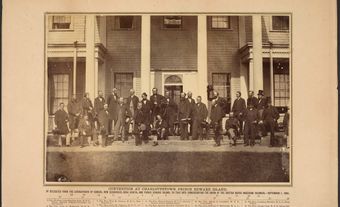
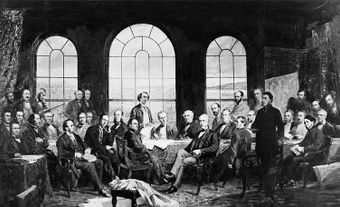
At Confederation, Canada consisted of Nova Scotia, New Brunswick, Quebec and Ontario. The Fathers of Confederation wanted to call the new country the “Kingdom of Canada.” But Britain feared that this name would offend the United States. Britain insisted on a different title.
New Brunswick’s Sir Leonard Tilley came up with “Dominion of Canada.” Tilley drew from a line in Psalm 72:8 of the Bible. It reads, “He shall have dominion also from sea to sea, and from the river unto the ends of the earth.”
The term Dominion was accepted. It was used several times in the British North America Act (BNA Act). This is the basis of Canada’s Constitution. (It is now called the Constitution Act, 1867.)
Canada and Other Dominions
By the early 20th century, the term “dominions of the British Empire” was used to refer to Canada; Newfoundland; Australia; New Zealand; the Irish Free State; and South Africa. (See Commonwealth.)
In 1931, the Statute of Westminster, 1931 was passed by the British parliament. It described these six nations not as colonies, but as countries. They were equal to Britain and “united in free association (as) members of the British Commonwealth of nations.”
Dominion Day
For the first decade after Confederation, some provinces observed Dominion Day as a de facto holiday. Parliament made Dominion Day an official annual holiday in 1879.
After the Second World War, several bills were proposed to change the name of Dominion Day. None succeeded. In 1958, at the urging of Prime Minister John Diefenbaker, a Dominion Day event was held on Parliament Hill. Diefenbaker wanted to promote Canada’s British heritage. He also hoped to reverse a trend of phasing out the use of the word Dominion. But by the early 1960s, the federal government had stopped using the word.
In July 1982, a bill to change the name of Dominion Day to Canada Day was proposed. The bill quickly passed through the House of Commons. It was ratified by the Senate in the fall.
Patriation of the Constitution, 1982
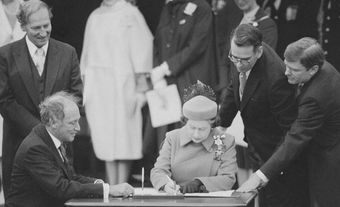
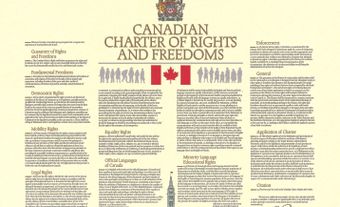
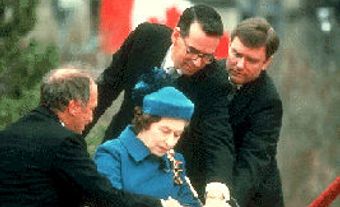
Canada patriated its Constitution (took control of it) from Britain in 1982. The word Dominion does not appear in the Constitution Act, 1982. It also does not appear in the Charter of Rights and Freedoms. Even so, the BNA Act (now called the Constitution Act, 1867) remains a crucial part of Canada’s Constitution.
(See also Confederation (Plain-Language Summary); Constitution of Canada (Plain-Language Summary); Constitution Act, 1867 (Plain-Language Summary); Statute of Westminster, 1931 (Plain-Language Summary); Constitution Act, 1982 (Plain-Language Summary); Canadian Charter of Rights and Freedoms (Plain-Language Summary); Patriation of the Constitution (Plain-Language Summary).)