Share on Facebook
 Share on X
 Share by Email
 Share on Google Classroom
Broadly speaking, bullying involves repeated harmful behaviour and a real or perceived imbalance of power. Harassment is unwelcome or unwanted conduct that a harasser knows or should know is intimidating, humiliating, hostile or fear-inducing. However, there is no single definition of bullying or harassment in Canada. Instead, bullying and harassment are addressed through various federal and provincial/territorial laws and regulations. Each jurisdiction typically has its own definition, as well as laws, regulations and methods for addressing such behaviour.
Federal Laws and Statutes
There is no provision in the Criminal Code of Canada for bullying. Instead, bullying-like behaviour is often dealt with through other categories. These include uttering threats (s. 264.1), intimidation (s. 423 [1]) or incitement of hatred (s. 319).
Unlike bullying, harassment is a category in the Criminal Code. However, for harassing behaviour to be criminal (s. 264), the harasser must be acting without lawful authority. They must also be reasonably aware that they are engaged in harassing conduct. The person who is harassed must reasonably fear for their safety or the safety of someone they know. Actions cited as criminal harassment in the Criminal Code include repeatedly following someone; repeatedly communicating with them; “besetting” or watching their home or work; or engaging in threatening conduct toward them or a member of their family.
The kind of speech-based conduct often associated with bullying and harassment is only narrowly addressed in the Criminal Code. This is mainly because it risks infringing on speech rights. (See Canadian Charter of Rights and Freedoms.) Reputational injury is addressed through two provisions: publishing a libel known to be false (s. 300) and publishing a libel (s. 301). Challenges to the legitimacy of both provisions have found mixed success. The Supreme Court of Canada ruled that s. 300 constitutes a reasonable limit on Charter-protected freedom of expression (R. v. Lucas, 1998). But several lower courts have deemed s. 301 unconstitutional. This reflects concerns that the law might be too broad to sustain a Charter challenge.
The challenge with using the Criminal Code to manage bullying and harassment can be seen in another important legal decision. In Saskatchewan (Human Rights Commission) v. Whatcott, heard in 2013, the Supreme Court affirmed that anti-hate human rights legislation aimed at protecting groups was constitutional. But the Court also concluded that not all offensive or abusive speech falls within the reach of constitutional or human rights sanctions. This demonstrates how difficult it would be to craft criminal offenses broad enough to capture many forms of behaviour viewed as bullying.
Federal statutes like the Canadian Human Rights Act (CHRA) also address bullying. But they tend not to use the word bullying explicitly. Instead, they address related conduct such as harassment or discrimination.
Rehtaeh Parsons and Amanda Todd
Two cases linked to harassment, bullying and cyberbullying significantly influenced public debate and legislation. In 2011, a Nova Scotia teenager named Rehtaeh Parsons was allegedly sexually assaulted. Photos of the assault were circulated online, and she was subjected to persistent in-person bullying and online harassment. In 2013, Parsons attempted suicide and suffered serious injuries that required her to be placed on life-support. Three days later, she was taken off life-support and died. Her death sparked a national debate about cyberbullying. The Nova Scotia government subsequently passed the Cyber-Safety Act in 2013. It was the first legislation in Canada to address cyberbullying. The Act was struck down by the Nova Scotia Supreme Court. But it was eventually replaced in 2017 by the Intimate Images and Cyber-Protection Act. Parsons’ case was also cited as a reason for the Protecting Canadians from Online Crime Act.
In October 2012, Amanda Todd, a 15-year-old from Port Coquitlam, BC, committed suicide after years of harassment. When she was 12, she was pressured into exposing her breasts on a live webcam stream. A pedophile who stalked girls online saved frames of the images and tried to use them to blackmail her. When that failed, he distributed the image, including sending it to other children at her school. Todd was continually harassed and bullied despite multiple school changes and moves. She suffered severe depression, anxiety and social isolation. (See Mental Health.) She made several attempts on her life before dying by suicide in 2012. The Dutch man who tried to extort Todd was extradited from Holland and convicted in 2022 of multiple charges, including extortion and possession of child pornography. He was sentenced to 13 years (shortened to six years in 2023). It will be served after he has completed a sentence of 10 years and eight months for similar crimes in the Netherlands.
As with the Rehtaeh Parsons case, Todd’s story galvanized public opinion. It drew international attention and became a touchstone for public conversations about cyberbullying and sextortion. It was cited in debates around the passage of BC’s Intimate Images Protection Act, which was passed in 2023. Todd was also mentioned in debates leading to the passage of the Protecting Canadians from Online Crime Act. However, Todd’s mother expressed reservations about the Bill’s potential infringements of Canadians’ privacy rights.
Cyberbullying
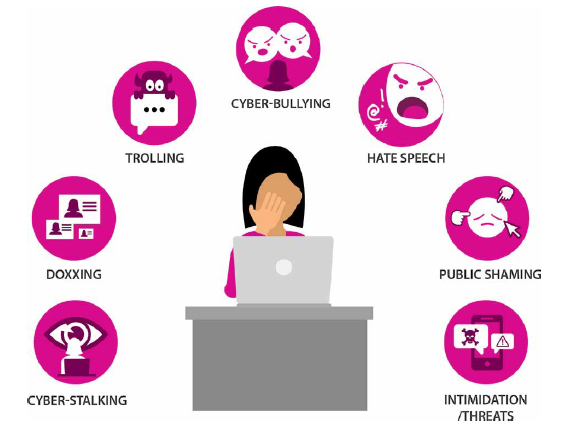
As with bullying, there is no legal provision for cyberbullying in Canada. However, federal legislation has been introduced to target bullying online. In 2014, Parliament responded to a marked increase in incidents of cyberbullying by enacting the Protecting Canadians from Online Crime Act (Bill C-13). The Act captured some behaviour many consider forms of cyberbullying, such as the nonconsensual sharing of intimate images.
In 2024, the federal Online Harms Act (Bill C‑63) was introduced in Parliament. Bill C-63 took a more comprehensive approach to cyberbullying. Notably, the Bill would make social media companies take greater responsibility for “reducing exposure to harmful content on their platforms.” This would include adding additional safety features to protect children and removing nonconsensual intimate images. The Bill also proposed a new “Digital Safety Commission” to ensure compliance and a “digital safety ombudsperson” to advocate for online safety.
The Bill received significant pushback from civil liberties groups, the Conservative Party of Canada, legal scholars and human rights advocates. Many of them expressed concern that the Bill’s overly broad definition of bullying and other measures infringed on rights to free expression and privacy. The Bill failed to pass. However, the Liberal government introduced similar legislation — Bill C-34, the Safe Social Media Act — on 10 June 2026.
Provincial and Territorial Laws, Statutes and Regulations
Provinces and territories have addressed bullying and harassment through education laws, workplace health and safety laws and human rights codes. For example, Alberta, Manitoba, Nova Scotia, Ontario and Quebec all include similar anti-bullying language in education legislation. Some municipalities have also included anti-harassment language in their bylaws.
Provincial Occupational Health and Safety Acts (OHSAs) typically also include anti-bullying or anti-harassment provisions. For example, violence and harassment are identified as “workplace hazards” in Alberta’s Occupational Health and Safety Act. In 2024, Quebec adopted the Act to Prevent and Fight Psychological Harassment and Sexual Violence in the Workplace. These provisions do not result in criminal charges. Instead, they can have consequences such as workplace sanctions, fines, or more serious penalties for repeated infractions.
Provincial human rights commissions and tribunals deal with discrimination-based harassment cases. If someone suffers harassment related to a protected status (like race, sex or disability), they can seek redress through a provincial human rights tribunal. Bullying or harassment, if it touches on a person’s protected class, can be addressed as discrimination in this forum.