Share on Facebook
 Share on X
 Share by Email
 Share on Google Classroom
The label “Arab Canadian” does not refer to one religious affiliation or country of origin but to a mixture of characteristics and beliefs that members of this ethnic group have assimilated from their family or have acquired in Canada.
Arabs, or more specifically, Syrian Lebanese immigrants, began to arrive in Canada in small numbers in 1882. Their immigration was relatively limited until 1945, after which time it increased progressively, particularly in the 1960s and thereafter. Since then, a diversity of immigrant cohorts from different countries have also settled in Canada.
The designation of Arab in the census can be unclear because it can refer to a geographic region, an ethnic group or a language group and the Arab classification includes people who are not included elsewhere. In 2021, there were 795,665 Arab Canadians, constituting 2.2 per cent of Canadian society at the time.
Origins
The Arab world extends from the Arabian Gulf through North Africa to the shores of the Atlantic Ocean. It is a region diverse in physical geography, climate and natural resources, but its inhabitants share cultural traditions and the Arabic language.
The early wave of Arab immigrants originated from Syria and what is now known as Lebanon. More than 90 per cent were Christians seeking freedom from poverty and the Ottoman (Turkish) colonial regime. The post-Second World War wave of Arab immigrants comprised a broader mixture of Christian groups and a substantial number of Muslims and Druzes who were motivated by the desire to escape unfavourable social, economic and political conditions in their homelands.
In the 1980s and the early 1990s, a large number of Convention Refugees arrived from countries of the Arab world (24,813 in 1983–92), notably Somalia, Lebanon and Iraq. (See Canadian Refugee Policy.) During the same 10-year period, 1983–92, a total of 13,379 investors/entrepreneurs came largely from Lebanon, Kuwait, Saudi Arabia and the United Arab Emirates, but with strong representation from Egypt, Iraq, Jordan and Syria.
The two waves of immigrants came from markedly different social and political contexts ― the early immigrants from an economically less-developed Arab world colonized by the Ottoman Turks, the postwar immigrants from a decolonized Arab world undergoing rapid socioeconomic development and political upheaval, as evidenced by the prevalence of refugees in the closing decades of this century. These differences are expressed through different world views, attitudes and behaviour.
Migration
By 1901, Canada had about 2,000 Syrian immigrants, by 1911 about 7,000. For the next 40 years, relatively few Syrian immigrants were admitted to Canada because of severe restrictions on the admission of immigrants from Asia (see Prejudice and Discrimination), but between 1946 and 1992 over 200,000 immigrants to Canada originated from the Arab world. In the post-Second World War period, the number of landings was initially small, but it increased substantially over time. For example, the average number of Arab immigrants per year was 150 for the period 1946–55; 446 for the period of 1956–60; 2,884 for the period 1961–70; 3,986 for the period 1971–80; 8,319 for the period 1981–90; and 24,615 immigrants per year for 1991–92.
The substantial growth in Arab immigration to Canada in the postwar period has radically altered the demographics of the Arab Canadian community. This is most apparent in the predominance of the immigrant (i.e., foreign-born) population, which accounted in 2021 for about 70 per cent of the total (compared to 23 per cent foreign-born in the Canadian population at large).
From 1970 to 1994, the most common country of birth for Arab immigrants was Lebanon. The Lebanese civil war took place from 1975 to 1990 and pushed many to leave the country. In the 1990s and 2000s, migration from North Africa intensified. This cohort mainly settled in Quebec as the province prioritized francophone immigration. (See Quebec Immigration Policies.) From 2015 to 2019, Arab immigration from Syria became particularly common as Canada responded to the Syrian refugee crisis.
According to the 2021 census, there were 795,665 Arabs in Canada. Around seven out of ten are immigrants who moved to Canada. They mainly came from Southwest Asia and North Africa. Among all Arab Canadians, 10.3 per cent were born in Lebanon, 10 per cent in Syria, 9.4 per cent in Morocco, 7.4 per cent in Egypt and 7 per cent in Iraq.
Settlement Patterns
Canadians of Arab origin have tended to settle in urban areas but not in neighbourhood concentrations. Since the turn of the century, Quebec and Ontario have consistently attracted the majority of Arab Canadians; 81.8 per cent of Arab Canadians are located in these two provinces. In Quebec, the heaviest concentration of Arab Canadians is in metropolitan Montreal, where over a third of all Arab Canadians live. In Ontario, they are to be found largely in Toronto and its vicinity, but also in Ottawa, Windsor and London. The Arab population in Alberta (9.5 per cent) ranks third among the provinces, and the largest concentrations are located in Edmonton and Calgary.
Economic Life
Many of the early Syrian immigrants entered the labour force through pedlary, an independent but relatively low-status occupation. Through hard work, frugality and reciprocal support, the economic fortunes of pedlars often rose, and they expanded their entrepreneurial activities. The postwar immigrants, however, arrived with higher average educational and occupational qualifications, the majority of them planning to follow professional and other white-collar careers.
Religion and Community Life
Both the early and postwar immigrants were involved in institution building, particularly religious institutions. At the beginning of this century, several Eastern Christian churches were founded: Antiochian Orthodox, Melkite (Catholic) and Maronite (Catholic). The Coptic Orthodox Church was established in 1965, following the arrival of large numbers of Coptic immigrants from Egypt.
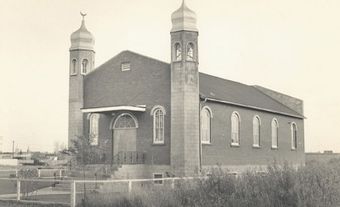
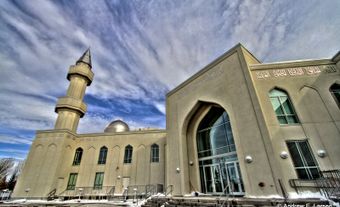
Muslim institutions developed more slowly, because of the initially small size and dispersal of this religious group. The first mosque in Canada, Al Rashid Mosque, was built in Edmonton in 1938. Since the 1950s, Muslim immigrants from the Arab world and from other parts of the Muslim world have come to Canada in large numbers and mosques have been established in virtually all major urban centres.
In 2001, 57 per cent of Arab Canadians were Muslim while 37.2 per cent were Christian. Twenty years later, according to the 2021 census, 70.1 per cent of Arabs were Muslim, 21.2 per cent were Christian and 7.4 per cent were not religious. Despite the fact that most Arab Canadians are Muslim, they only make up 31.4 per cent of all Muslims in Canada.
Secular associations were also established by both the early pioneers and later immigrants to serve social, cultural, charitable and political needs. Memberships are usually mixed; in a few cases they are confined to youth, women, university students or professionals. Some national groups, e.g., Lebanese, Syrians, Palestinians, Egyptians and Maghrebis, have established their own distinct associations. Only the Canadian Arab Federation is national in scope and membership. Several Arab Canadian associations have sponsored the publication of multilingual (Arabic, English and French) periodicals; some newspapers are published by individual Canadian Arabs.
Education
Arab immigrants value education highly, both for themselves and for their children.
The educational attainment of Arab Canadians is higher than the Canadian average. According to the 2021 census, the majority (50.7 per cent) of Arab Canadians aged 25 to 54 had a bachelor’s degree or higher. In contrast, this percentage was only 31.5 per cent among non-racialized and non-Indigenous Canadians of the same age. (See also: Racialized Minority; Indigenous Peoples in Canada.)
Arab Canadians are to be found at all levels of the occupational hierarchy and some have achieved renown in their respective fields.
Politics
Arab Canadians are involved in the political process at the municipal, provincial and federal levels. Arab ethnicity has not been a prominent feature of their political involvement in Canada, except in pressure-group politics involving their social status in Canada or Canada's Middle East policy. (See also Islamophobia.)
Group Maintenance
Arab immigrants have had to learn a new language, establish new social networks, integrate themselves into the economic system, learn new cultural norms and values and discard some of the ways of the country of origin. The Canadian-born generations have naturally been even further assimilated into Canadian society. At the same time, however, a moderate degree of institutional development within the Arab ethnic group reflects a tendency towards preserving ethnic traditions. Maintaining the Arabic language, for example, is important, and the family and the community language school helped this process with varying degrees of success. In the past decades, cultural preservation has been facilitated by the steady inflow of immigrants from the Arab world.
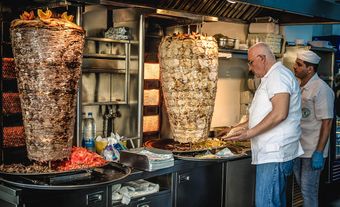
Whether or not an Arab Canadian knows Arabic, links with the ancestral heritage can be and have been maintained through Arabic food, music, dances, mass-media exposure, visits to the “old country” and correspondence with friends and relatives left behind. Generally, the immigrant generation is more likely to maintain links with the cultural heritage than its Canadian-born counterpart, but although many Canadians of Arabic origin have probably lost contact with the past, the majority are aware and proud of their ethnic origins.