
Double Victory: Chinese Canadians in the Second World War
Video- Military History
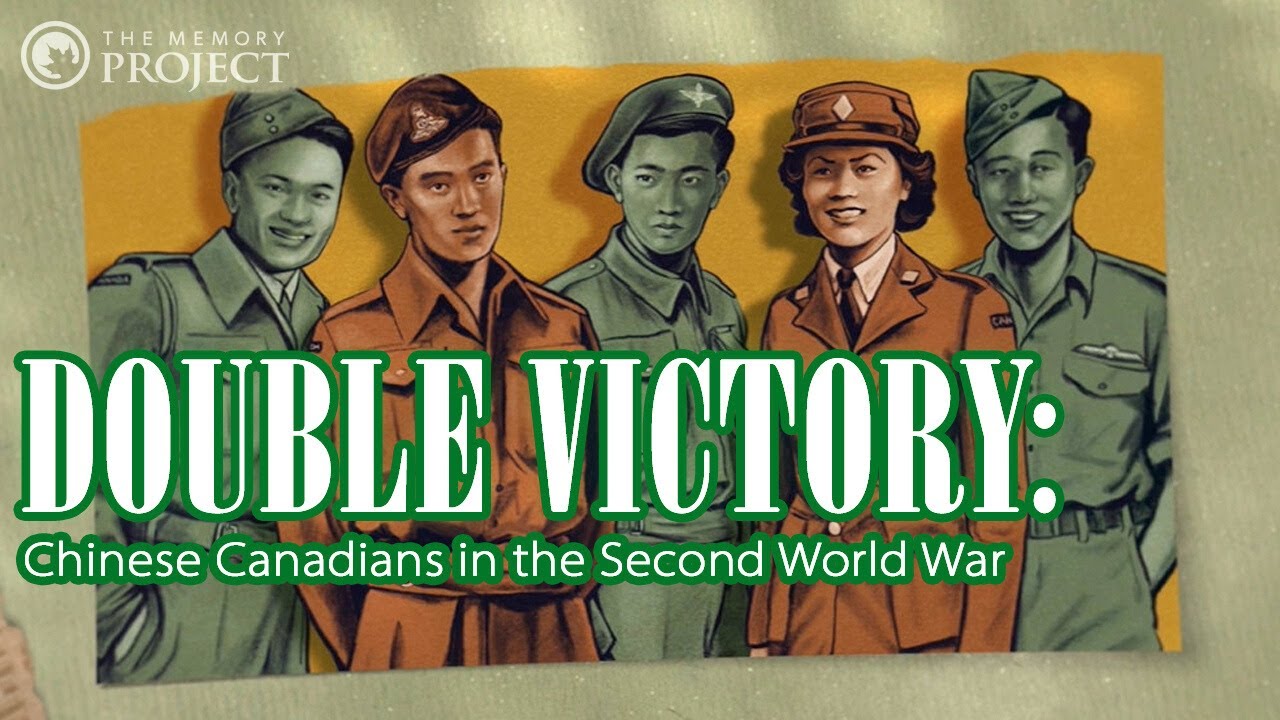
View the transcript
MARY KO BONG: Visible minorities were not welcome, so what are we going to do? We just can’t sit back.
NARRATOR: When Canada began recruiting soldiers at the beginning of the Second World War, many Chinese Canadians saw serving in the military as an opportunity to correct historic wrongs and to earn basic rights.
Chinese people had a long history in Canada. Many early migrants came to build the transcontinental railway and were often mistreated and put at extreme risk. Just as the railway was being completed and Chinese labour was no longer needed, a new head tax was introduced to prevent more Chinese people from coming to Canada and to encourage those already here to return to China. This tax was only for new immigrants, including the wives and children of those who had built the railway.
By 1923, Chinese immigrants were, for the most part, banned from coming into Canada; those who remained could not vote and were generally confined to low-paid menial labour. When war broke out in 1939, Chinese people in Canada were largely excluded from service. But this changed in December 1941.
MARY KO BONG: When the Japanese attacked Pearl Harbor, the British Empire was in a big rush to get visible minorities involved. So, that’s how the Chinese got in.
NARRATOR: As Japanese occupation spread through the Pacific, Britain was desperate to infiltrate the region to gather intelligence and sabotage the enemy. [Its] Special Operations Executive, or SOE, had successfully trained and dropped secret agents behind enemy lines throughout Europe. But the Pacific would be very different, as White agents would struggle to gain trust with resistance fighters who often resented their former European colonizers as much as their Japanese occupiers. It was thought that Chinese Canadians could blend in with locals more easily.
EDWARD LEE: The Canadian government was very surprised that 100 per cent of Chinese Canadian Service signed on the dotted line to volunteer for special overseas forces in Asia Service.
VICTOR WONG: I was only 18 when we were sent letters to join the Armed Forces. We were trained with different rifles. So we had, also grenades. We were supposed to be spies.
NARRATOR: Between 1944 and ’45, about 150 Chinese Canadians were recruited to the British SOE. Force 136 was an elite unit of Chinese Canadian soldiers. Their mission was to wreak havoc on Japanese forces, cutting supply lines and gathering secret intel alongside local resistance fighters. They were dropped into the thick jungle of Japanese-occupied territories. If captured, their existence would be denied. They were given a 50-50 chance of survival.
EDWARD LEE: If you are still alive and get caught by Japanese soldiers, you will try to take two cyanide pills to prevent the enemy torturing you. When you are captured, you are not qualified as a prisoner of war. You will be shot immediately.
NARRATOR: They received extremely specialized commando training. This included stalking, silent killing, demolition, jungle survival, wireless operations, espionage, parachuting, interpretation and silent swimming.
EDWARD LEE: You could be called anytime for duty into the guerrilla warfare in Japanese-occupied territory. By parachute into the jungle, individually, not by group. You will be in the jungle for three to four months until someone relieves you.
NARRATOR: Force 136 wasn’t the only opportunity for Chinese Canadians to fight for their country. Some recruitment offices were more lenient than others, and several Chinese Canadians managed to join the fighting in Europe. Corporal Frank Wong was one of these few who served in France and the Netherlands. He was assigned to maintain artillery and was in Holland during the Battle of the Bulge.
FRANK WONG: I remember on New Year’s Day, I was going for my practice one morning and I heard the ack-ack gun firing in the distance. And then all of a sudden, the firing came closer and closer, so, I look up, and saw a fighter plane coming right straight at me, and I said, “Holy smokes, somebody’s trying to shoot me!” So, I jumped into the ditch, and that was the day of the German final push; they put up over nearly a thousand planes in the air.
NARRATOR: Despite the brutal jungle conditions, all the Chinese Canadian soldiers in Force 136 survived the war. Their service demonstrated their courage and loyalty to Canada, extraordinary achievements they had to keep secret for a long time.
HERBERT LIM: Before they let me leave London to come back to Canada, I had to sign a War Secrets Act. My lips were sealed for 25 years; I could not say anything. I could not tell what I did, what I learned, otherwise I’d go to jail.
NARRATOR: The contributions that Chinese Canadians made to the war effort [were] a double victory. Their service helped secure a victory for their country, and, combined with years of activism on the home front, their bravery and commitment helped advance equal rights for the community. In 1945, the BC government extended the right to vote to Chinese Canadian veterans.
VICTOR WONG: Parliament, in 1946, passed a law that on January 1st, 1947, Chinese can apply for citizenship; all Chinese can be citizens of Canada then. I think we won two wars: one over the enemy and one at home.
HERBERT LIM: I saw a lot of things there, a lot of people dying, but it made me a better man because of that. If I didn’t go through that, I don’t appreciate life.