
Patrolling the Green Line: Canadian Peacekeepers in Cyprus
Video- Military History
View the transcript
ROBERT THOMAS: Peacekeeping is not a soldier’s job, but only a soldier can do it.
PAUL HALE: You train for war fighting, hope you never have to do it.
NARRATOR: The peacekeeping operation in Cyprus is one of Canada’s longest overseas military commitments. Because of the island’s proximity to the Suez Canal and the Middle East, Cyprus is considered extremely valuable from both a military and geopolitical standpoint. It has been governed by many nations and empires over the past thousand years; however, its population descends predominantly from Greece and Turkey. A Turkish Cypriot community and a larger Greek Cypriot community form the two distinct groups that live on the island. Constant political instability in the region paved the way for ethnic tensions throughout the 20th century.
After the First World War, the United Kingdom took full possession of Cyprus. In 1955, Greek Cypriot nationalists seeking independence and political union (or enosis) with Greece launched a guerrilla warfare campaign against British forces in Cyprus.
In 1960, Cyprus gained [its] independence from the United Kingdom. The new Cypriot government was meant to share power between the majority population of Greek Cypriots and the minority Turkish Cypriots, who opposed political union with Greece. However, this arrangement proved unstable, and soon Cyprus spiralled toward civil war, which threatened to escalate into a wider war between Turkey and Greece if nothing was done.
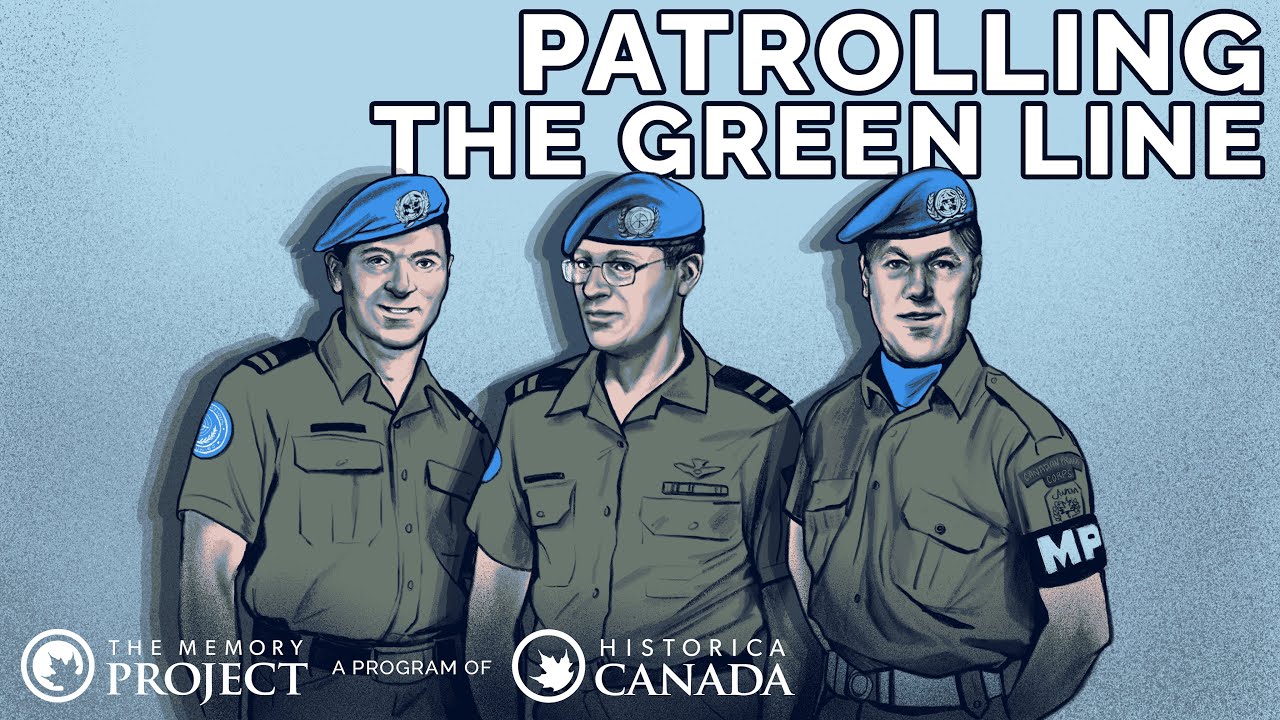
On March 4th 1964, the United Nations, with Canadian assistance, created the United Nations Peacekeeping Force in Cyprus. Sergeant Robert Thomas and Major Paul Hale both served in the peacekeeping mission, patrolling the Green Line, a buffer zone dividing Nicosia, the island’s capital.
ROBERT THOMAS: We pretty much hit the ground running. It was a no man’s land between the Turk side and the Greek side, patrolled by the United Nations. It’s a difficult task because you’re basically going in the middle of a firestorm. We lived behind the main building in tents. There was UN painted on the ground and on the roof. And that was to help avoid either side coming over and bombing us.
PAUL HALE: We’re the stabilizing force on the ground, trying to keep them apart while the politicians do all the diplomatic stuff. I don’t smoke, but I carry cigarettes because you can defuse a situation where people are nervous by offering ’em a cigarette. They’ve got to take their hand off the gun, lean into you so you can light the cigarette. It calms ’em down.
ROBERT THOMAS: We would head out to a Turkish village that was pretty much surrounded by Greek villages, to escort a bus that would bring people that were sick into the hospital. And escort them through various checkpoints. And quite often there would be a young kid there with an old Sten gun. The Sten guns were never very safe at the best of times. And when you’re looking at a 14- or 15-year-old kid pointing a Sten gun in your face, you start to think, how much training has this kid had? You know, you just wanted to make sure nobody made a mistake.
NARRATOR: On July 20th, 1974, 40,000 Turkish soldiers invaded Cyprus after an attempted coup by Greek Cypriot extremists. The peacekeepers found themselves in the middle of a war zone. Lieutenant-Colonel Ronald Bragdon was part of the Canadian troops called in for support.
RONALD BRAGDON: We got there just as the invasion was going on. At that time, the big concern was the airport at Nicosia. There was a lot of posturing going on; you could see a movement of tanks and APCs and artillery and such. Firefights increased. There was more tension along the Green Line. I don’t think anybody slept very well that night. You could hear armoured movement and you could hear the tanks moving. And then about first light the next day, everything erupted. Our guys caught in between jets coming in and strafing in the area around the airport. So everything was going like crazy. It was very intense. I got the feeling that really neither side wanted us there. The Turks had come in and reinforced the Turkish Cypriot fighters and the Turkish communities. They were now the bullies on the block. It was not peacekeeping, it was peace enforcement and survival.
NARRATOR: During that summer, 2 Canadian peacekeepers were killed and 17 were wounded. But Canadians and other UN contingents were able to arrange local ceasefires around sensitive locations such as Nicosia’s airport. The UN’s nationwide ceasefire took effect on August 16th, 1974. This included extending the initial Green Line to divide the entire country, a 180 km physical barrier separating the Turkish-inhabited north from the Greek-inhabited south, which remains in place today.
PAUL HALE: It’s 95 per cent boredom, 2 per cent sheer terror and 3 per cent I’m scared. And you can’t predict when it’s going to change like that. So you have to learn to handle it. Soldiers are also warriors. To be a peacekeeper, you have to be a warrior. Because you have to be able to go from zero to 100 km in 10 seconds.
ROBERT THOMAS: Canadians really are natural for peacekeeping. We don’t bring a lot of baggage with us. We’re friendly people.
NARRATOR: More than 33,000 Canadians have served one or more tours on the island over the years. Though the peace has held, the conflict in Cyprus remains unresolved to this day. Turkish Cypriots have left their seats in the House of Representatives vacant since 1965, and they, along with Turkey, maintain claims of a Turkish Cypriot country in Northern Cyprus that remain unrecognized internationally. Despite the competing narratives of governance and the persistent resentment on both sides of the Green Line, the tensions have stabilized in Cyprus.
After three decades of large deployments, Canada withdrew in 1993 and has sent only a few military personnel to the ongoing UN mission since then. To date, 28 Canadians have been killed in Cyprus, making it Canada’s second most deadly peacekeeping operation.
PAUL HALE: Remember the soldiers who made the ultimate sacrifice in Cyprus. They sacrificed themselves just as much in peacekeeping as those who made the ultimate sacrifice in World War II, Korea, Afghanistan. The Christmases you miss, the birthdays, the anniversaries — various soldiers have missed the birth of their children because they were deployed overseas. Those sacrifices you can’t quantify.
ROBERT THOMAS: We didn’t save the world, but where we operated, we made life better and probably defused situations that could have resulted in people being killed. So, yeah, I’m very proud of it.