
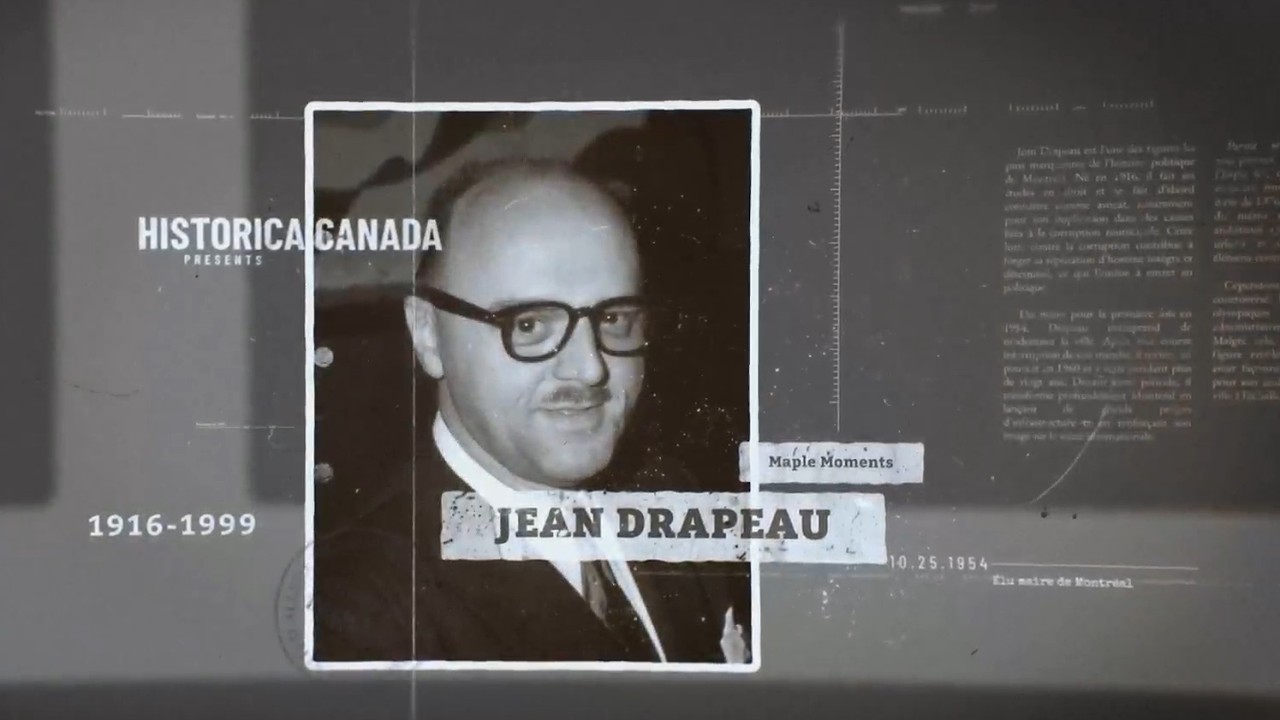
Maple Moments: Jean Drapeau
Video- French Canadian History
- Arts & Culture
- Social History
View the transcript
NARRATOR: For a very long time, Jean Drapeau was Montreal. He made his name first as a crime-busting lawyer in a city known for its promiscuous nightlife where corruption ran from the underworld to the police force. Then he was the mayor for 29 years in office through seven prime ministers and nine Quebec premiers. He won one election with 92 per cent of the vote. His record is filled with epic achievement and failings on a similar scale. He worked from dawn to dark, often 100 hours a week, energizing his city with audacious plans many people thought were impossible. He once said, "There are never any problems, only solutions."
JASON MOSCOVITZ: It’s important to remember that he was mayor when the Quiet Revolution was in full swing. The sixties. And at that time, it was a good thing to have a dreamer. He dreamed, and he wanted his city, his province, his country to be something everyone could truly be proud of.
NARRATOR: There was Expo 67, the grandest centennial project of them all, built incredibly on a man-made island in the St. Lawrence River. There was the city's first subway, the Metro, rolling not on steel wheels and rails, but on rubber tires through stations designed with stained glass and mosaics. He persuaded Major League Baseball to come to Canada, even though Montreal didn't have the big stadium the baseball moguls had demanded. It was Drapeau who created what some see as Canada's first government lottery, though lotteries were illegal at the time, so he called it a voluntary tax. The courts shut him down, but before long, provinces changed their laws so they could run their own lotteries. Drapeau won the Summer Olympics for Montreal in 1976, the first ever in Canada. He'd put his city in the world's eye again, but his ambition ran into financial reality. He had famously said, "The Olympics can no more have a deficit, that a man can have a baby." Then he ran up a billion-dollar deficit. It wasn't paid off for 30 years.
Drapeau, ever fixed on dazzling, was accused of ignoring the mundane things like public housing, city planning, and pollution control. Terry Mosher, the legendary cartoonist for The Gazette in Montreal, remembers that Drapeau always did things his way.
TERRY MOSHER: He was very much an autocrat. He once said that between elections, he was a benevolent dictator, and he got that right because if he decided something, for example he loved art, but he didn't like an outdoor art show that was going on just before the Olympics. So he sent the city crew and said “tear it down.” You couldn't get away with something like that today, but he just shrugged about it. He said, “well I don't like it.”
NARRATOR: But he was never accused of corruption. Until he died, he lived in the same modest home he bought before he became mayor. Brian Stewart is a journalist who covered Jean Drapeau.
BRIAN STEWART: What he set out to achieve for the city in a word was grandeur. A sort of sense of sophisticated yearning to be on the world stage, to do great things, to achieve enormous monuments to the city and to its quality of life.
NARRATOR: Jean Drapeau had little interest in consensus. He wanted Montreal to be seen as an extraordinary city with achievements recognized around the world. On one thing, both his admirers and his critics can agree. His passion and drive transformed Montreal, the city he led and loved so much.