
Browse "Things"
-
Macleans
Irish Peace Accord
For 30 years, it had been an unwinnable religious war of endless reprisals, fuelled by hate and hopelessness.This article was originally published in Maclean's Magazine on April 20, 1998
"https://thecanadianencyclopedia.ca/images/tce_placeholder.jpg?v=e9dca980c9bdb3aa11e832e7ea94f5d9" // resources/views/front/categories/view.blade.php
https://thecanadianencyclopedia.ca/images/tce_placeholder.jpg?v=e9dca980c9bdb3aa11e832e7ea94f5d9
-
Macleans
Irish Referendum Campaign
On the Falls Road in the western precincts of Belfast, right in the heart of the city's Roman Catholic strongholds, there is an exclusive watering hole with a singularly appropriate name. They call the place the Felons' Club.This article was originally published in Maclean's Magazine on May 25, 1998
"https://thecanadianencyclopedia.ca/images/tce_placeholder.jpg?v=e9dca980c9bdb3aa11e832e7ea94f5d9" // resources/views/front/categories/view.blade.php
https://thecanadianencyclopedia.ca/images/tce_placeholder.jpg?v=e9dca980c9bdb3aa11e832e7ea94f5d9
-
Article
Iron and Steel Industry
Iron is the primary raw material used to produce steel — itself an alloy of concentrated iron with a minute amount of carbon. (See also Mineral Resources in Canada.) Globally, steel production drives 98 per cent of the demand for iron, while electronics and non-metallurgical uses drive the remaining 2 per cent. Iron extraction and steel production have historically constituted major industries in Canada, especially in the industrial zones of Ontario and Quebec.
"https://d3d0lqu00lnqvz.cloudfront.net/ironandsteelindustry/workmenstelcosteelcompany.jpg" // resources/views/front/categories/view.blade.php
https://d3d0lqu00lnqvz.cloudfront.net/ironandsteelindustry/workmenstelcosteelcompany.jpg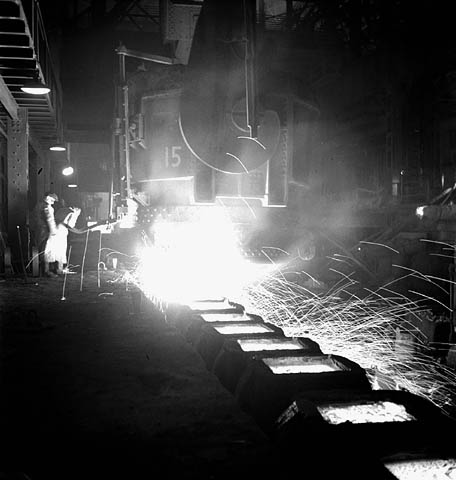
-
Article
Iron Ore
Its most important mineral forms are magnetite (Fe3O4, 72.4% Fe), hematite (Fe2O3, 69.9% Fe) and siderite (FeCO3, 48.29% Fe). In Brazil, some ore that contains practically no other minerals can grade as high as 68% Fe, but the crude ore mined in Canada grades between 30 and 44% Fe.
"https://d3d0lqu00lnqvz.cloudfront.net/media/media/0fa44cb9-3338-463a-ad5c-498dbf2d0950.jpg" // resources/views/front/categories/view.blade.php
https://d3d0lqu00lnqvz.cloudfront.net/media/media/0fa44cb9-3338-463a-ad5c-498dbf2d0950.jpg
-
Article
Iron Ore Company of Canada
Iron Ore Company of Canada, incorporated 1949 by Labrador Mining and Exploration and Hanna Mining interests to exploit the some 400 million t of open-pit IRON ORE reserves proved in central Québec and Labrador in the late 1940s.
"https://thecanadianencyclopedia.ca/images/tce_placeholder.jpg?v=e9dca980c9bdb3aa11e832e7ea94f5d9" // resources/views/front/categories/view.blade.php
https://thecanadianencyclopedia.ca/images/tce_placeholder.jpg?v=e9dca980c9bdb3aa11e832e7ea94f5d9
-
Article
Iron Ring
The Iron Ring is a symbol of professional duty and obligation worn by Canadian engineers. The tradition began in 1922 when a group of Montréal engineers met to consider the solidarity of, and a means for providing guidance to, their profession.
"https://thecanadianencyclopedia.ca/images/tce_placeholder.jpg?v=e9dca980c9bdb3aa11e832e7ea94f5d9" // resources/views/front/categories/view.blade.php
https://thecanadianencyclopedia.ca/images/tce_placeholder.jpg?v=e9dca980c9bdb3aa11e832e7ea94f5d9
-
Article
Iroquois-class Destroyers
The Iroquois class of helicopter-carrying destroyers (DDH) entered service in the Canadian Navy in the early 1970s, featuring several innovations that distinguished them as trailblazers in antisubmarine warfare (ASW). Although only four were built, they played a critical flagship role for deployed Canadian naval task groups. The class was modernized in the early 1990s and transformed into guided-missile destroyers (DDG), providing fleet area air defence until their withdrawal from service in the 2010s.
"https://d3d0lqu00lnqvz.cloudfront.net/Iroquois-destroyers/athabaskan.jpg" // resources/views/front/categories/view.blade.php
https://d3d0lqu00lnqvz.cloudfront.net/Iroquois-destroyers/athabaskan.jpg
-
Article
Iroquois Wars
The Iroquois Wars, also known as the Beaver Wars and the French and Iroquois Wars, were a series of 17th-century conflicts involving the Haudenosaunee Confederacy (also known as the Iroquois or Five Nations, then including the Mohawk, Oneida, Onondaga, Cayuga and Seneca), numerous other First Nations, and French colonial forces. The origins of the wars lay in the competitive fur trade. In about 1640, the Haudenosaunee began a campaign to increase their territorial holdings and access to animals like beaver and deer. Hostilities continued until 1701, when the Haudenosaunee agreed to a peace treaty with the French. The wars represent the intense struggle for control over resources in the early colonial period and resulted in the permanent dispersal or destruction of several First Nations in the Eastern Woodlands.
"https://d3d0lqu00lnqvz.cloudfront.net/media/media/596cf750-11c8-4462-a70d-9aa0a300bd42.jpg" // resources/views/front/categories/view.blade.php
https://d3d0lqu00lnqvz.cloudfront.net/media/media/596cf750-11c8-4462-a70d-9aa0a300bd42.jpg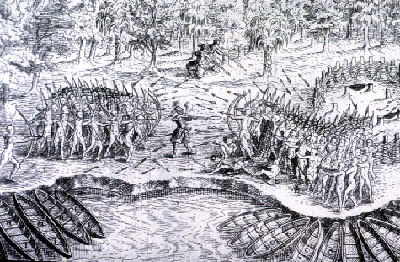
-
Article
Irrigation
Irrigation is warranted where the CLIMATE is essentially arid or semiarid and is characterized by low and unpredictable precipitation (see RAIN).
"https://thecanadianencyclopedia.ca/images/tce_placeholder.jpg?v=e9dca980c9bdb3aa11e832e7ea94f5d9" // resources/views/front/categories/view.blade.php
https://thecanadianencyclopedia.ca/images/tce_placeholder.jpg?v=e9dca980c9bdb3aa11e832e7ea94f5d9
-
Article
Irving Group of Companies
Companies owned by New Brunswick’s Irving family dominate the province’s natural resource industries, as well as its media, engineering and construction industries. The first Irving business was a sawmill purchased in 1881. The family now owns many companies that supply each other from different steps in the chain of production. These companies largely fall under four umbrellas: J.D. Irving Limited (whose many segments include forestry, food, construction and transportation), Brunswick News (newspapers), Irving Oil (oil refining and marketing) and Ocean Capital Holdings (real estate, radio, construction and materials). The Irving family owns Canada’s largest oil refinery, is one of the five largest landowners in North America, and employs 1 in 12 people in New Brunswick. It is one of the wealthiest families in Canada.
"https://d3d0lqu00lnqvz.cloudfront.net/media/new_article_images/Irving/Irving_BigStop_Salisbury.jpg" // resources/views/front/categories/view.blade.php
https://d3d0lqu00lnqvz.cloudfront.net/media/new_article_images/Irving/Irving_BigStop_Salisbury.jpg
-
Macleans
Israel at 50
Gabriel Ben Yitzhak and Jamil Abu Heykal share an uneasy existence on a hilltop overlooking ancient Hebron, a town that was already old when Abraham arrived more than 35 centuries ago. The Jewish patriarch is, in religious tradition if not irrefutable fact, buried near the foot of the hill.This article was originally published in Maclean's Magazine on April 27, 1998
"https://thecanadianencyclopedia.ca/images/tce_placeholder.jpg?v=e9dca980c9bdb3aa11e832e7ea94f5d9" // resources/views/front/categories/view.blade.php
https://thecanadianencyclopedia.ca/images/tce_placeholder.jpg?v=e9dca980c9bdb3aa11e832e7ea94f5d9
-
Article
Israeli Music in Canada
By 1990 there had been little emigration from Israel to Canada, and that was mostly to Montreal and Toronto, with smaller numbers settling in Hamilton, Ottawa, and Vancouver. Groups such as the YMHA and YWHA, the Canada-Israel Cultural Foundation (established 1963), and various local organizations have worked to perpetuate and disseminate Israeli culture through classes, demonstrations, concerts, and lectures. In June 1978, in honour of Israel's 30th anniversary, Toronto's Ontario Place staged the first of...
"https://thecanadianencyclopedia.ca/images/tce_placeholder.jpg?v=e9dca980c9bdb3aa11e832e7ea94f5d9" // resources/views/front/categories/view.blade.php
https://thecanadianencyclopedia.ca/images/tce_placeholder.jpg?v=e9dca980c9bdb3aa11e832e7ea94f5d9
-
Article
Canada and the Italian Campaign
Canada’s longest Second World War army campaign was in Italy. Canadian forces served in the heat, snow and mud of the grinding, nearly two-year Allied battle across Sicily and up the Italian peninsula—prying the country from Germany's grip, at a cost of more than 26,000 Canadian casualties.
"https://d3d0lqu00lnqvz.cloudfront.net/media/media/b953ce91-4743-48e3-a180-ffe7c2816954.jpg" // resources/views/front/categories/view.blade.php
https://d3d0lqu00lnqvz.cloudfront.net/media/media/b953ce91-4743-48e3-a180-ffe7c2816954.jpg
-
Article
Italian Music in Canada
Though a few Italians were associated with early European exploration in Canada (eg, John Cabot, b Giovanni Caboto), immigration did not begin in earnest until ca 1880, increasing dramatically in the early 20th century.
"https://thecanadianencyclopedia.ca/images/tce_placeholder.jpg?v=e9dca980c9bdb3aa11e832e7ea94f5d9" // resources/views/front/categories/view.blade.php
https://thecanadianencyclopedia.ca/images/tce_placeholder.jpg?v=e9dca980c9bdb3aa11e832e7ea94f5d9
-
Article
J. & O. Crémazie
J. & O. Crémazie. Quebec City booksellers and music publishers. The partnership between the brothers Joseph (1812-80) and Octave (1827-79) began in 1844 and lasted until 1862.
"https://thecanadianencyclopedia.ca/images/tce_placeholder.jpg?v=e9dca980c9bdb3aa11e832e7ea94f5d9" // resources/views/front/categories/view.blade.php
https://thecanadianencyclopedia.ca/images/tce_placeholder.jpg?v=e9dca980c9bdb3aa11e832e7ea94f5d9