
Browse "Politics & Law"
-
Article
Local Government
Local government is the level of government below the provinces. The most important local governments are the MUNICIPAL GOVERNMENTS. Under the constitution, the provinces have exclusive jurisdiction over municipal affairs (see MUNICIPAL-PROVINCIAL RELATIONS).
"https://thecanadianencyclopedia.ca/images/tce_placeholder.jpg?v=e9dca980c9bdb3aa11e832e7ea94f5d9" // resources/views/front/categories/view.blade.php
https://thecanadianencyclopedia.ca/images/tce_placeholder.jpg?v=e9dca980c9bdb3aa11e832e7ea94f5d9
-
Macleans
Locked up, locked out
The chief behind Canada’s first jail on reserve land pushes for more jobs training for Aboriginal inmatesThis article was originally published in Maclean's Magazine on September 23, 2013
"https://thecanadianencyclopedia.ca/images/tce_placeholder.jpg?v=e9dca980c9bdb3aa11e832e7ea94f5d9" // resources/views/front/categories/view.blade.php
https://thecanadianencyclopedia.ca/images/tce_placeholder.jpg?v=e9dca980c9bdb3aa11e832e7ea94f5d9
-
Article
London Conference
From 4 December 1866 to March 1867, politicians from the Province of Canada, Nova Scotia and New Brunswick met with delegates of the British government in London. This was the last of three conferences — after the Charlottetown Conference and Quebec Conference in 1864 — that were held to determine the constitutional details of Confederation. The Quebec Resolutions — 72 points that had been agreed upon in Quebec City — were reviewed and amended. They formed the basis of the British North America Act (now the Constitution Act, 1867). It was passed by the British Parliament and received Queen Victoria’s Royal Assent on 29 March 1867.
"https://d3d0lqu00lnqvz.cloudfront.net/media/media/9a650dcd-e8ad-4685-8baf-c4bba9cae8e7.jpg" // resources/views/front/categories/view.blade.php
https://d3d0lqu00lnqvz.cloudfront.net/media/media/9a650dcd-e8ad-4685-8baf-c4bba9cae8e7.jpg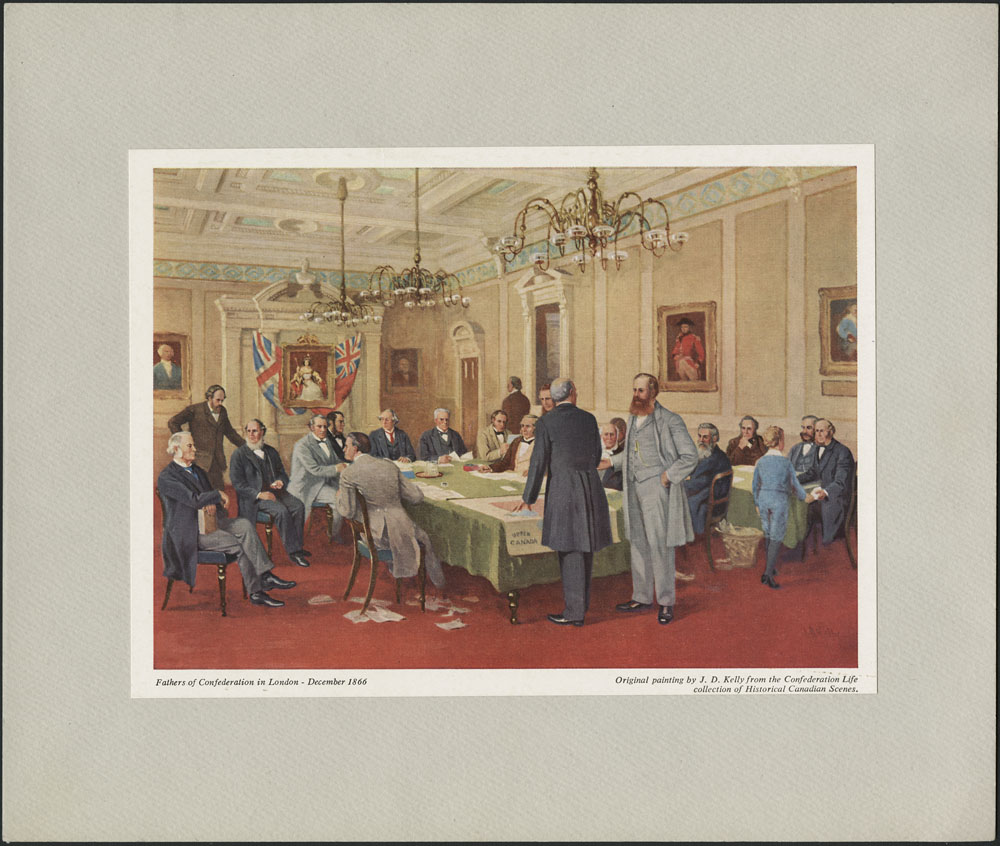
-
Article
London Conference (Plain-Language Summary)
The London Conference took place in London, England, from 4 December 1866 to March 1867. Politicians from British North America met with members of the British government. This was the last of three conferences that were held to work out the legal details of Confederation. The first two were the Charlottetown Conference and Quebec Conference. They were both held in 1864. The Quebec Resolutions were agreed upon in Quebec City. They were reviewed and updated in London. They formed the basis of the British North America Act (now the Constitution Act, 1867). It is the foundation of Canada’s Constitution. It was passed by the British Parliament. It received Queen Victoria’s Royal Assent on 29 March 1867. This article is a plain-language summary of the London Conference. If you would like to read about this topic in more depth, please see our full-length entry: London Conference.
"https://d3d0lqu00lnqvz.cloudfront.net/media/media/9a650dcd-e8ad-4685-8baf-c4bba9cae8e7.jpg" // resources/views/front/categories/view.blade.php
https://d3d0lqu00lnqvz.cloudfront.net/media/media/9a650dcd-e8ad-4685-8baf-c4bba9cae8e7.jpg
-
Article
London Township Treaty (No. 6)
The London Township Treaty of 1796 (also known as Treaty 6 in the Upper Canada treaties numbering system) was an early land agreement between First Nations and British authorities in Upper Canada (later Ontario). It was one of a series of Upper Canada Land Surrenders. The London Township Treaty encompassed a tract of land 12 miles square (about 31 kilometres square) in the southwestern part of the colony. The British originally purchased it as the location to establish the capital of the colony, but York (modern Toronto) became the capital instead. (See also Treaties with Indigenous Peoples in Canada.)
"https://d3d0lqu00lnqvz.cloudfront.net/DundasLondonON.jpg" // resources/views/front/categories/view.blade.php
https://d3d0lqu00lnqvz.cloudfront.net/DundasLondonON.jpg
-
Macleans
Lord Encouraged to Lead Tories
It takes a political animal to know one.This article was originally published in Maclean's Magazine on October 7, 2002
"https://thecanadianencyclopedia.ca/images/tce_placeholder.jpg?v=e9dca980c9bdb3aa11e832e7ea94f5d9" // resources/views/front/categories/view.blade.php
https://thecanadianencyclopedia.ca/images/tce_placeholder.jpg?v=e9dca980c9bdb3aa11e832e7ea94f5d9
-
Macleans
Lord's First 200 Days
His absence was, in reality, due to a bout of flu. But many nights, Lord's tan minivan is the last vehicle in the parking lot behind the government buildings. His heavy workload has even reduced the premier to working out at home, instead of his usual fitness regimen of ball hockey and racquetball.This article was originally published in Maclean's Magazine on January 17, 2000
"https://d3d0lqu00lnqvz.cloudfront.net/media/media/2154bcd0-2e92-4fbf-ae63-3342734f8489.jpg" // resources/views/front/categories/view.blade.php
https://d3d0lqu00lnqvz.cloudfront.net/media/media/2154bcd0-2e92-4fbf-ae63-3342734f8489.jpg
-
Macleans
Lortie Released
Denis Lortie, the former army corporal who murdered three people and injured 13 others after storming the Quebec National Assembly in May, 1984, was released on day parole to a halfway house in Hull, Quebec.This article was originally published in Maclean's Magazine on January 16, 1995
"https://thecanadianencyclopedia.ca/images/tce_placeholder.jpg?v=e9dca980c9bdb3aa11e832e7ea94f5d9" // resources/views/front/categories/view.blade.php
https://thecanadianencyclopedia.ca/images/tce_placeholder.jpg?v=e9dca980c9bdb3aa11e832e7ea94f5d9
-
Article
Lower Canada
Lower Canada was a British colony from 1791 to 1840. Its geographical boundaries comprised the southern portion of present-day Quebec. In 1791, Britain divided the Province of Quebec into Upper Canada and Lower Canada. (See: Constitutional Act 1791.) Britain had followed a similar policy of territorial division twice before. Prince Edward Island was detached from Nova Scotia in 1769. The provinces of Cape Breton and New Brunswick were created in 1784 in response to the wave of Loyalist immigration (which also occurred in Quebec). In 1841, Upper Canada and Lower Canada were renamed Canada West and Canada East, respectively. They were united as the single colony of the Province of Canada.
"https://d3d0lqu00lnqvz.cloudfront.net/media/media/0a40188b-4ef4-4e9e-90bb-ec21d39c1c45.jpg" // resources/views/front/categories/view.blade.php
https://d3d0lqu00lnqvz.cloudfront.net/media/media/0a40188b-4ef4-4e9e-90bb-ec21d39c1c45.jpg
-
"https://thecanadianencyclopedia.ca/images/tce_placeholder.jpg?v=e9dca980c9bdb3aa11e832e7ea94f5d9" // resources/views/front/categories/view.blade.php
https://thecanadianencyclopedia.ca/images/tce_placeholder.jpg?v=e9dca980c9bdb3aa11e832e7ea94f5d9
-
Article
Maggie Vail Murder Case
In September 1869, berry pickers in Saint John, New Brunswick, discovered the remains of an adult and a child hidden in some bushes. The bodies were soon identified as belonging to Sarah Margaret “Maggie” Vail and her infant daughter, Ella May. Later that month, architect John A. Munroe was charged with the murder of Vail, with whom he had an affair. Although his lawyer argued that Munroe was incapable of murder given his education and social standing — an early example of the “character” defence — he was convicted in December 1869. Munroe eventually confessed to the murders and was executed in February 1870.
"https://d3d0lqu00lnqvz.cloudfront.net/media/new_article_images/Maggie Vail Memorial Nov 2013.JPG" // resources/views/front/categories/view.blade.php
https://d3d0lqu00lnqvz.cloudfront.net/media/new_article_images/Maggie Vail Memorial Nov 2013.JPG
-
Article
Magna Carta
The 1215 agreement between King John of England and his barons provided the foundation for English common law, which spread throughout the English-speaking world. Magna Carta is the first example of a king of England consenting to written limits on his power drafted by his subjects. The Magna Carta (or Great Charter) informs the legal system in English Canada, and the Canadian Charter of Rights and Freedoms.
"https://thecanadianencyclopedia.ca/images/tce_placeholder.jpg?v=e9dca980c9bdb3aa11e832e7ea94f5d9" // resources/views/front/categories/view.blade.php
https://thecanadianencyclopedia.ca/images/tce_placeholder.jpg?v=e9dca980c9bdb3aa11e832e7ea94f5d9
-
Article
Mahe Case
Mahe CaseOn appeal from the Court of Appeal in Alberta, where a small group of francophone parents had taken the Alberta Government through the court system (Queen's Bench 1985; Appeal 1987) on minority language educational rights, the Supreme Court of Canada had to rule whether the rights that Section 23 of the CANADIAN CHARTER OF RIGHTS AND FREEDOMS mandates, depending upon the number of students, include 1) a right to "management and control" over minority...
"https://thecanadianencyclopedia.ca/images/tce_placeholder.jpg?v=e9dca980c9bdb3aa11e832e7ea94f5d9" // resources/views/front/categories/view.blade.php
https://thecanadianencyclopedia.ca/images/tce_placeholder.jpg?v=e9dca980c9bdb3aa11e832e7ea94f5d9
-
Article
Maher Arar Case
Maher Arar is a Syrian-born Canadian. In 2002 he was sent by the United States to Syria as an accused terrorist, based on faulty information supplied to US agents by the Royal Canadian Mounted Police (RCMP). Arar was tortured in Syria before being released and returned to Canada. The federal government paid him $10.5 million in compensation for the wrongs done to him.
"https://d3d0lqu00lnqvz.cloudfront.net/media/media/639fe415-c7ee-4abe-9d0e-784e01d934e5.jpg" // resources/views/front/categories/view.blade.php
https://d3d0lqu00lnqvz.cloudfront.net/media/media/639fe415-c7ee-4abe-9d0e-784e01d934e5.jpg
-
Article
Maintiens le Droit
Maintiens le Droit [Fr, "Uphold the Right"], the official motto of the ROYAL CANADIAN MOUNTED POLICE. The use of the motto by the NORTH-WEST MOUNTED POLICE was first advocated in 1873 and adopted 2 years later.
"https://thecanadianencyclopedia.ca/images/tce_placeholder.jpg?v=e9dca980c9bdb3aa11e832e7ea94f5d9" // resources/views/front/categories/view.blade.php
https://thecanadianencyclopedia.ca/images/tce_placeholder.jpg?v=e9dca980c9bdb3aa11e832e7ea94f5d9