Browse "History"
-
Article
Hudson's Bay Record Society
Hudson's Bay Record Society, est 1938 by the HUDSON'S BAY CO to publish selections from its extensive company records accumulated since 1670. Under an agreement with the CHAMPLAIN SOCIETY, 12 volumes appeared, 1938-49.
"https://thecanadianencyclopedia.ca/images/tce_placeholder.jpg?v=e9dca980c9bdb3aa11e832e7ea94f5d9" // resources/views/front/categories/view.blade.php
https://thecanadianencyclopedia.ca/images/tce_placeholder.jpg?v=e9dca980c9bdb3aa11e832e7ea94f5d9
-
Article
Human Rights
Human rights are rights that we all have by virtue of our shared humanity. Depending on the nature of the right, both individuals and groups can assert human rights. Human rights as we understand them today are a relatively modern concept. All human rights are indivisible, interrelated and interdependent. None has automatic precedence over any other. The realization of human rights is a constant struggle on the part of people who suffer injustices and who seek redress. Human rights are an important part of the social fabric of Canadian society. Canadians have also played a role in the evolution of human rights on the international stage.
"https://d3d0lqu00lnqvz.cloudfront.net/media/media/cecf9ede-d0ed-487d-a002-e8f44a491add.jpg" // resources/views/front/categories/view.blade.php
https://d3d0lqu00lnqvz.cloudfront.net/media/media/cecf9ede-d0ed-487d-a002-e8f44a491add.jpg
-
Article
Wendake (Huronia)
Wendake is a Huron-Wendat settlement dating back to the 17th century, once known by various names including “Huronia,” "the country of the Huron" or “the Huron village.” Today, Wendake refers to the urban reserve of the Huron-Wendat Nation, located near Quebec City, Quebec.
"https://d3d0lqu00lnqvz.cloudfront.net/media/media/dbcf9b74-90d5-42a2-8f3c-9e38996ea0b7.jpg" // resources/views/front/categories/view.blade.php
https://d3d0lqu00lnqvz.cloudfront.net/media/media/dbcf9b74-90d5-42a2-8f3c-9e38996ea0b7.jpg
-
Article
Ice Storm of 1998
The ice storm of 1998 was one of the largest natural disasters in Canadian history. Between 4 and 10 January 1998, sections of the St. Lawrence Valley from Kingston to Quebec’s Eastern Townships received up to 100 mm of ice pellets and freezing rain — more than double the icy precipitation normally received in those areas in a whole year. The storm claimed as many as 35 lives, injured 945, and resulted in the temporary displacement of 600,000 people. Several roads were shut down and massive power outages occurred, cutting off electricity for nearly 1.4 million customers in Quebec and over 230,000 in eastern Ontario. The total financial cost of the storm is estimated at $5.4 billion.
"https://d3d0lqu00lnqvz.cloudfront.net/media/media/50883f65-a6e7-4f26-9c7b-ffd9ab7625ee.jpg" // resources/views/front/categories/view.blade.php
https://d3d0lqu00lnqvz.cloudfront.net/media/media/50883f65-a6e7-4f26-9c7b-ffd9ab7625ee.jpg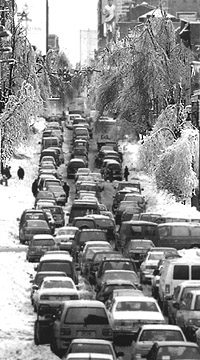
-
Article
If Day
If Day was a mock occupation of Winnipeg, Manitoba, on 19 February 1942 during the Second World War. The occupying Nazi force was portrayed by volunteers from the Young Men’s Section of the Winnipeg Board of Trade. If Day was intended to demonstrate what life under Nazi occupation might be like, and consequently, encourage people to buy war bonds (also called Victory Loans), which generated millions of dollars for the war effort. If Day was also a military exercise involving approximately 3,500 personnel, the largest in the city’s history to that date.
"https://d3d0lqu00lnqvz.cloudfront.net/If-Day/BondsorBondage_TweetOnly.jpg" // resources/views/front/categories/view.blade.php
https://d3d0lqu00lnqvz.cloudfront.net/If-Day/BondsorBondage_TweetOnly.jpg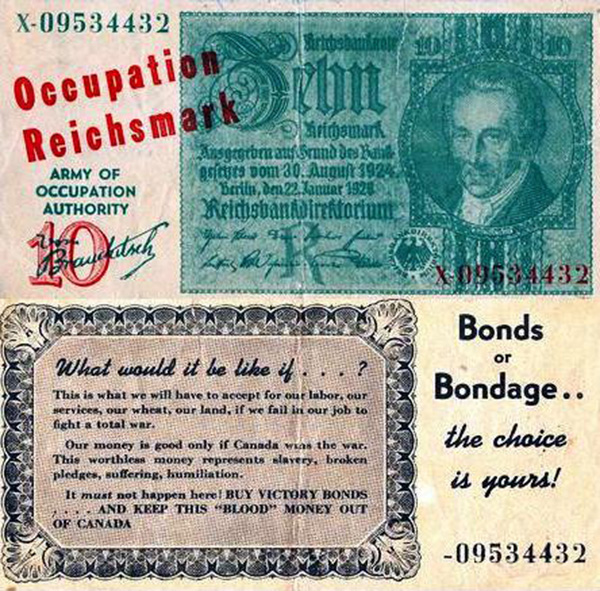
-
Editorial
Editorial: Igor Gouzenko Defects to Canada
The following article is an editorial written by The Canadian Encyclopedia staff. Editorials are not usually updated. A knock on the apartment door froze him in his steps. Another knock, louder, more insistent. The knocking turned to pounding. A voice called his name several times. Finally, the pounding stopped, and he heard footsteps going down the stairs. He knew he needed help.
"https://d3d0lqu00lnqvz.cloudfront.net/media/media/ef877228-646a-42e0-8096-b939feb24100.jpg" // resources/views/front/categories/view.blade.php
https://d3d0lqu00lnqvz.cloudfront.net/media/media/ef877228-646a-42e0-8096-b939feb24100.jpg
-
Article
Imperialism
Support for the British Empire and imperialism was strong in much of Canada in the decades after Confederation. But gradually, imperialist loyalties declined and Canadians demanded and won full autonomy within the empire.
"https://d3d0lqu00lnqvz.cloudfront.net/media/media/1558a81b-d087-438f-bb69-6c19774bd62a.jpg" // resources/views/front/categories/view.blade.php
https://d3d0lqu00lnqvz.cloudfront.net/media/media/1558a81b-d087-438f-bb69-6c19774bd62a.jpg
-
Interview
In Conversation with Rod Matheson
Social Media & Outreach Editor Zach Parrott interviews Rod Matheson for The Canadian Encyclopedia.
"https://d3d0lqu00lnqvz.cloudfront.net/media/media/53376be8-b6de-431d-bf44-315cba10770f.jpg" // resources/views/front/categories/view.blade.php
https://d3d0lqu00lnqvz.cloudfront.net/media/media/53376be8-b6de-431d-bf44-315cba10770f.jpg
-
Article
Trade Goods of the Fur Trade
During the fur trade in Canada, items of European manufacture (historically referred to in the literature as Indian trade goods) were traded with Indigenous peoples for furs. These items include, for example, metal objects, weapons and glass beads. (See also Trade Silver.) In various ways, however, cultural exchanges went both ways. Some Europeans, namely the voyageurs, adopted various Indigenous technologies and clothing during the fur trade, including the use of moccasins, buckskin pants and hats, and snowshoes.
"https://d3d0lqu00lnqvz.cloudfront.net/media/media/e4ec1e55-01c2-4b77-a220-f05a84fd4c9c.jpg" // resources/views/front/categories/view.blade.php
https://d3d0lqu00lnqvz.cloudfront.net/media/media/e4ec1e55-01c2-4b77-a220-f05a84fd4c9c.jpg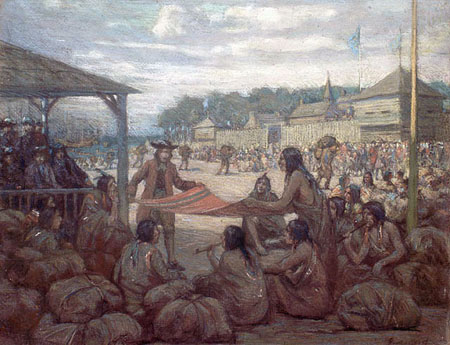
-
Article
Trade Silver
Gifts of silver were presented and traded to Indigenous peoples in Canada by European fur traders. Trade silver was made by silversmiths in Quebec City, Montreal, London and various American cities, including New York, Philadelphia and Detroit. (See also Fur Trade in Canada and Trade Goods of the Fur Trade.)
"https://d3d0lqu00lnqvz.cloudfront.net/TradeSilverHBC.jpg" // resources/views/front/categories/view.blade.php
https://d3d0lqu00lnqvz.cloudfront.net/TradeSilverHBC.jpg
-
Article
Indigenous Veterans Day
Indigenous Veterans Day is observed in Canada on 8 November. The day recognizes the contributions of First Nations, Inuit and Métis veterans of the Canadian armed forces.
"https://d3d0lqu00lnqvz.cloudfront.net/National-Aboriginal_Veterans-Monument.jpg" // resources/views/front/categories/view.blade.php
https://d3d0lqu00lnqvz.cloudfront.net/National-Aboriginal_Veterans-Monument.jpg
-
Article
Industrialization in Canada
Industrialization is a process of economic and social change. It is one that shifts the centres of economic activity onto the focus of work, wages and incomes. These changes took two forms in Canada, beginning in the 19th century. First, economic and social activities were transformed from agriculture and natural resource extraction to manufacturing and services. Second, economic and social activities shifted from rural cottage industries to urban industrial pursuits. Industrialized production took place under the privately owned factory system, in which a larger proportion of the population expected to be wage earners for all of their working lives. Therefore, industrialization brought major changes, not only in work and the economy, but in the way society was organized and in the relations among different groups in society. Although it has evolved over nearly two centuries, the process of industrialization is considered revolutionary — as the term Industrial Revolution suggests — because it marked the shift from feudalism to capitalism, and from agriculture to manufacturing and services — changes that fundamentally altered human existence. This is the full-length entry about Industrialization in Canada. For a plain-language summary, please see Industrialization in Canada (Plain-Language Summary).
"https://d3d0lqu00lnqvz.cloudfront.net/media/media/e82643fb-76c4-461d-ba67-acf2e559c83a.jpg" // resources/views/front/categories/view.blade.php
https://d3d0lqu00lnqvz.cloudfront.net/media/media/e82643fb-76c4-461d-ba67-acf2e559c83a.jpg
-
Article
Intellectual History
Intellectual History is a record of the thought of groups and individuals who may or may not be academics or "intellectuals.
"https://d3d0lqu00lnqvz.cloudfront.net/media/media/6e559a82-fa39-4e67-8505-cd188e83d9d0.jpg" // resources/views/front/categories/view.blade.php
https://d3d0lqu00lnqvz.cloudfront.net/media/media/6e559a82-fa39-4e67-8505-cd188e83d9d0.jpg
-
Article
Internment in Canada
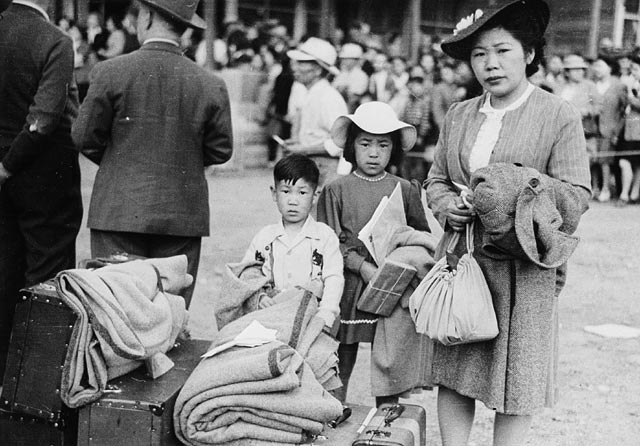
Internment is the forcible confinement or detention of a person during wartime. Large-scale internment operations were carried out by the Canadian government during the First World War and the Second World War. In both cases, the War Measures Act was invoked. This gave the government the authority to deny people’s civil liberties, notably habeas corpus (the right to a fair trial before detention). People were held in camps across the country. More than 8,500 people were interned during the First World War and as many as 24,000 during the Second World War — including some 21,000–22,000 Japanese Canadians.
"https://d3d0lqu00lnqvz.cloudfront.net/media/media/2913948d-0dc6-4142-807e-5206fce81700.jpg" // resources/views/front/categories/view.blade.php
https://d3d0lqu00lnqvz.cloudfront.net/media/media/2913948d-0dc6-4142-807e-5206fce81700.jpg
-
Article
Internment of Japanese Canadians
The forcible expulsion and confinement of Japanese Canadians during the Second World War is one of the most tragic sets of events in Canada’s history. Some 21,000–22,000 Japanese Canadians were taken from their homes on Canada’s West Coast, without any charge or due process. Beginning 24 February 1942, they were exiled to remote areas of British Columbia and elsewhere. The federal government stripped them of their property and pressured many of them to accept mass deportation after the war. Those who remained were not allowed to return to the West Coast until 1 April 1949. In 1988, the federal government officially apologized for its treatment of Japanese Canadians. A redress payment of $21,000 was made to each survivor, and more than $12 million was allocated to a community fund and human rights projects. This article is the full-length text on Japanese Internment in Canada. For a plain-language summary, see Internment of Japanese Canadians (Plain-Language Summary).
"https://d3d0lqu00lnqvz.cloudfront.net/media/media/0bec6156-0467-4a97-909f-da599383381d.jpg" // resources/views/front/categories/view.blade.php
https://d3d0lqu00lnqvz.cloudfront.net/media/media/0bec6156-0467-4a97-909f-da599383381d.jpg