Browse "Communities & Sociology"
-
Article
Henry John Cody
Henry John Cody, clergyman, educator (b at Embro, Ont 6 Dec 1868; d at Toronto 27 Apr 1951). Educated at U of T, he was ordained a Church of England priest in 1894. He served at St Paul's Church, Toronto, for 40 years, the last 25 as rector.
"https://thecanadianencyclopedia.ca/images/tce_placeholder.jpg?v=e9dca980c9bdb3aa11e832e7ea94f5d9" // resources/views/front/categories/view.blade.php
https://thecanadianencyclopedia.ca/images/tce_placeholder.jpg?v=e9dca980c9bdb3aa11e832e7ea94f5d9
-
Article
Henry Morgentaler
Henekh (Henry) Morgentaler, CM, abortion advocate, physician (born 19 March 1923 in Lodz, Poland; died 29 May 2013 in Toronto, ON. Morgentaler spent much of his life advocating for women’s reproductive rights at a time when they could not legally obtain abortions. He established illegal abortion clinics across Canada, challenging the federal and provincial governments to repeal their abortion laws. As a result of his campaign (and the work of organizations such as the Canadian Abortion Rights Action League (CARAL)), the Supreme Court struck down federal abortion law as unconstitutional in 1988, thereby decriminalizing the procedure. Morgentaler was also the first to use the vacuum aspiration method in Canada, a safer procedure for women than previous methods.
"https://d3d0lqu00lnqvz.cloudfront.net/media/media/ffed93ed-6e85-442c-8316-619f423fa8cd.jpg" // resources/views/front/categories/view.blade.php
https://d3d0lqu00lnqvz.cloudfront.net/media/media/ffed93ed-6e85-442c-8316-619f423fa8cd.jpg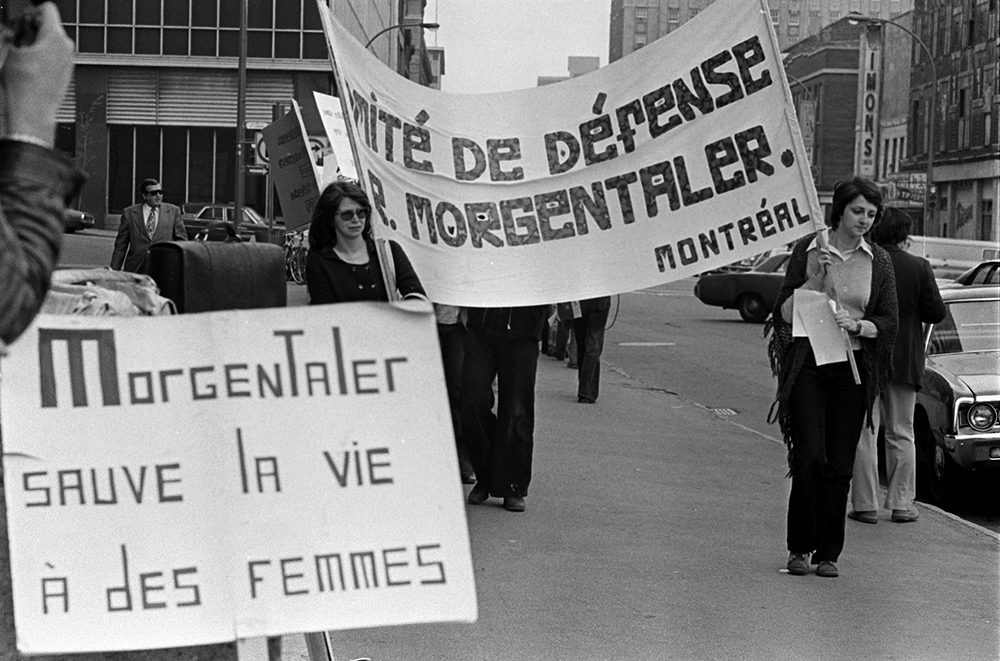
-
Article
Henry Scadding
Henry Scadding, clergyman, scholar (b at Dunkeswell, Eng 29 July 1813; d at Toronto 6 May 1901). Educated at Upper Canada College and St John's College, Cambridge, Scadding became a Church of England clergyman in 1838.
"https://thecanadianencyclopedia.ca/images/tce_placeholder.jpg?v=e9dca980c9bdb3aa11e832e7ea94f5d9" // resources/views/front/categories/view.blade.php
https://thecanadianencyclopedia.ca/images/tce_placeholder.jpg?v=e9dca980c9bdb3aa11e832e7ea94f5d9
-
Collection
Heritage Minutes
The Heritage Minutes collection is a bilingual series of history-focused public service announcements. Each 60-second short film depicts a significant person, event or story in Canadian history. They are produced by Historica Canada, the not-for-profit organization that also publishes this encyclopedia. First released in 1991, the Heritage Minutes have been shown on television, in cinemas and online. They have become a recognizable part of Canadian culture. The collection currently includes 100 episodes.
"https://d3d0lqu00lnqvz.cloudfront.net/media/media/1bfa3d45-2952-4f79-b7d4-4c6cb6601164.jpg" // resources/views/front/categories/view.blade.php
https://d3d0lqu00lnqvz.cloudfront.net/media/media/1bfa3d45-2952-4f79-b7d4-4c6cb6601164.jpg
-
Article
Hilda Ramacière
Hilda Ramacière (née Hildegard Weiland), community worker and volunteer (born 7 November 1927 in Zizenhausen, Germany; died 6 January 2010 in Montreal, Quebec). Mrs. Ramacière left her mark through her social commitment in the Plateau Mont-Royal neighbourhood. A strong-minded and determined woman, she exemplified the pride of Montreal's immigrant community.
"https://d3d0lqu00lnqvz.cloudfront.net/media/Twitter_Cards/Hilda Rananciere.jpg" // resources/views/front/categories/view.blade.php
https://d3d0lqu00lnqvz.cloudfront.net/media/Twitter_Cards/Hilda Rananciere.jpg
-
Article
Hippies in Canada
“Hippies” is a term used to describe young people who participated in the 1960s counterculture movement, which originated in the United States and spread throughout Canada in the second half of that decade. As a noun, “hippie” was a play on the adjective “hip,” which was used to describe young bohemians who lived in Greenwich Village in New York City, and in San Francisco, in the 1950s and early 1960s. Hippies were part of the “baby boom” generation, born immediately following the end of the Second World War (see Baby Boomers in Canada). This demographic wave was significant enough to transform Canadian society; by the mid-1960s more than half of Canada’s population of 20 million was under the age of 25.
"https://d3d0lqu00lnqvz.cloudfront.net/media/new_article_images/HippiesinCanada/VW_Van_Hippies_British_Columbia.jpg" // resources/views/front/categories/view.blade.php
https://d3d0lqu00lnqvz.cloudfront.net/media/new_article_images/HippiesinCanada/VW_Van_Hippies_British_Columbia.jpg
-
Article
History of Acadia
Acadia’s history as a French-speaking colony stretches as far back as the early 17th century. The French settlers who colonized the land and coexisted alongside Indigenous peoples became called Acadians. Acadia was also the target of numerous wars between the French and the English. Ultimately, the colony fell under British rule. Many Acadians were subsequently deported away from Acadia. Over time, as a British colony and then as part of Canada, Acadians increasingly became a linguistic minority. Nonetheless, Acadians have strived to protect their language and identity throughout time.
"https://d3d0lqu00lnqvz.cloudfront.net/media/media/66c056b0-bee3-47a2-9680-5d5a50b5e7eb.jpg" // resources/views/front/categories/view.blade.php
https://d3d0lqu00lnqvz.cloudfront.net/media/media/66c056b0-bee3-47a2-9680-5d5a50b5e7eb.jpg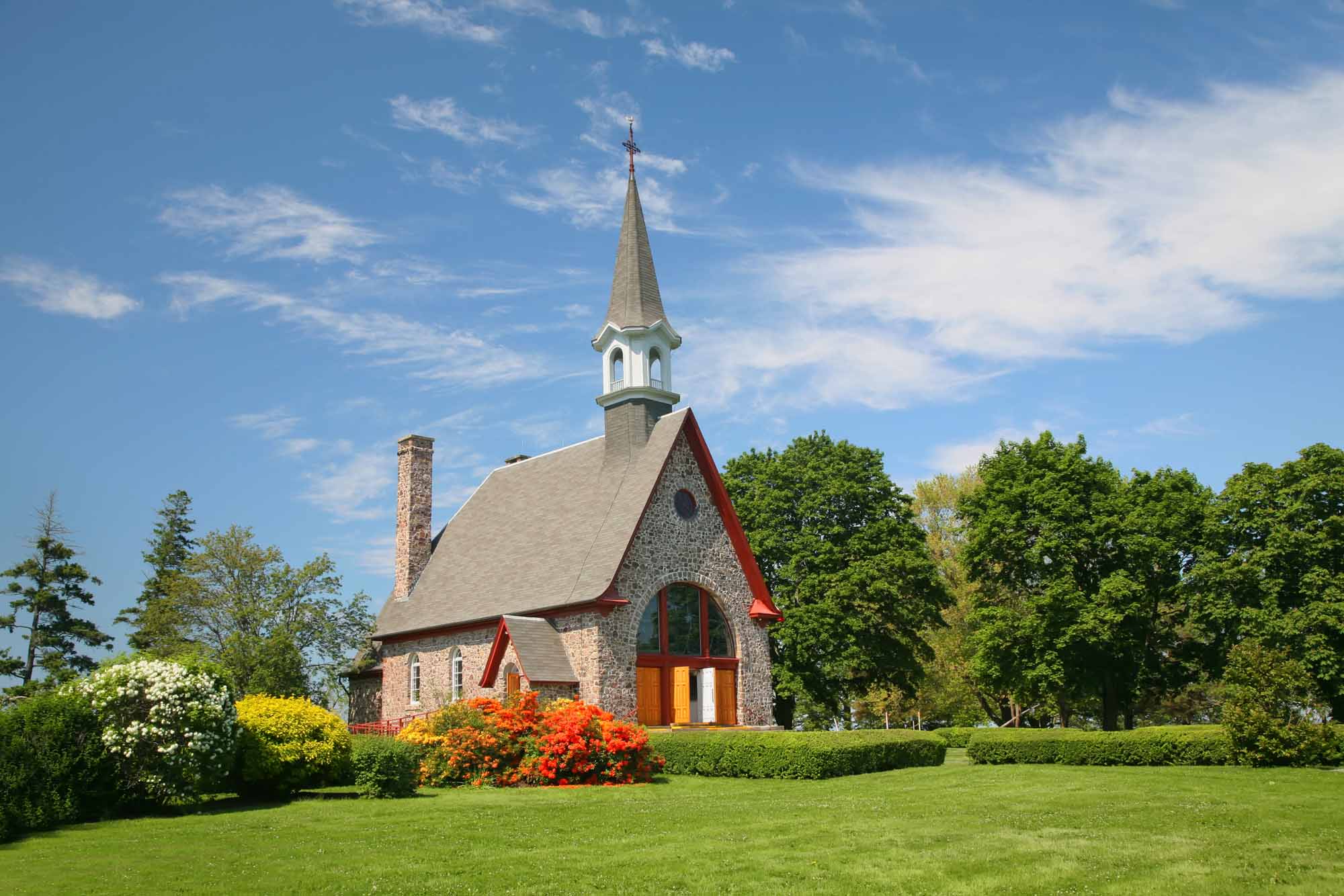
-
Article
Canada and the Holocaust
The Holocaust is defined as the systematic persecution and murder of 6 million Jews and 5 million non-Jews, including Roma and Sinti, Poles, political opponents, LGBTQ people and Soviet prisoners of war (POWs), by Nazi Germany from 1933 to 1945. Jews were the only group targeted for complete destruction. Nazi racial ideology considered them subhuman. Though Jewish Canadians did not experience the Holocaust directly, the majority endured anti-Semitism in Canada. Jewish Canadians were only one generation removed from lands under German occupation from 1933 to 1945. They maintained close ties to Jewish relatives in those lands. These ties affected the community’s response to the Holocaust. There was, for instance, a disproportionate representation of Jews in the Canadian armed forces. Jewish Canadians were also heavily involved in postwar relief efforts for displaced persons and Holocaust survivors in Europe.
"https://d3d0lqu00lnqvz.cloudfront.net/media/media/57bd8748-3caa-48d0-8d34-2eb38b8b0f92.jpg" // resources/views/front/categories/view.blade.php
https://d3d0lqu00lnqvz.cloudfront.net/media/media/57bd8748-3caa-48d0-8d34-2eb38b8b0f92.jpg
-
Article
Homosexuality
Homosexuality can be characterized as sexual attraction or "sexual orientation" towards others of one's own sex. Homosexuals may be male ("gay") or female ("lesbian"). Like heterosexual behaviour, homosexual behaviour ranges from anonymous sex, promiscuity and prostitution to romantic affairs and lifelong faithful relationships.
"https://d3d0lqu00lnqvz.cloudfront.net/media/media/6483ddf2-6bee-4d0b-a2b1-142ae795176c.jpg" // resources/views/front/categories/view.blade.php
https://d3d0lqu00lnqvz.cloudfront.net/media/media/6483ddf2-6bee-4d0b-a2b1-142ae795176c.jpg
-
Article
Horace Llewellyn Seymour
Horace Llewellyn Seymour, urban planner (b at Burford, Ont 1882; d at Ottawa 21 Apr 1940). One of the founders of modern Canadian URBAN AND REGIONAL PLANNING, Seymour was a leading exponent of the scientific approach to planning and of zoning as the best means of achieving efficient cities.
"https://thecanadianencyclopedia.ca/images/tce_placeholder.jpg?v=e9dca980c9bdb3aa11e832e7ea94f5d9" // resources/views/front/categories/view.blade.php
https://thecanadianencyclopedia.ca/images/tce_placeholder.jpg?v=e9dca980c9bdb3aa11e832e7ea94f5d9
-
Article
Howard Engel
Howard Engel, novelist, cartoonist (under the pen name “Foo”), story writer, poet (born 2 April 1931 in Toronto, ON; died 16 July 2019 in Toronto). Howard Engel was raised in St. Catharines, Ontario, and educated at McMaster University and the Ontario College of Education. During his career as a producer of literary and cultural programs at the CBC, Engel published a few stories and poems, but he did not begin to write seriously until he became interested in detective fiction.
"https://thecanadianencyclopedia.ca/images/tce_placeholder.jpg?v=e9dca980c9bdb3aa11e832e7ea94f5d9" // resources/views/front/categories/view.blade.php
https://thecanadianencyclopedia.ca/images/tce_placeholder.jpg?v=e9dca980c9bdb3aa11e832e7ea94f5d9
-
Article
Hugh Burnett
Hugh Burnett, civil rights activist, carpenter (born 14 July 1918 in Dresden, ON; died 29 September 1991 in London, ON). Burnett was a key figure in the fight for anti-discrimination legislation in Ontario. Through the 1940s and early 1950s, he organized tirelessly against racial discrimination in public service in his hometown of Dresden, Ontario, rising to prominence as a leader and organizer of the National Unity Association (NUA), a coalition of Black community members pushing for equal rights in Dresden and the surrounding area. He was instrumental to in bringing about legislative and legal victories for civil rights at the provincial level related to the 1954 Fair Accommodation Practices Act, an early anti-discrimination law in Ontario.
"https://d3d0lqu00lnqvz.cloudfront.net/media/media/32bb14c4-dbb3-42cc-9e51-84520bb7fe69.jpg" // resources/views/front/categories/view.blade.php
https://d3d0lqu00lnqvz.cloudfront.net/media/media/32bb14c4-dbb3-42cc-9e51-84520bb7fe69.jpg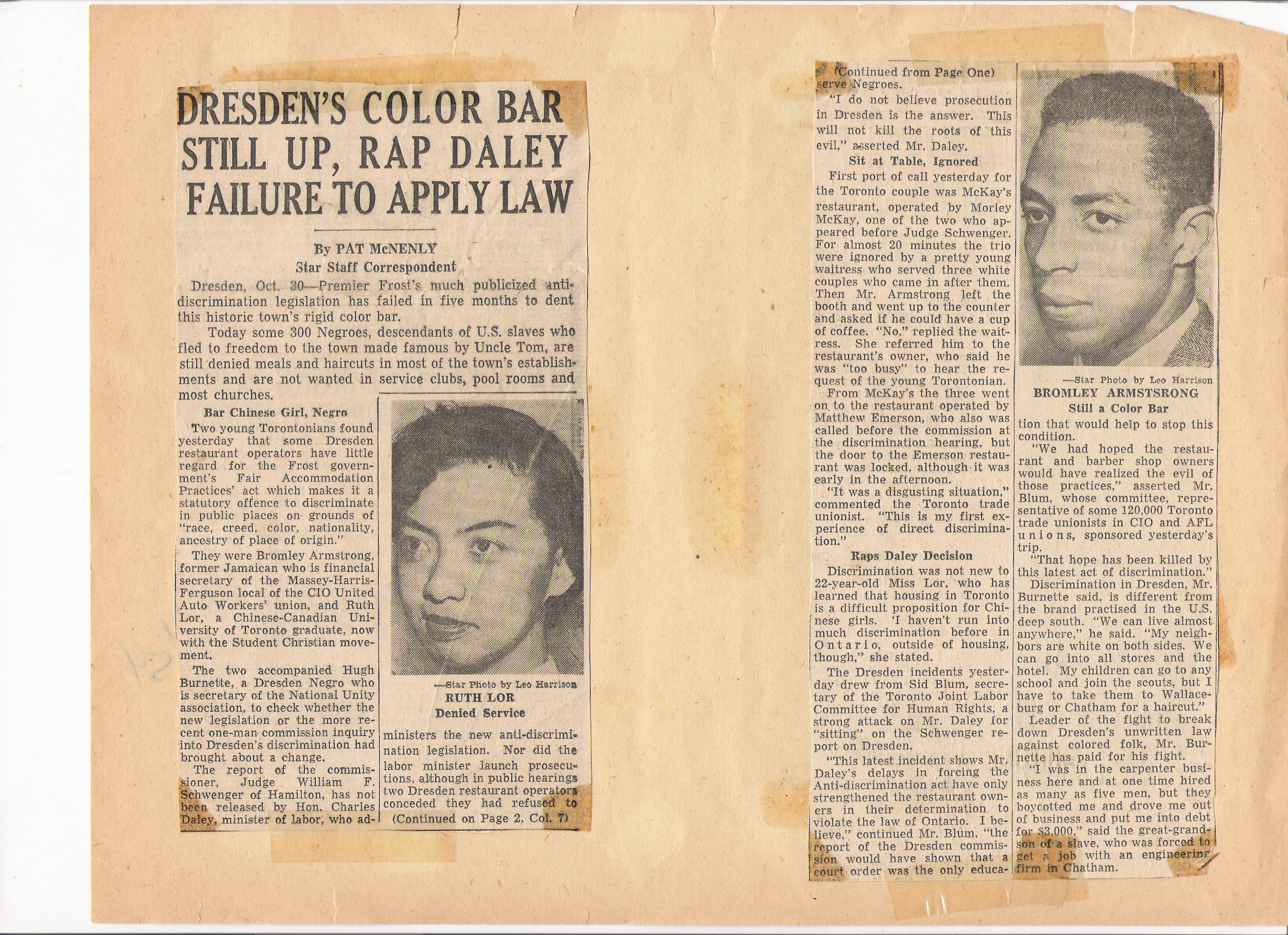
-
Article
Huguenots
Huguenots, a popular term used since 1560 to designate French Protestants, some of whom became involved in the Newfoundland fishery and Canadian fur trade, and in abortive colonization attempts in Canada (1541-42), Brazil (1555) and the Carolinas (1562-64).
"https://thecanadianencyclopedia.ca/images/tce_placeholder.jpg?v=e9dca980c9bdb3aa11e832e7ea94f5d9" // resources/views/front/categories/view.blade.php
https://thecanadianencyclopedia.ca/images/tce_placeholder.jpg?v=e9dca980c9bdb3aa11e832e7ea94f5d9
-
Article
Francophone Comedians
French-language comedy has evolved considerably following the success of burlesques and cabarets during the first half of the 20th century.
"https://d3d0lqu00lnqvz.cloudfront.net/media/media/4d00156e-4b02-4425-b9c4-4f1dd7e649a5.jpg" // resources/views/front/categories/view.blade.php
https://d3d0lqu00lnqvz.cloudfront.net/media/media/4d00156e-4b02-4425-b9c4-4f1dd7e649a5.jpg
-
Article
Hungarian Canadians
Present day Hungary is a landlocked country in central Europe. It is bordered by Slovakia, Austria, Slovenia, Croatia, Serbia, Romania and Ukraine. Hungarian immigrants to the United States began migrating to Canada in the 1880s. The 2016 census reported 348, 085 Canadians of Hungarian origin (83, 400 single and 264, 685 multiple responses).
"https://d3d0lqu00lnqvz.cloudfront.net/media/media/19010781-237b-4709-8f12-9e17e6d269a4.jpg" // resources/views/front/categories/view.blade.php
https://d3d0lqu00lnqvz.cloudfront.net/media/media/19010781-237b-4709-8f12-9e17e6d269a4.jpg