Share on Facebook
 Share on X
 Share by Email
 Share on Google Classroom
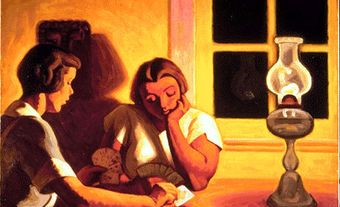
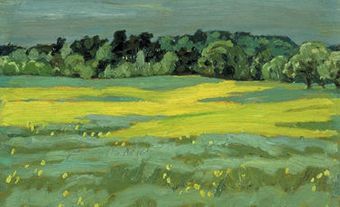
The Beaver Hall Group (also known as the Beaver Hall Hill Group) was a group of artists (both male and female) who shared studio space at 305 Beaver Hall Hill in Montreal. A.Y. Jackson was the first president. The group, which had no manifesto, began exhibiting their works together in 1920. There is some disagreement about how long the group lasted. Most scholars agree that it disbanded in 1922 due to financial problems. Edwin Holgate described the Beaver Hall Group as a loose association of artists who had similar ideas and little money. Artists associated with the Beaver Hall Group focused mainly on figurative paintings. It was also one of the first artist groups in which women played key roles.
Origins and Members
The Montreal artists most closely tied to the beginnings of the Beaver Hall Group are Randolph Hewton, Lilias Torrance Newton, Henrietta Mabel May and Edwin Holgate. Many of the artists in the Group had studied under William Brymner at the Art Association of Montreal.
In 1920, Hewton, along with Torrance Newton and Holgate, discovered some large rooms at 305 Beaver Hall Hill that they realized could be used as studios. Soon after, the three artists invited others, including Mabel Lockerby, to share the studio spaces. They did so in part to help with the rent but also to establish a place where Montreal artists could discuss their work. Unlike the Group of Seven, painters associated with the Beaver Hall Group focused mainly on figurative paintings.
Although she has often been discussed in relation to the group, Prudence Heward was not an “official” member. She did not share the studio space at 305 Beaver Hall Hill and was not included in the first major Beaver Hall Group exhibition in 1921. Nevertheless, Heward was friends with many members of the group, and she exhibited with several of them after the group was dissolved.
There are several paintings by artists associated with the Beaver Hall Group in the National Gallery of Canada. This is in part because of Eric Brown, who was director of the National Gallery from 1912 to 1939. Brown was a supporter of the younger generation of Canadian painters. Sometimes called the “young moderns,” they included members of both the Beaver Hall Group and the Group of Seven. The latter group had its first exhibition in 1920, the same year that the Beaver Hall Group was formed.
Location
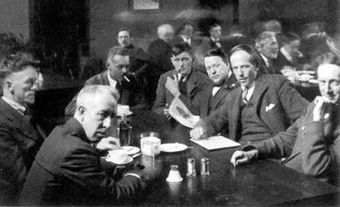
The studios rented by the Beaver Hall Group were in a house located at 305 Beaver Hall Hill, a north-south link between Phillips Square and Victoria Square in Montreal. The spot was situated in the heart of the artist community. The area included local haunts such as Krausmann’s Tavern and the Oxford Pub. These were regarded by regulars as comparable in ambience to Paris bistros.
Significant Roles for Women
The Beaver Hall Group is significant in the history of Canadian art for being one of the first artist groups in which women played key roles. In 1920, when the Group first began to paint and exhibit together, the only art organization (aside from the Art Association of Montreal) to admit women as members was the Women’s Art Society. (It was founded as the Women’s Art Club by artist and teacher Mary E. Dignam in Toronto in 1886.) Previously, women who painted were largely regarded as amateurs rather than as professional artists. Most of the female members of the Beaver Hall Group continued to exhibit both nationally and internationally after 1922.
In 1924, members of the Beaver Hall Group could no longer afford to pay for the studio space. The surviving female members — Henrietta Mabel May, Lilias Torrance Newton, Mabel Lockerby, Anne Savage, Sarah Robertson and Nora Collyer — continued to exhibit and spend time together, along with Heward, Kathleen Morris and Ethel Seath. Most of these women (the exception being Torrance Newton) remained single. At the time, women were still expected to give up their careers when they married.
The women who had been associated with the Beaver Hall Group also stayed in touch with other women artists. They exhibited at the Women’s Art Association in Toronto. Several of them became friends with the sculptor Frances Loring (1887–1968), president of the Women’s Art Association, and her partner, Florence Wyle (1881–1968). Anne Savage, Henrietta Mabel May and Sarah Robertson met Emily Carr when the British Columbia artist visited Montreal in 1927.
Exhibitions
The Beaver Hall Group’s first official exhibition took place on 17 January 1921. Nineteen artists exhibited their work: eleven men and eight women. A review appeared in the Montreal Gazette the following day. The article included the headline “Public Profession of Artistic Faith: Nineteen Painters Represented in ‘Beaver Hall Group’s’ Exhibition Are Not Secessionists.” In the piece, the journalist noted, “Individual Expression, Sincerity and Striking of National Note are Ideals – some Excellent Canvases.” The exhibition was identified as the “first annual” exhibition of the Beaver Hall Group. In fact, an earlier show had already taken place between 22 November and 4 December 1920. But the January exhibition is important because it was widely covered in the press and some of the Group’s major aims were articulated.
A.Y. Jackson was reported in the Montreal Gazette on 18 January 1921 as saying that the primary objective of the Group’s members was “to give the artist the assurance that he can paint what he feels, with utter disregard for what has hitherto been considered requisite to the acceptance of the work at the recognized art exhibitions in Canadian centres. Schools and ‘isms’ do not trouble us; individual expression is our chief concern.”
In 1966, The National Gallery of Canada organized The Beaver Hall Hill Group travelling exhibition. Norah McCullough wrote the short exhibition catalogue, focusing primarily on the female members. Kathryn Kollar wrote the catalogue essay for the exhibition Women Painters of the Beaver Hall Group. It was organized by the Sir George Williams Galleries at Montreal’s Concordia University in 1982.
There have been several feminist exhibitions that have included works by artists associated with the Beaver Hall Group. They have included From Women’s Eyes: Women Painters in Canada (Agnes Etherington Art Centre, 1975); Expressions of Will: The Art of Prudence Heward (Agnes Etherington Art Centre, 1986); and The Artist Herself: Self-Portraits by Canadian Historical Women Artists (Agnes Etherington Art Centre, 2015).
An exhibition entitled 1920s Modernism in Montreal: The Beaver Hall Group was organized by the Montreal Museum of Fine Arts in 2015. It travelled to the Art Gallery of Hamilton, the Art Gallery of Windsor and the Glenbow Museum in Calgary.