Share on Facebook
 Share on X
 Share by Email
 Share on Google Classroom
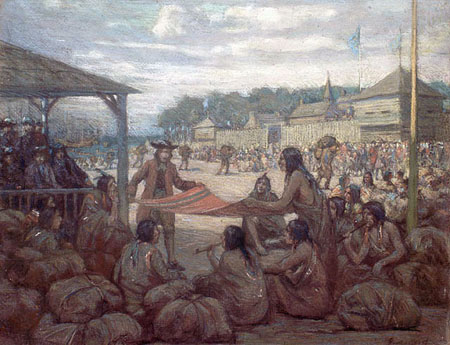
The staple thesis is a theory that asserts that the export of natural resources, or staples, from Canada has a pervasive impact on the economy as well as on social and political systems. (See also International Trade.) Furthermore, different staples (fur, fish, timber, grain, oil, etc.) have differing impacts on rates of settlement, federal-provincial conflicts, etc. (See also Fur Trade in Canada; Timber Trade History.)
Background
The staple thesis was formulated in the 1920s by economic historians Harold Innis and W. A. Mackintosh. Agreeing that Canada had been born with a staple economy, they differed insofar as W. A. Mackintosh saw a continuing evolution toward a mature industrialized economy based on staple production, whereas Harold Innis saw a tendency for Canada to become permanently locked into dependency as a resource hinterland. Contemporary proponents of the thesis argue that Innis's version more accurately describes the Canadian situation to the present. (See also Economic History of Canada.)
Significance
The staple thesis may be the most important single contribution to scholarship by Canadian social scientists and historians. (See also Social History.) The thesis has also had some influence internationally, notably in the analysis of a comparable country such as Australia.