Share on Facebook
 Share on X
 Share by Email
 Share on Google Classroom
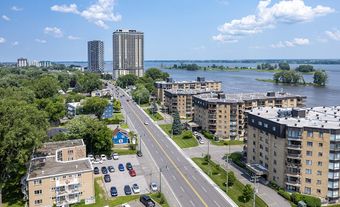
Sainte-Thérèse, Quebec, incorporated as a city in 1916, population 26,533 (2021 census), 25,989 (2016 census). Sainte-Thérèse is located 20 km north of Montreal along the Rivière aux Chiens.
Settlement and Development
In 1714, Gaspard Piot de Langloiserie and his spouse, Marie-Thérèse du Gué, received the seigneury of Mille-Iles. In 1735 colonization occurred mainly through the efforts of the widow Marie-Thérèse du Gué and continued through her descendants. In 1789, this territory was placed under the patronage of Sainte-Thérèse and became the Parish of Sainte-Thérèse de Blainville in honour of the granddaughter of the first seigneur. In 1849, a part of the territory was taken to form the village of Sainte-Thérèse.
Economy and Cultural Life
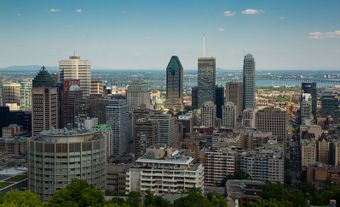
Sainte-Thérèse is a mature city containing little undeveloped territory. A suburb of Montreal, it is located at the crossroads of major routes and 16 km south of Mirabel Airport. Proximity to large economic markets has made it an attractive site for manufacturing.
Sainte-Thérèse is a centre for arts and culture. It hosts the Festival du Cinema International and the Festival des Arts de la Scène. The city also boasts the Praxis Art Gallery and the Musée Joseph-Filion (1990), a regional history museum. With its high spire, Sainte-Thérèse d'Avila Church was declared a historic monument in 1987. In 1837 it received the first organ made by Joseph Casavant at Sainte-Thérèse.