Share on Facebook
 Share on X
 Share by Email
 Share on Google Classroom
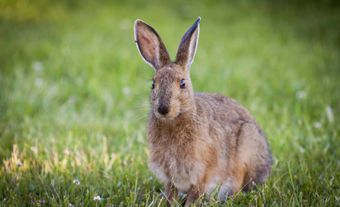
Rabbit is a common name for some mammals of the order Lagomorpha. The young (leverets), born in fur-lined nests, are naked, blind and helpless in contrast to the hairy, well-developed leverets of hares. Gestation lasts 26–30 days, with 2–7 leverets per litter and usually 3–4 litters per year. Leverets are nursed for 16–22 days and leave the nest after about two weeks. Family units are often formed, lasting up to seven weeks. Females frequently mate within three days after the birth of a litter, while still nursing. Female rabbits are usually larger than males.

Distribution and Habitat
In Canada, both native rabbits belong to the genus Sylvilagus. The eastern cottontail (S. floridanus), found in southern Ontario, Quebec and Manitoba (introduced to BC), is small (average weight 1.2 kg) and active at dawn, dusk and night. Nuttall's cottontail (S. nuttalli) is found in parts of BC, Alberta and Saskatchewan. This smaller, paler version of the eastern cottontail inhabits arid sagebrush areas.
Biological Importance
Both native species of rabbits form important links in the food chain, and the eastern cottontail is often hunted for food and sport by humans. The common or European rabbit (Oryctolagus cuniculus), the ancestor of our domestic rabbit, has proved valuable in many ways, e.g., for food, for laboratory research and as pets. Some local, wild populations exist in various parts of the country, but these are largely released domesticated rabbits rather than descendants of European rabbits.