Share on Facebook
 Share on X
 Share by Email
 Share on Google Classroom
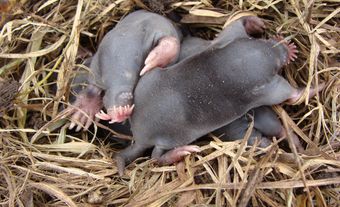
Mountain beavers (Aplodontia rufa) are living members of the order Rodentia. Unlike true beavers, the mountain beaver has no close living relative. It resembles a tailless muskrat and has a thick-set, heavy body, small ears and eyes, forefeet equipped with long, strong, curved claws for digging, and dense, short, grizzled brown fur. Adult males average 850 g in weight, females 775 g. Mountain beavers breed once annually (February-March), have a gestation period of 28–30 days and bear 2–3 young.

Distribution and Habitat
Mountain beavers inhabit moist coniferous forests of the Cascade Mountains from southwestern BC to central California. The mountain beaver digs a burrow system in damp, porous soil near streams. Burrow tunnels are 10–25 cm in diameter and 25–150 cm underground. Although several burrow systems may be adjacent, giving the appearance of a colony, the animals are by nature solitary.
Diet
Mountain beavers do not hibernate and, in winter, eat conifer needles, leaves, tender twigs and bark, often climbing 2.5 m up shrubs and trees to clip leaders and branches. In summer, they prefer sword ferns, bracken, leaves and various herbaceous plants. They can cause extensive damage to young conifers and shrubs, and also eat vegetable crops in gardens.