Share on Facebook
 Share on X
 Share by Email
 Share on Google Classroom
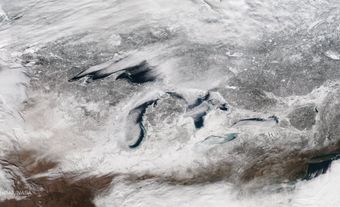
Lakes are bodies of water surrounded by land. Canada has about 2 million lakes, which is 14 per cent of the world’s lakes. Some of the best-known lakes in Canada are the Great Lakes: Lake Superior, Lake Ontario, Lake Huron and Lake Erie. Lake Superior, with a surface area of 82,100 km2, is also the largest lake in Canada.
This article is a plain-language summary of lakes in Canada. If you are interested in reading about this topic more in depth, please see our full-length entry, Lakes in Canada.

Description
The water cycle is an important environmental process. During the water cycle, water evaporates from lakes and oceans and then sometimes rains down on land. This water then ends up in streams and rivers. If there is some kind of basin in the land, a lake may form.
Lakes are dynamic, with water constantly flowing in and out of the lake. Over very long time periods, lakes can change or even disappear.

Lake Formation
Lakes can form in many different ways, such as through glacial, tectonic, coastal, river, volcanic and dissolution processes.
Glacial
Glaciers, including ice sheets, are giant chunks of ice. During long-ago ice ages, these chunks of ice created basins in the ground and left piles of rocks (e.g., moraines, eskers, drumlins) behind. These basins then filled with water, making lakes and ponds.

Tectonic
Movements of the Earth’s crust can create basins that later fill with water to make a new lake. Glacial and tectonic processes together formed Lake Superior.
Coastal
Waves and currents can move sand, rocks and soil around. Sandbars can form as a result, blocking the entrances of bays and creating lagoons. This can create new lakes if freshwater drains into the lagoon. Many small lakes like this can be found along the Atlantic coast of Nova Scotia.
River
Parts of rivers can be separated from the main flow of water, forming a lake, like an oxbow lake or a slough. If sediment builds up at the mouths of rivers, lakes can also form as the area floods with water.

Volcanic
Centres of volcanic cones may collapse into craters, forming crater lakes, which are often very deep. Lava flows may dam rivers to form lakes.
Dissolution
Some rocks can dissolve over long periods of time when exposed to water. If this happens underground, caverns and caves can form. If these caverns collapse, the hole often fills with water, creating a new lake.
Did you know?
One of the most unique lakes in Canada is the Manicouagan Reservoir. This lake was formed when water filled the crater left behind by a meteorite impact in central Quebec 200 million years ago.

Distribution of Lakes in Canada
There are up to 2 million lakes in Canada. About 7.6 per cent of Canada's nearly 10 million km² is covered by freshwater. These lakes and rivers contain enough water to flood the entire country to a depth of over 2 m. Canada has nearly 14 per cent of the world's lakes with surface areas over 500 km2.
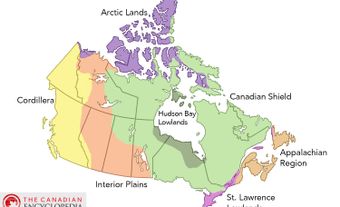
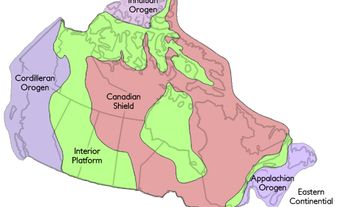
Lakes are different across Canada, as they change depending on local geology and climate (see Physiographic Regions).
Lakes in the Canadian Shield
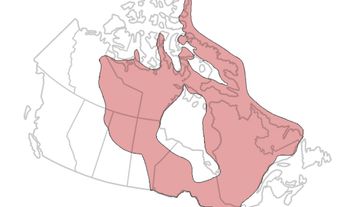
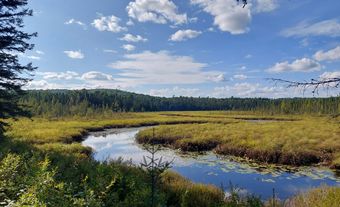
In the Canadian Shield, almost all lakes are glacial in origin. Since this area has little soil, the lakes are often very clear. This area also has lots of wetlands like muskegs and bogs, which may contain small lakes. Some ancient rivers and shorelines have also turned into lakes in this region after sediment built up, blocking water from draining away.
Lakes in the Western Interior Lowlands
The area where the Canadian Shield connects with the Western Interior Lowlands has some of the largest lakes in Canada, like Great Bear Lake in the Northwest Territories and the Great Lakes in Ontario.
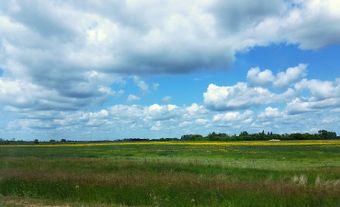
Lakes in the prairies of the Western Interior Lowlands are usually shallower and have more sediment, since the prairies have a lot of soil. These lakes are very important to lots of farming in the area and to wild animals like ducks.
The north of this region also has many wetlands like the muskegs and bogs of the Canadian Shield.
Lakes in Western Canada
There are fewer lakes in the western side of Canada than in the central or eastern side. Those that do exist are very different from one another, with some coming from ancient glacial and tectonic processes. Other lakes formed when ancient coastal fjords got separated from the sea.
Lakes in the Atlantic Provinces
The Atlantic provinces have the remnants of ancient mountains. They were also covered by glaciers during the last ice age. Because of this, the lakes in the Atlantic provinces are very similar to those in the Canadian Shield. Along the east coast of Nova Scotia, there are many coastal lakes.
Lakes in the St. Lawrence Lowlands and Lower Great Lakes Region
This area usually has less lakes than the Canadian Shield, but it has lots of soil that is good for agriculture, and it is right next to the massive Great Lakes. Together, the Great Lakes (Lakes Superior, Huron, Michigan, Erie and Ontario) create the largest body of fresh water on Earth.

Human Impacts
Humans can impact the shape of lakes and the quality of the water within.
Lake Eutrophication
Lake eutrophication happens when lakes receive too many nutrients and become shallow, warm and turbid. This sometimes happens naturally. Sometimes, however, this happens when humans let sewage or soil from farms get into the water. Cutting down trees and plants around lakes and rivers can also cause this. Lake eutrophication can be harmful for anything or anyone that uses the lake’s water. Bacteria grows in the lake, fish die out and humans can no longer safely bathe and drink the water.
Toxins and Acid Rain
Some compounds can be harmful if they end up in lakes. Some chemicals used in agriculture, mining and forestry are toxic when ingested. Acid rain, which is caused by burning fossil fuels, can make lakes more acidic. Salt from roads can make lakes saltier. All these changes can impact which plants and animals can survive in and around the lake. Some of these compounds can even make it so that lakes are no longer safe for humans to bathe in or drink from.
Biodiversity Declines and Invasive Species
Many plants and animals help keep lakes healthy. Some plants help stop the erosion of the shoreline. Snapping turtles help eat organic materials that end up in the lake, keeping it clean and clear. When animals and plants decline around a lake, the lake can change and become less healthy for humans to bathe in and drink from.

On the other hand, some plants and animals that are not from Canada can harm Canadian lakes. These are known as invasive species. Some known to harm Canadian lakes are Phragmites australis, purple loosestrife, Asian carp, zebra mussels, quagga mussels and sea lampreys (see Invasive Species in Canada: Plants, Invasive Species in Canada: Animals).

Wetland Destruction and River Alteration
Lakes receive water from the ecosystem that surrounds them, sometimes from hundreds of kilometres away through networks of rivers and wetlands. When wetlands are destroyed or rivers are altered, the lakes downstream from them can be impacted in ways that are difficult to predict.