Share on Facebook
 Share on X
 Share by Email
 Share on Google Classroom
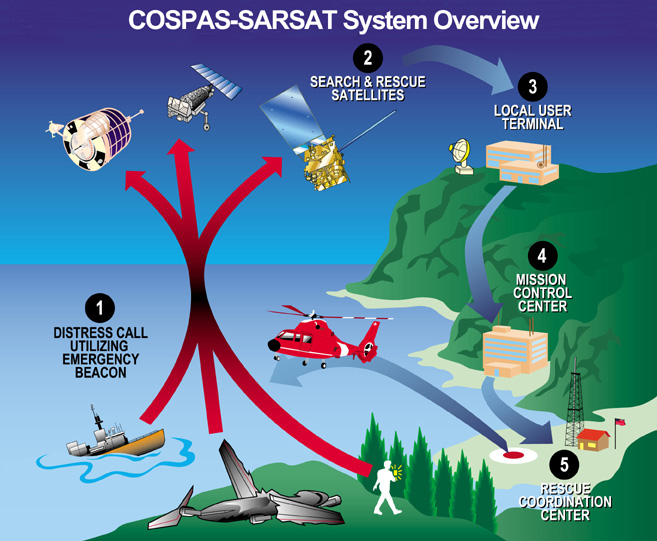
Canada is part of the International COSPAS-SARSAT Program. This system uses satellites to detect and locate distress alerts and send them to more than 200 Search and Rescue coordination centres and points of contact around the world. The program is an integral part of Canada’s Search and Rescue system.
The International COSPAS-SARSAT Program was a joint effort by Canada, France, the Soviet Union (now Russia) and the United States that began in 1979. The countries formally constituted the organization in 1988. Since then, another 39 states and two organizations have joined the program.
The system uses satellites to locate the positions of emergency beacons activated on aircraft, maritime vessels and persons in distress. Such beacons include emergency location transmitters (ELT) on aircraft, emergency position-indicating radiobeacons (EPIRB) on maritime vessels and personal locator beacons (PLB) used by individuals.
COSPAS is an acronym for the Russian words “Cosmicheskaya Sistema Poiska Avariynyh Sudov" (in English, “Space System for the Search of Vessels in Distress.”), while SARSAT is an acronym for Search and Rescue Satellite Aided Tracking.
The Soviets launched their first satellite, Kosmos-1383, on 29 June 1982. The United States launched their first SARSAT on 28 March 1983. The first rescue using one of the satellites was on 9 September 1982, when COSPAS detected the ELT signal of a Cessna that crashed in the Stikine Mountains of British Columbia. The next day the survivors were rescued by search and rescue crews from 442 Squadron.
Since September 1982, the COSPAS-SARSAT system has led to the rescue of more than 52,000 people in 16,000 search and rescue operations worldwide. On average, seven lives are saved every day.