Share on Facebook
 Share on X
 Share by Email
 Share on Google Classroom
Edward Michael Pakenham, British army officer, military figure in the War of 1812 (born 19 March 1778 in County Westmeath, Ireland; died 8 January 1815 near New Orleans, Louisiana). Pakenham was an Anglo-Irish officer in the British army, who served in Ireland, the West Indies, the Iberian Peninsula and North America. He was killed during the Battle of New Orleans.
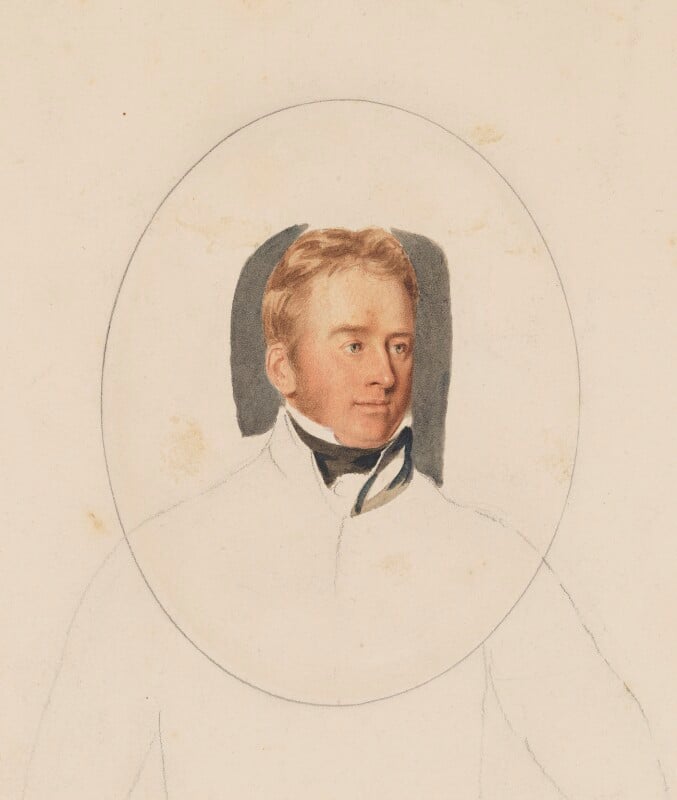
Family
Edward Pakenham was born on his family’s estate in County Westmeath, Ireland. His family was part of the Anglo-Irish aristocracy, descended from English settlers who had arrived in Ireland in the 16th century. Pakenham’s connections included Arthur Wellesley, the future Duke of Wellington, who married his sister Catherine (“Kitty”) in 1806.
Military Career
On 28 May 1794, at age 16, Edward Pakenham became a lieutenant in the 92nd Foot. A few days later he was made captain, and on 6 December he became a major in the 33rd Light Dragoons. He served in Ireland during the uprising of 1798, and in 1799 he was appointed lieutenant-colonel of the 64th Foot. Pakenham went to the West Indies in 1801 and was later wounded during the capture of St Lucia in June 1803.
In 1805, Pakenham became a lieutenant colonel and joined the 1st Battalion of the 7th Royal Fusiliers. He commanded the battalion at Copenhagen in 1807 and took it to Nova Scotia in 1808. Pakenham served with Sir George Prevost in St Lucia and Nova Scotia before taking part in the Napoleonic Wars.
Battle of New Orleans
Edward Pakenham was not interested in serving in the North American war, but in October 1814 he was selected to take command of the New Orleans expedition. The original commander, Major General Robert Ross, had died at the Battle of Baltimore in September 1814. The British goal was to gain command of the entrance to the Mississippi River and to challenge the legality of the Louisiana Purchase.
Pakenham's task was complicated by his force being scattered between England and North America. He hoped to arrive at the rendezvous at Jamaica before the troops had gone ashore, but this was not to be. Adverse winds delayed Pakenham's arrival until mid-December, two weeks after a 5,000-man brigade under Major General John Keane and the fleet under Vice Admiral Alexander Cochrane had departed for New Orleans.
Pakenham reached the army on Christmas Day, when it was only 14 km from New Orleans, and reorganized his command into several brigades. On the 28th, he sent a reconnaissance in strength to probe the American defences, which were found to be formidable. On 1 January 1815, Pakenham attempted to breach the American line with artillery, which proved ineffective. He then decided to conduct a deliberate attack.
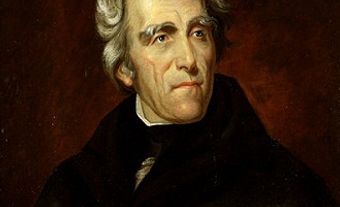
Pakenham developed a complicated plan using four brigades. A brigade under General John Lambert formed the reserve. Another, led by Pakenham's second-in-command, Major General Samuel Gibbs, was entrusted with the main assault against the centre-left of the American line. At the same time, a force of light troops was to breach the American right, while a brigade under Major General John Keane would follow to exploit the success against this attack or move against the American centre. Across the Mississippi River, Lieutenant-Colonel William Thornton was to capture an American battery that could fire onto the main British attack and then turn the guns against the American line. Pakenham fielded some 5,400 men, while the Americans, under Major General Andrew Jackson, had 4,000 men in an excellent defensive position. The 600 m of open ground the British would cross was well covered by fire.

Pakenham's Death
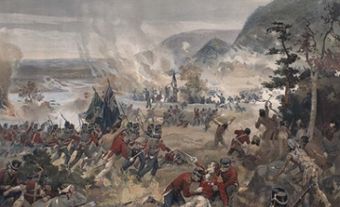
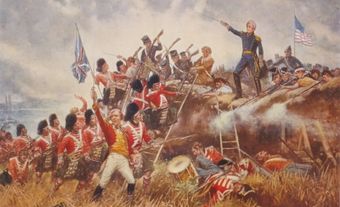
On the morning of 8 January 1815, Edward Pakenham learned that William Thornton's force had been delayed in crossing the river. A much smaller force than originally planned was eventually ferried across the river, landing well below the intended landing site, but it succeeded in taking the guns. Pakenham meanwhile continued with the attack. The American skirmishers were quickly forced back and the British then came under heavy fire from American guns.
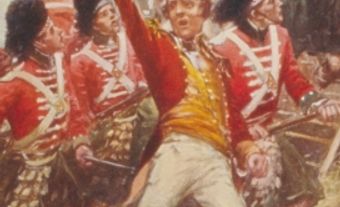
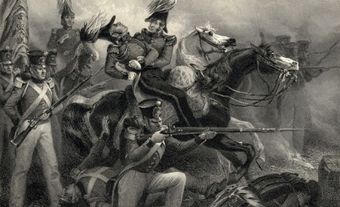
When Pakenham moved forward to encourage the troops, he fell, mortally wounded. Samuel Gibbs and John Keane were also wounded, along with many other officers. John Lambert took over and although portions of the American line had been breached, he called off the action. The British withdrew, re-embarked on the flotilla and moved into the Gulf of Mexico. The war ended in February.
Pakenham's body was returned to England and buried in the family vault in Killucan, Westmeath, Ireland.