Share on Facebook
 Share on X
 Share by Email
 Share on Google Classroom
COVID-19 is a severe acute respiratory syndrome caused by a new type of coronavirus, SARS-CoV-2, that emerged in 2019. The virus caused the first cases in China and then quickly spread around the world. Between January 2020 and March 2023, the COVID-19 pandemic caused more than 759 million confirmed cases and 6.87 million deaths globally, including over 4.6 million cases and 51,720 deaths in Canada. It is one of the deadliest pandemics in world history and among the most disruptive and transformative on many levels, especially economically and socially. In May 2023, the World Health Organization declared that COVID-19 was no longer a global emergency. The virus and syndrome continue to circulate in Canada and around the world.
Click here for definitions of key terms used in this article.
This is the full-length entry about the COVID-19 Pandemic in Canada. For a plain-language summary, please see COVID-19 Pandemic in Canada (Plain-Language Summary).

What Is COVID-19?
In December 2019, a new type of coronavirus quietly emerged in China. On 31 December 2019, the World Health Organization (WHO) was formally notified of the first cluster of cases of a severe acute respiratory syndrome in Wuhan, China, that became known as “coronavirus disease 2019,” or COVID-19. The causal virus was identified in early January 2020 as “severe acute respiratory syndrome coronavirus-2,” or SARS-CoV-2.
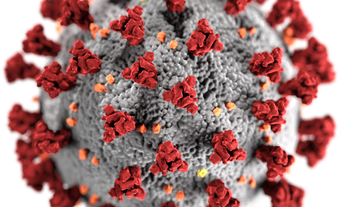
Coronaviruses are a group of viruses that cause disease, usually respiratory tract infections, in mammals and birds. In humans, the disease can vary between mild, such as the common cold, to lethal, as experienced with the first SARS epidemic in 2003, MERS (Middle East respiratory syndrome) since 2012 and COVID-19. Coronaviruses are distinguished by the fringe of large surface projections from the central virion (the main part of a virus particle) that looks like the solar corona (the outermost part of the sun’s atmosphere). Death from COVID-19 can follow anywhere from six to 41 days after the onset of symptoms, but typically happens around 14 days, with higher mortality rates generally linked to age and various underlying health conditions.
Initial Spread of COVID-19
The first human cases of COVID-19 occurred in China in December 2019, mostly among those who had visited the Huanan Seafood Wholesale Market in the city of Wuhan (with a few earlier cases not linked to the market). On 7 January 2020, Chinese authorities publicly identified the new virus, and on 12 January, they shared its genetic sequence. The WHO initially named it “2019 novel coronavirus” and later settled on SARS-CoV-2. The first known death was reported on 11 January, and by 21 January human-to-human transmission was confirmed. The US also confirmed the country’s first case of the virus on 21. On 23 January, the Chinese government took the unprecedented step of ordering a strict lockdown of the city of Wuhan.
By the end of January, the virus had spread to other provinces in China, as well as to Italy; the first two cases in Italy were tourists from China. Canada’s first confirmed case was reported on 25 January. On 30 January, the WHO declared that the novel coronavirus was a Public Health Emergency of International Concern. As there was “pandemic potential,” personal protective equipment (PPE) for health workers was strongly recommended and testing for the virus was essential.
On 11 March, the WHO formally declared that the world was in a pandemic, by which time Europe had become its active epicentre. On 19 March, Italy overtook China as the country with the most deaths (3,405 deaths in Italy), and on 26 March, the United States became the country with the highest number of confirmed cases (82,404 cases and more than 1,000 deaths). New York City was hit hard first (NYC passed 1,000 deaths on March 31), with most of the initial cases traced to travellers from Europe.
How Does COVID-19 Spread?
The initial model for understanding SARS-CoV-2 was based on how the first SARS epidemic spread in 2003, particularly in Canada and especially in Toronto. With SARS, the virus was most infectious when those infected were severely ill, which was about two weeks after exposure. Indeed, in early January 2020, Canada’s Chief Public Health Officer, Dr. Theresa Tam, saw the new respiratory virus outbreak as another possible SARS. Tam, however, was initially less concerned when she thought it was not affecting health-care workers, as SARS had. However, it soon became clear that COVID-19 was transmissible early in the infection and often before distinctive symptoms appeared.
The virus can be transmitted through infected respiratory droplets and aerosols via coughing, talking, or singing. This became clear early in February 2020, particularly when several cruise ships were quarantined for extended periods after COVID-19 outbreaks spread quickly among passengers and crews. The Diamond Princess cruise ship was quarantined for nearly a month beginning on 4 February, during which there were more than 700 cases and 14 deaths. This and similar outbreaks highlighted the severity of the virus, especially in crowded, semi-enclosed areas.

Early in the pandemic, there were concerns that the virus could be transmitted indirectly via infected droplets on various surfaces. But it soon became evident that the virus did not survive long enough on surfaces to be infectious. The primary means of preventing transmission soon focused on physical or social distancing and the use of masks or face coverings designed to reduce the transmission of droplets and small airborne particles from a potentially infected person to another.
Global COVID-19 Pandemic
On 11 March 2020, the WHO officially declared a global pandemic. This followed a series of alarming developments, including the imposition of a full national lockdown in Italy on 9 March. On 11 March, the National Basketball Association suspended its season after one COVID-19 case was confirmed, followed by the suspension of other professional sports leagues and the shutdown of Broadway in New York City on 12 March. The US declared a national emergency on 13 March, followed shortly by states of emergency in all Canadian provinces. This prompted varying degrees of school and day care closures, prohibitions on gatherings, closures of non-essential businesses, Canada–U.S. border restrictions and mandatory self-isolation for travellers. Europe remained the global epicentre of the pandemic from 13 March until it was overtaken by South America on 22 May.
By 28 April, more than half of the planet’s population, about 4.2 billion people, were under some form of lockdown, which was an unprecedented shared global experience. The scope, strictness and length of public health measures and the timing of lockdowns shaped the course and severity of the pandemic. Political leadership remained a critical factor in the pandemic’s impact, especially before the introduction of COVID-19 vaccines. The most notable examples were U.S. president Donald Trump and Brazil president Jair Bolsonaro, each of whom actively downplayed the severity of the pandemic and questioned the necessity of strict public health measures to control it. This fuelled an increasingly divisive politicization of the pandemic in many countries.
Where Did COVID-19 Originate?
There are two competing theories about the origins of the virus: the “lab-leak” hypothesis and the natural origin or zoonotic hypothesis. According to the lab-leak theory, the virus could have been genetically engineered and somehow leaked from the Wuhan Institute of Virology (WIV), Chinese Academy of Sciences. Based on previous experience with SARS and extensive studies of coronaviruses among animals in China and elsewhere, there were ongoing studies of coronaviruses in the WIV labs. Proponents of the lab-leak theory believe that Chinese scientists may have become infected while performing research-associated activities.
The zoonotic theory posits that the virus mutated during transmission among animals into a strain that can infect humans and cause disease and then, most significantly, be transmitted between humans. This is how other viral diseases, such as influenza, HIV, Ebola, and SARS, have naturally evolved and spread from animals to humans and then between humans. Proponents of this theory point to epidemiological data that shows early cases clustered around the live-animal market in Wuhan in December 2019.
The debate about origins has been politically charged and divisive. Early in the pandemic, the zoonotic theory was portrayed as the scientific consensus while the lab leak hypothesis was dismissed as a conspiracy theory. Public opinion has changed since 2023, however, with a shift towards the lab-leak theory in some countries, including the United States.
In February 2023, for example, FBI Director Christopher Wray announced that the virus had likely originated in a lab. In December 2024, a committee of the American House of Representatives came to the same conclusion (although Democratic members disagreed with the committee’s report). In January 2025, the CIA stated that the lab leak theory was more likely than the zoonotic hypothesis, although it had “low confidence” in this assessment.
Other organizations maintain that the zoonotic theory is the scientific consensus. In June 2025, the WHO Scientific Advisory Group for the Origins of Novel Pathogens (SAGO) published a report stating the virus was likely zoonotic in origin. SAGO’s report also noted, however, that it had not been provided with the information necessary to fully evaluate all hypotheses.
Despite WHO requests, China has not provided genetic sequences from individuals infected with COVID-19 early in the pandemic, nor has it made available detailed information about animals sold in markets in Wuhan, or biosafety conditions at labs in Wuhan. Many researchers believe that the issue cannot be settled given the available evidence.
COVID-19 in Canada
The COVID-19 pandemic hit home for Canadians, at least symbolically, on 12 March 2020, when Sophie Grégoire Trudeau, wife of Prime Minister Justin Trudeau, tested positive for the virus. This forced the first family into quarantine and the prime minister to manage the escalating crisis from his home. By 15 March, there had been 317 cases, including one death, from COVID-19 in Canada; by 23 April, 42,110 cases and 2,147 deaths had been reported, the majority occurring among residents of long-term care facilities.
Pandemic Waves
By July 2022, there had been seven waves of the pandemic in Canada. The first wave peaked on 30 May 2020, and then incidence declined until late summer. The second wave began to build in mid-July 2020, and by September 23, restrictions and regional lockdowns had again been implemented, along with increased economic aid programs. The second wave peaked in mid-January 2021, then eased. In mid-March, a third wave emerged and peaked in mid-April, prompting the reimposition of public health restrictions that had been relaxed, most notably in Alberta.
A fourth wave began in the summer of 2021, leading to some renewed restrictions; the situation was described as a “pandemic of the unvaccinated.” The fourth wave peaked on 26 September. Not long after cases had eased, a fifth wave began to quickly emerge in early November, driven by the introduction of a much more infectious, though milder, variant known as “Omicron.” The variant’s infectiousness quickly overwhelmed laboratory testing capacities. By March 2022, the fifth wave seemed to have peaked, but by April 2022, a sixth wave was announced by Canadian public health officials. In early July 2022 Quebec and Ontario announced a seventh wave. Health experts warned that reported cases of COVID-19 had been underestimated due to limited lab-based polymerase chain reaction (PCR) testing and inconsistent reporting.
Variants
During the second wave, the pandemic was complicated by the emergence and rapid spread of a “variant of concern” known as “Alpha.” It first appeared in the United Kingdom in September 2020 and began to spread in Canada in December, where it caused more than 268,000 cases. A second “variant of concern,” later called “Beta,” first became apparent in South Africa in May 2020 and began spreading in Canada in early January 2021, leading to more than 2,400 cases. Another variant, known as “Gamma,” emerged in Brazil in November 2020 and began causing cases in Canada in February, leading to nearly 21,000 cases. More significantly, the “Delta” variant was first discovered in India in October 2020. It began to spread rapidly in Canada in April 2021, quickly displacing the previous variants and causing nearly 211,000 cases. The more infectious Omicron variant quickly displaced the Delta variant. As of September 2022, Omicron and its sub-lineages were the primary variants circulating in Canada.

Public Health and Government Response
Throughout the pandemic, federal, provincial and local governments imposed a series of public health restrictions and lockdowns and a variety of vaccine mandates to contain or slow the spread of the virus and reduce often overwhelming pressure on hospitals and the health-care system.
The federal and provincial governments also provided a variety of financial lifelines to businesses and individuals, including income support and sickness benefits, wage subsidies, grants, and loans. The most notable was the Canada Emergency Response Benefit (CERB), which was introduced in early April 2020. This federal program provided $2,000 for four-week periods (to a maximum of 16 weeks) to those who stopped working and had no employment income because of COVID, e.g., those who had lost their job, were sick, quarantined, or took care of someone with COVID-19.
However, as the pandemic continued, such supports did not prevent the broad social and economic fallout of the on-and-off series of lockdowns. While the healthcare and long-term care sectors struggled to find enough workers, job losses were high in the cultural, tourism and hospitality sectors. Lockdowns and social isolation also contributed to higher levels of mental illness and increased opioid use among Canadians.
COVID-19 Vaccines
It normally takes an average of 10 to 15 years for a vaccine to move from the initial concept to testing and approval to, finally, administration. However, because of the urgency of the pandemic, a process of parallel steps was developed. The public release of the SARS-CoV-2 genetic sequence on 12 January 2020 sparked an unprecedented level of government funding and collaboration with pharmaceutical firms, university research labs and international health organizations to develop a vaccine.
The first vaccine to be approved was the mRNA vaccine produced by Pfizer-BioNTech. It was approved for emergency use in the United Kingdom on 2 December 2020, in Canada on 9 December and in the US on 10 December. (See also Covid-19 Vaccines.) In Canada, the first vaccinations were administered on 14 December to residents of long-term care homes and front-line workers. Canada approved a second mRNA vaccine, produced by Moderna, on 23 December. A third, viral vector vaccine, produced by Oxford-AstraZeneca, was approved in Canada on 26 February 2021, while a fourth, vaccine, Johnson & Johnson’s single dose vaccine, was approved on 5 March 2021 A protein-based vaccine produced by Novavax Inc was authorized by Health Canada on 17 February 2022. That same month, a plant-based vaccine by Medicago Covifenz was approved in Canada.

As of 3 March 2023, 83.4 per cent of Canada’s total population had received at least one dose of vaccine, and of those five years of age and older, it was 87.1 per cent. Of the total population, 80.7 per cent were fully vaccinated, and among those five years and older, it was 84.5 per cent. A small percentage of Canada’s population, however, expressed hesitancy or opposition to vaccinations and vaccine mandates. (See also Vaccination and Vaccine Hesitancy in Canada.)
Significance
The COVID-19 pandemic touched everyone directly or indirectly. It was devastating and transformative at all levels, causing illness and deaths in families and leaving a debilitating legacy of “long COVID-19” in many cases. It placed unprecedented pressure on health-care systems and health-care workers. The pandemic also damaged or destroyed livelihoods and transformed work from the office to work from home. It also disrupted education, exacerbated social and economic inequities, and fuelled political polarization. In sum, it irrevocably changed the world as we once knew it in the “Before Times,” as the pre-pandemic world is often described.
Key Terms
Epidemic – A widespread outbreak of an infectious disease in a population at a particular time.
Pandemic – An outbreak of an infectious disease, usually caused by a new virus or bacterium, or a novel strain, that affects a large proportion of the population in multiple countries or worldwide.
Public Health – Health Services, usually preventative in approach, provided by a government to improve the health of citizens on a population level.
Quarantine – The separation of an individual, or a group of people, from a surrounding population and the restriction of their movement to prevent the introduction and spread of a disease.
Vaccine – A preparation made from killed or weakened bacteria or virus, or their specific antigens, that stimulates the body to develop immunity to that same bacteria or virus.
Virus – An organism, too small to be seen with a typical microscope, that can multiply inside the cells of its host and usually causes disease.