Share on Facebook
 Share on X
 Share by Email
 Share on Google Classroom
Common law is the body of laws that has been established by judges, rather than by legislatures or executive decrees. Common law originated in England following the Norman conquest of 1066. It was a time when few laws were codified, but the state wanted to implement a system of governance that would be seen as fair and predictable. In principle, common law courts are bound by precedent. This means that Judges generally apply the same decisions that have been applied to similar cases in the past. This is known as the doctrine of stare decisis, or “to stand by decided matters.” Common law remains dominant in most of the British Commonwealth countries, as well as the United States. However, the practice of common law across these countries varies widely. Common law is used in most of Canada. It stands in contrast to civil law — the body of laws that are written by legislators and applied directly by judges — which is used in Quebec.
Common Law in Canada
There are two major critiques of common law. The first is that common law is excessively complex and lacks transparency. This is because it consists of thousands of judicial precedents that form a large and uncodified body of rules. The second is that it is rigidly conservative. Because rulings are expected to follow precedent, common law does not naturally evolve to reflect changing social norms and values.
However, the practice of common law is less rigid than it might appear at first glance, especially in Canada. This section discusses some of the ways in which Canada departs from the traditional practice of common law.
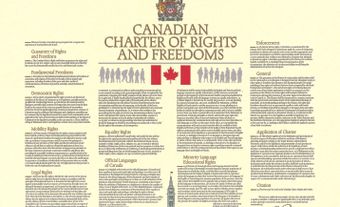
First, Canadian law has in some ways been “constitutionalized” over time. (See also Constitution of Canada.) This is especially true since the passage of the Charter of Rights and Freedoms in 1982. In particular, the strengthening of civil liberties through the Charter has meant that this area of law now resembles the civil law tradition in many ways. (Similar developments have occurred in the US.) By contrast, the judicial approach to private law — issues like property, torts and contracts — remains more firmly rooted in common law. The only exception is Quebec, where the Civil Code of Quebec governs private law.

Second, Canada is not uniformly dominated by common law. Rather, it has a “bijural” system that reflects the dual influences of British and French colonization. Civil law is dominant in Quebec — including in private law — while common law is practiced throughout the other provinces and territories.
Third, the semi-autonomous character of the provincial courts means that precedents set in one province are “persuasive” rather than binding in the other provinces.
Fourth, there are a variety of circumstances in which judges might depart from judicial precedent. If new legislation has been passed, it effectively replaces the judicial precedents. In another scenario, judges may argue that existing precedents do not apply because of the unique nature of the case before them. In this circumstance, their ruling may set a new precedent. Finally, courts have some ability to overrule precedents if they find that they were incorrectly determined. Specifically, courts may overrule decisions made by themselves or lower courts. But they cannot overrule the decisions of higher courts, aside from exceptional cases.
(See also Civil Law; Substantive and Procedural Law; Administrative Law.)