Share on Facebook
 Share on X
 Share by Email
 Share on Google Classroom
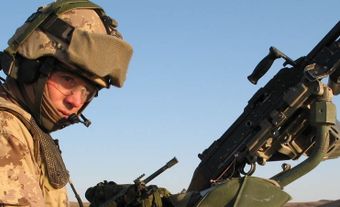
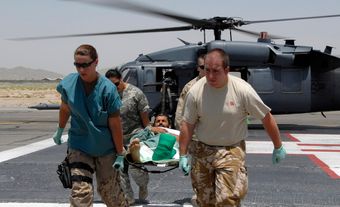
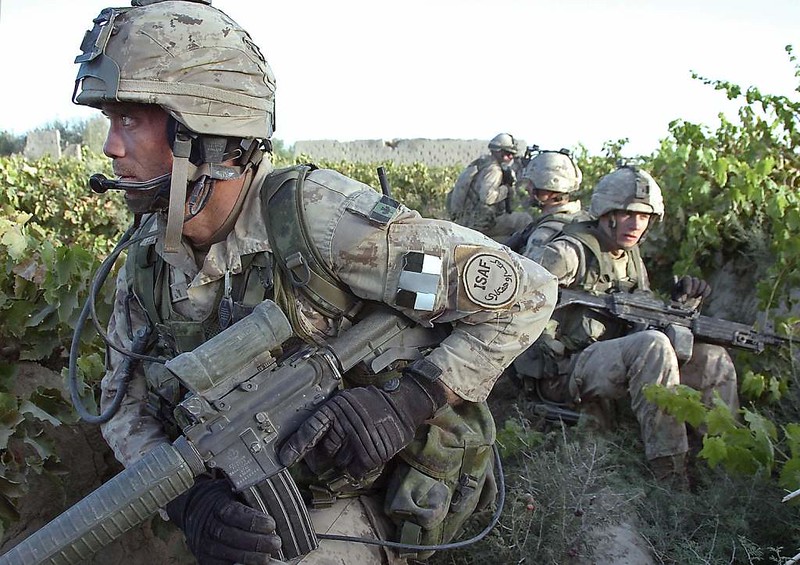
Operation Medusa (2–17 September 2006) was a Canadian-led military campaign during the war in Afghanistan. It was carried out by coalition forces against Taliban insurgents in the Panjwai district of Afghanistan’s Kandahar Province. It was the largest Canadian combat operation since the Korean War, involving 1,050 Canadian Armed Forces members and about 400 soldiers from other countries. It was also the first ever NATO-led, large-scale combat operation. Twelve Canadians were killed during the battle.
Background
Panjwai district is the spiritual home of the Taliban, where the movement’s leader, Mullah Mohammed Omar, was born. The movement began there in the mid-1990s. The Arghandab River flows through the district, which is centred on the town of Bazaar-e-Panjwai. Two mountains, Masum Ghar and Mar Ghar, dominate Panjwai. Ditches, irrigation canals, sun-baked mud walls surrounding fields, orchards, vineyards and tall marijuana plants hinder both movement and visibility.
In early 2006, the 1st Battalion, Princess Patricia’s Canadian Light Infantry (1 PPCLI) Battlegroup moved south into Kandahar Province from the country’s capital at Kabul. The Canadians quickly discovered that Taliban activity was high in the province and centred on Panjwai, about 20 km southwest of Kandahar city.
In early August, the 1st Battalion, the Royal Canadian Regiment (1 RCR) Battlegroup, replaced the PPCLI one. The new battlegroup’s commander, Lieutenant-Colonel Omer Lavoie, sent a company-sized force to occupy the high point on Masum Ghar and observe any enemy activity. At about 7:00 p.m. on 19 August, a force of between 300 and 500 Taliban attacked the outpost.
Although the assault was defeated, with about 100 Taliban killed and no Canadian casualties, it sent a clear message to the Canadians: there were more Taliban in the area than had been previously assessed. This meant it would take a major combat operation to defeat and drive them out of the district.
Taliban Forces
Estimates indicated there were more than 700 Taliban fighters in the region, led by experienced commanders. They had established several fortified positions, including trenches and bunkers, and also made extensive use of improvised explosive devices (IEDs). It appeared the Taliban planned to use the terrain to their advantage and mount a fierce defence. This was a marked change in their strategy, considering the Taliban was an unconventional force that had previously used hit-and-run tactics but was now massing its fighters and resorting to conventional methods.
Coalition Forces
As the commander of NATO’s Multi-National Brigade (Regional Command South), Canadian Brigadier-General David Fraser was in charge of coalition forces in the province, operating from his headquarters at Kandahar airfield, near Kandahar city.
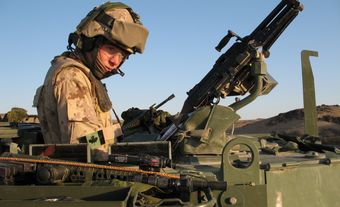
Fraser’s Canadian element consisted of the RCR battle group of four companies (including one from the PPCLI) mounted in LAV III infantry fighting vehicles; 23 Field Squadron from 2 Combat Engineer Regiment; E Battery from 2nd Regiment, Royal Canadian Horse Artillery, equipped with four M777 155mm howitzers; an ISTAR (intelligence, surveillance, target acquisition and reconnaissance) squadron from the Royal Canadian Dragoons (RCD) mounted in Coyote LAV II vehicles; and support elements. US and Afghan National Forces were also involved.
Air support was provided by a mixture of coalition aircraft. British and Dutch Apache attack helicopters would remain on station, waiting to be called in to fire on Taliban targets with rockets and 30mm cannons. British Harriers and Dutch F-16 Falcons would release 500 lb bombs, while American B-1B Lancer bombers dropped precision-guided munitions from altitudes of 15,000 feet and higher.
Plan
Based on the change in Taliban tactics, Fraser initiated planning for Operation Medusa in August 2006. Its aim was to attack Taliban strongholds in Panjwai district to break their hold on the area and restore stability. Fraser designed the operation to mitigate the threat to his soldiers, as well as to Afghan civilians, their fields and buildings. The operation was planned in two phases. Phase 1 was an initial assault to encircle and weaken Taliban positions, while Phase 2 was a full-scale ground offensive to clear the area, originally planned for three days after Phase 1.
Execution
Phase 1 began early on 2 September 2006. It made heavy use of air support and artillery to neutralize Taliban defensive positions, which was intended to weaken their ability to withstand the ground assault. The Taliban, however, quickly adapted by breaking up into smaller units, sheltering in deep dugouts and using their knowledge of the local terrain to avoid detection.
At the same time, coalition forces had encircled the area and were either closing in or blocking all escape routes. At 5:30 a.m., Charlie Company 1 RCR led the main effort and advanced from the south through Bazaar-e-Panjwai, while Bravo Company descended from the north. Task Force 31, composed mainly of US special forces, and Task Force Grizzly, an American infantry company, guarded the eastern flank, while a Danish squad guarded the western one. A Dutch company patrolled the northern flank.
Charlie Company was to seize Masum Ghar and Mar Ghar and then advance to, but not cross, the Arghandab River. It accomplished this by 6:15 a.m. and fired at suspected enemy positions across the river while it waited for the next phase of the plan. This was to be three days of air and artillery strikes on Objective Rugby, the codename for Taliban positions centred on the village of Pashmul.
Fraser visited the area that afternoon when Taliban activity had tapered off. Seeing this, he gave the order to cross the river, which, after some discussion, was to begin at first light the next day. This was a full 48 hours earlier than the original plan and without the scheduled bombardment. To many of the soldiers, this was an inexplicable and unpopular decision. According to Fraser, however, intelligence reports suggested that the enemy had been sufficiently weakened to proceed with the attack.
On the same day, a four-engine British Nimrod reconnaissance aircraft crashed a few kilometres away. The RCD ISTAR squadron immediately rushed to the area to render assistance, but on arrival it was obvious no one had survived. Soldiers secured the crash site to await the arrival of a recovery team. All 14 crew members onboard died.
Phase 2 began on 3 September. With engineer support, Charlie Company moved out at 6:00 a.m., crossed the Arghandab and advanced into the fields beyond toward Objective Rugby. The Taliban opened up with heavy fire, which damaged or destroyed several vehicles and killed four soldiers and wounded another 10. Less than four hours later, the company withdrew across the river.
The next day, as Charlie Company was at Masum Ghar preparing to mount a second attack across the river, an American A-10 Thunderbolt close air support fighter mistakenly attacked it. The attack killed one soldier and wounded more than 30 others, including the company commander. The company was no longer combat-effective; it was now Bravo Company’s turn to take the lead.
But first, some regrouping occurred. The remnants of Charlie Company joined the RCD ISTAR squadron, which was folded into Task Force Grizzly under an American commander. Its mission was to hold the southern end of the area along the Arghandab River and try to disrupt any Taliban across the river. Task Force 31, the American infantry company, was to keep pressure on the Taliban positions from the southeast. Coalition forces began to squeeze the Taliban from three directions: north, south and southeast.
On 5 September, Bravo Company crossed a deep ditch and began advancing south. Each night, the battalion’s recce platoon scouted ahead, selecting approaches for Bravo’s advance the next day. The company moved forward bit by bit and reached Objective Templar, an intermediate point on the way to Rugby.
To the south, Task Force Grizzly crossed the Arghandab at a different location from the one Charlie had used and met little opposition. By the time Task Force 31 and Bravo Company reached Rugby on 14 September, there was little resistance from the Taliban. Almost 10 days of direct and indirect fire had killed, wounded or driven them out.
Results
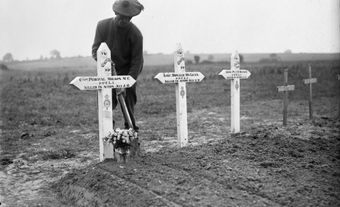
Operation Medusa achieved its primary aim of clearing Taliban forces from Panjwai. More than 500 of its fighters were killed and their command structures severely disrupted. On the Canadian side, 12 soldiers were killed and several more wounded, a clear indication of the intensity of the fighting.
Legacy
Operation Medusa became a defining moment in Canadian military history. After years of peacekeeping missions, it showed that the Canadian army was still capable of successfully planning and mounting large-scale, all-arms operations. In addition, it highlighted the professionalism and bravery of Canadian soldiers and confirmed Canada’s reputation as a major participant in NATO’s Afghanistan mission.
Medusa also showed the challenges posed by modern counterinsurgency warfare, including the difficulties in achieving a lasting peace and the integration of military, political and humanitarian efforts.