
Browse "Business & Economics"
-
Article
Canadian Film History: 1939 to 1973
Filmmaking is a powerful form of cultural and artistic expression, as well as a highly profitable commercial enterprise. From a practical standpoint, filmmaking is a business involving large sums of money and a complex division of labour. This labour is involved, roughly speaking, in three sectors: production, distribution and exhibition. The history of the Canadian film industry has been one of sporadic achievement accomplished in isolation against great odds. Canadian cinema has existed within an environment where access to capital for production, to the marketplace for distribution and to theatres for exhibition has been extremely difficult. The Canadian film industry, particularly in English Canada, has struggled against the Hollywood entertainment monopoly for the attention of an audience that remains largely indifferent toward the domestic industry. The major distribution and exhibition outlets in Canada have been owned and controlled by foreign interests. The lack of domestic production throughout much of the industry’s history can only be understood against this economic backdrop. This article is one of four that surveys the history of the film industry in Canada. The entire series includes: Canadian Film History: 1896 to 1938; Canadian Film History: 1939 to 1973; Canadian Film History: 1974 to Present; Canadian Film History: Regional Cinema and Auteurs, 1980 to Present.
"https://d3d0lqu00lnqvz.cloudfront.net/media/media/365bfdc3-53d4-4033-b13f-5a89a83a85d5.jpg" // resources/views/front/categories/view.blade.php
https://d3d0lqu00lnqvz.cloudfront.net/media/media/365bfdc3-53d4-4033-b13f-5a89a83a85d5.jpg
-
Article
Canadian Film History: 1974 to Present
Filmmaking is a powerful form of cultural and artistic expression, as well as a highly profitable commercial enterprise. From a practical standpoint, filmmaking is a business involving large sums of money and a complex division of labour. This labour is involved, roughly speaking, in three sectors: production, distribution and exhibition. The history of the Canadian film industry has been one of sporadic achievement accomplished in isolation against great odds. Canadian cinema has existed within an environment where access to capital for production, to the marketplace for distribution and to theatres for exhibition has been extremely difficult. The Canadian film industry, particularly in English Canada, has struggled against the Hollywood entertainment monopoly for the attention of an audience that remains largely indifferent toward the domestic industry. The major distribution and exhibition outlets in Canada have been owned and controlled by foreign interests. The lack of domestic production throughout much of the industry’s history can only be understood against this economic backdrop. This article is one of four that surveys the history of the film industry in Canada. The entire series includes: Canadian Film History: 1896 to 1938; Canadian Film History: 1939 to 1973; Canadian Film History: 1974 to Present; Canadian Film History: Notable Films and Filmmakers 1980 to Present.
"https://d3d0lqu00lnqvz.cloudfront.net/media/media/4fd4ee50-6f27-491b-aeb7-2f5cd3c95f9e.jpg" // resources/views/front/categories/view.blade.php
https://d3d0lqu00lnqvz.cloudfront.net/media/media/4fd4ee50-6f27-491b-aeb7-2f5cd3c95f9e.jpg
-
Article
Canadian Film History: Notable Films and Filmmakers 1980 to Present
Filmmaking is a powerful form of cultural and artistic expression, as well as a highly profitable commercial enterprise. From a practical standpoint, filmmaking is a business involving large sums of money and a complex division of labour. This labour is involved, roughly speaking, in three sectors: production, distribution and exhibition. The history of the Canadian film industry has been one of sporadic achievement accomplished in isolation against great odds. Canadian cinema has existed within an environment where access to capital for production, to the marketplace for distribution and to theatres for exhibition has been extremely difficult. The Canadian film industry, particularly in English Canada, has struggled against the Hollywood entertainment monopoly for the attention of an audience that remains largely indifferent toward the domestic industry. The major distribution and exhibition outlets in Canada have been owned and controlled by foreign interests. The lack of domestic production throughout much of the industry’s history can only be understood against this economic backdrop. This article is one of four that surveys the history of the film industry in Canada. The entire series includes: Canadian Film History: 1896 to 1938; Canadian Film History: 1939 to 1973; Canadian Film History: 1974 to Present; Canadian Film History: Notable Films and Filmmakers 1980 to Present.
"https://d3d0lqu00lnqvz.cloudfront.net/media/media/193cc1b9-24f9-4e96-a47d-4fc2142514ae.jpg" // resources/views/front/categories/view.blade.php
https://d3d0lqu00lnqvz.cloudfront.net/media/media/193cc1b9-24f9-4e96-a47d-4fc2142514ae.jpg
-
Article
Canadian Foundations
Foundations are "non-governmental, non-profit organizations with funds (usually from a single source, either an individual, a family, or a corporation) and program managed by (their) own trustees or directors, established to maintain or aid social, educational, charitable, religious, or other activities serving the common welfare through the making of Grants".
"https://thecanadianencyclopedia.ca/images/tce_placeholder.jpg?v=e9dca980c9bdb3aa11e832e7ea94f5d9" // resources/views/front/categories/view.blade.php
https://thecanadianencyclopedia.ca/images/tce_placeholder.jpg?v=e9dca980c9bdb3aa11e832e7ea94f5d9
-
Article
Canadian Free Trade Agreement
The Canadian Free Trade Agreement (CFTA) is an inter-governmental trade agreement regulating trade within Canada. It took effect on 1 July 2017. The goal of the agreement was to reduce or eliminate regulations against the free movement of goods, services, and investments within Canada. The officials who framed the new deal said they wanted to ensure that Canadian firms got the same access to the Canadian market as firms from the country’s international trading partners. CFTA also more closely matches the terms of the Canada-European Union Comprehensive Economic Trade Agreement (CETA), which began taking effect in 2017.
"https://d3d0lqu00lnqvz.cloudfront.net/media/media/133a2d02-51cc-4318-b7c7-5aeb80b30cf3.png" // resources/views/front/categories/view.blade.php
https://d3d0lqu00lnqvz.cloudfront.net/media/media/133a2d02-51cc-4318-b7c7-5aeb80b30cf3.png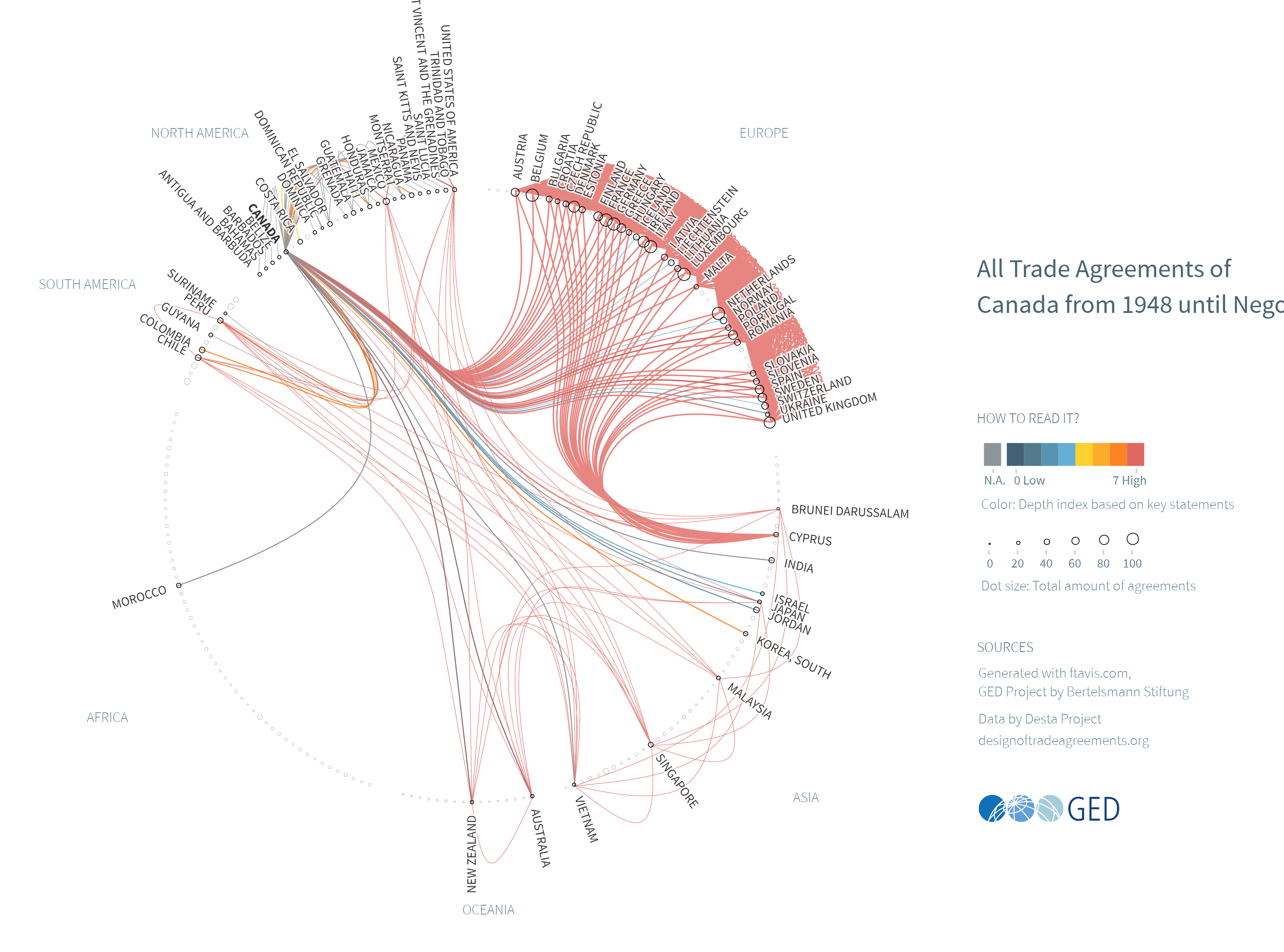
-
Article
Canadian Government Railways
Canadian Government RailwaysCanadian Government Railways was the descriptive name of all federally owned railways in Canada from about the 1880s until 1918, when its operations were combined with the recently nationalized CANADIAN NORTHERN RAILWAY; in the following year the CANADIAN NATIONAL RAILWAYS were incorporated to operate both companies. The Canadian Government Railways, entrusted to the CN for operation in 1923, still exists as a component of the CN and has 4 principal constituents: the Intercolonial,...
"https://thecanadianencyclopedia.ca/images/tce_placeholder.jpg?v=e9dca980c9bdb3aa11e832e7ea94f5d9" // resources/views/front/categories/view.blade.php
https://thecanadianencyclopedia.ca/images/tce_placeholder.jpg?v=e9dca980c9bdb3aa11e832e7ea94f5d9
-
Article
Icewine
Canada didn’t invent icewine but in the space of a couple of decades it has become the Canadian product that is most sought after by the international wine community.
"https://d3d0lqu00lnqvz.cloudfront.net/media/media/b2b75291-9e2b-472e-8ef3-a3d6632e9111.jpg" // resources/views/front/categories/view.blade.php
https://d3d0lqu00lnqvz.cloudfront.net/media/media/b2b75291-9e2b-472e-8ef3-a3d6632e9111.jpg
-
Article
Canadian Imperial Bank of Commerce (CIBC)
The Canadian Imperial Bank of Commerce, commonly known as CIBC, is the fifth largest chartered bank in Canada. It was created through the 1961 merger of two Ontario-based banks, the Canadian Bank of Commerce and the Imperial Bank of Canada — the largest merger of two chartered banks in Canada’s history. Today, CIBC operates its business in Canada and abroad through three divisions: retail and business banking, wealth management, and capital markets. CIBC is a public company that trades on the Toronto Stock Exchange and the New York Stock Exchange under the symbol CM. In 2023, CIBC registered $23.3 billion in revenue and $5.0 billion in net income and held $975.72 billion in assets. The bank employs approximately 48,000 people, who serve 14 million clients around the world.
"https://d3d0lqu00lnqvz.cloudfront.net/media/media/43f7863d-e606-460c-a226-86ceb49f6896.jpg" // resources/views/front/categories/view.blade.php
https://d3d0lqu00lnqvz.cloudfront.net/media/media/43f7863d-e606-460c-a226-86ceb49f6896.jpg
-
Article
Canadian Institute for Economic Policy
Canadian Institute for Economic Policy, privately funded, independent institute, established in 1979 with a 5-year mandate to study Canadian fiscal, industrial and other public-policy issues.
"https://thecanadianencyclopedia.ca/images/tce_placeholder.jpg?v=e9dca980c9bdb3aa11e832e7ea94f5d9" // resources/views/front/categories/view.blade.php
https://thecanadianencyclopedia.ca/images/tce_placeholder.jpg?v=e9dca980c9bdb3aa11e832e7ea94f5d9
-
Article
Canadian Journal of Economics and Political Science
Canadian Journal of Economics and Political Science was the academic journal of the Canadian Political Science Association, whose membership originally covered all the social sciences.
"https://thecanadianencyclopedia.ca/images/tce_placeholder.jpg?v=e9dca980c9bdb3aa11e832e7ea94f5d9" // resources/views/front/categories/view.blade.php
https://thecanadianencyclopedia.ca/images/tce_placeholder.jpg?v=e9dca980c9bdb3aa11e832e7ea94f5d9
-
Article
Canadian Labor Union
Founded in 1873 on the initiative of the Toronto Trades Assembly, the Canadian Labor Union represented organized labour's first attempt at a national federation. Moderate in ideology and practice, the CLU would only extend support to striking members who had sought arbitration first.
"https://thecanadianencyclopedia.ca/images/tce_placeholder.jpg?v=e9dca980c9bdb3aa11e832e7ea94f5d9" // resources/views/front/categories/view.blade.php
https://thecanadianencyclopedia.ca/images/tce_placeholder.jpg?v=e9dca980c9bdb3aa11e832e7ea94f5d9
-
Article
Canadian Labour Congress
The Canadian Labour Congress is a national Union central founded on 23 April 1956 from the merger of the Canadian Congress of Labour and the Trades and Labor Congress of Canada.
"https://thecanadianencyclopedia.ca/images/tce_placeholder.jpg?v=e9dca980c9bdb3aa11e832e7ea94f5d9" // resources/views/front/categories/view.blade.php
https://thecanadianencyclopedia.ca/images/tce_placeholder.jpg?v=e9dca980c9bdb3aa11e832e7ea94f5d9
-
Article
Canadian Manufacturers' Association
Canadian Manufacturers' Association, founded 1871, incorporated by Act of Parliament 1902 "to promote Canadian industries and to further the interests of Canadian manufacturers and exporters.
"https://thecanadianencyclopedia.ca/images/tce_placeholder.jpg?v=e9dca980c9bdb3aa11e832e7ea94f5d9" // resources/views/front/categories/view.blade.php
https://thecanadianencyclopedia.ca/images/tce_placeholder.jpg?v=e9dca980c9bdb3aa11e832e7ea94f5d9
-
Article
Canadian National Railway (CN)
Canadian National Railway Company, incorporated 6 June 1919, is the longest railway system in North America, controlling more than 31,000 km of track in Canada and the United States. It is the only transcontinental rail network in North America, connecting to three coasts: Atlantic, Pacific and Gulf of Mexico. Known as Canadian National (CN), the former Crown corporation expanded its holdings to include marine operations, hotels, telecommunications and resource industries. However, the core of CN was still its railway system, which had its origins in the amalgamation of five financially troubled railways during the years 1917–23: the Grand Trunk and its subsidiary, the Grand Trunk Pacific; the Intercolonial; the Canadian Northern; and the National Transcontinental. In 1995, CN was sold to private investors. CN is primarily a rail freight company and transports approximately $250 billion worth of goods annually. In 2016, it earned over $12 billion in revenue and employed over 22,000 people in Canada and the US.
"https://d3d0lqu00lnqvz.cloudfront.net/media/media/ffb48914-8c79-474f-ad6b-5edb6ccc0cc6.jpg" // resources/views/front/categories/view.blade.php
https://d3d0lqu00lnqvz.cloudfront.net/media/media/ffb48914-8c79-474f-ad6b-5edb6ccc0cc6.jpg
-
Article
Canadian Northern Railway
The Canadian Northern Railway started as a single Manitoba line of 84 miles (135 km) in 1896. In 1899, the railway received federal charter and was quickly developed by the railway entrepreneurs Sir William Mackenzie and Sir Donald Mann. By 1917, it had expanded to more than 9,000 miles (14,485 km) of track across seven provinces. Originally a major railway network over the Prairie provinces, the Canadian Northern Railway expanded into a transcontinental line with many supporting enterprises, including telegraph and steamship companies. (See also Railway History in Canada.)
"https://d3d0lqu00lnqvz.cloudfront.net/media/media/b1d9b093-5205-4fa7-9886-bf8da31e7062.jpg" // resources/views/front/categories/view.blade.php
https://d3d0lqu00lnqvz.cloudfront.net/media/media/b1d9b093-5205-4fa7-9886-bf8da31e7062.jpg