Share on Facebook
 Share on X
 Share by Email
 Share on Google Classroom
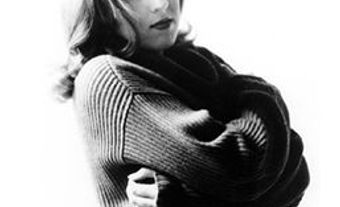
Morris “Moe” Koffman, OC, flutist, saxophonist, clarinetist, composer, arranger, booking agent (born 28 December 1928 in Toronto, ON; died 28 March 2001 in Orangeville, ON). Moe Koffman was one of Canada’s most popular jazz instrumentalists. His instrumental flute single “Swinging Shepherd Blues” was an international hit in 1957–58. The song has since been recorded by more than 300 artists and was inducted into the Canadian Songwriters Hall of Fame in 2016. Koffman subsequently became a major figure in Toronto’s jazz, studio and theatrical worlds as a player and a contractor. His jazz band was a fixture at the Toronto restaurant George’s Spaghetti House from 1956 to 1994. They toured widely in Canada and appeared in concert abroad. Koffman also played in other Toronto jazz bands, notably Rob McConnell’s Boss Brass. Koffman was made an Officer of the Order of Canada in 1993 and was inducted into the Canadian Music Hall of Fame in 1997.

Early Life and Education
Moe Koffman began studying violin at nine and alto saxophone at 13. Soon afterward, he attended the Toronto Conservatory of Music (now Royal Conservatory of Music), where his teachers were Herbert Pye (clarinet) and Samuel Dolin (theory).
In his mid-teens, Koffman dropped out of school and began playing in dance bands, working in turn with Horace Lapp, Leo Romanelli, and Benny Louis. One of the first Canadian jazz musicians to adopt the new bebop style born in New York in the early 1940s, Koffman won a CBC Jazz Unlimited poll as best alto saxophonist in 1948. He then made his first recordings (78s) in Buffalo with US musicians for the Main Stem company that same year. He also studied with Gordon Delamont at this time.
In 1950, Moe Koffman moved to the US, where he played in the big bands of Sonny Dunham, Jimmy Dorsey and others. In New York, he studied flute with Harold Bennett of the Metropolitan Opera orchestra and clarinet with Leon Russianoff, the principal of the New York Philharmonic Orchestra.
Career Highlights
Moe Koffman returned to Toronto in 1955, thereafter dividing his career between his jazz group and studio work. He became the booking agent for George’s Spaghetti House in 1956. He remained in that role while also appearing there roughly one week a month with his band — the Moe Koffman Quartet and later the Moe Koffman Quintet — until 1994. The Canadian and US success of his recording of his “Swinging Shepherd Blues” in 1957–58 established his name as a flutist and at the same time helped to popularize that instrument in jazz.
In the 1960s, Koffman engaged in various experiments, none necessarily original (e.g., playing two saxophones at once, employing electronics to amplify and modify the saxophone's sound, and incorporating elements of rock into jazz.) These left Koffman straddling the pop and jazz worlds and brought him unusually wide exposure for a Canadian jazz musician, including appearances in the mid-1960s on NBC TV's Tonight Show. He led his own big band as music director in 1974 for Global TV's Everything Goes.
In the 1970s, assisted by the producer-arranger Doug Riley, Koffman made several popular LPs of arrangements of music by Bach, Berlioz, Debussy, Gluck, Grieg, Mozart, and Vivaldi. The initiative was typical of Koffman's refusal to be pigeon-holed by jazz purists, preferring instead to record what he perceived his audiences wanted. Of his 10 LPs in the 1970s only three could be considered purely jazz recordings: Solar Explorations, Live at George's, and Museum Pieces.
For Solar Explorations, Koffman commissioned works in honour of the planets from Ron Collier, Riley, Fred Stone, Don (W.) Thompson, and Rick Wilkins. Koffman himself wrote Neptune and Venus. Museum Pieces, co-produced by GRT and the Royal Ontario Museum (Toronto), comprised works by Koffman (Museum Pieces and Evolution Blues), Marty Morell, Riley, Thompson, and Wilkins, inspired by various aspects of museology.
While The Magic Flute (1985) and Music for the Night (1991) returned Koffman to a pop instrumental settings, his Duke Street releases between 1986 and 1990 were consistently in a jazz vein and comprised original tunes, themes by his longtime pianist Bernie Senensky, and jazz standards. Other compositions for which Koffman was known include the opening and closing themes (“Curried Soul” and “Koff Drops,” respectively) for CBC Radio’s long-running current affairs show As It Happens.
Koffman's recordings (more than 25 albums) combined versatility with a sure commercial instinct. Some were of a pop instrumental nature, drawing on repertoire and styles from the classical (Moe Koffman Plays Bach, 1971) and disco (Jungle Man, 1976) to stage musicals (Music for the Night: A Tribute to Andrew Lloyd Webber, 1991). Others were more strictly jazz, including One Moe Time (1986) and Oop-Pop-A-Da (1988), the latter with Dizzy Gillespie.
Live Performance
Benefitting from the wide exposure received by his pop ventures, Moe Koffman led one of the most successful jazz groups in Canada, a quartet or, latterly, quintet with the guitarist Ed Bickert as a longstanding member. The group appeared at Expo 67, performed in 1975 at the Shaw Festival (in a Mozart program with Camerata), and travelled in 1979 to Art Park (Lewiston, NY) and the Monteray Jazz Festival.
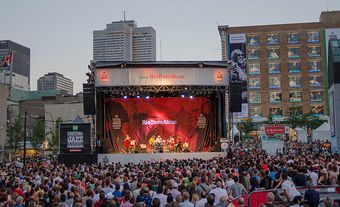
Although some jazz circles held Koffman's commercial endeavours in disdain, he and his quintet appeared at various festivals including the Festival international de jazz de Montréal (FIJM) and the Ontario Place Jazz Festival. His national itinerary, however, was based for the most part on “community concert” series. Koffman also appeared with several orchestras, including the Toronto Symphony Orchestra (with which he was a soloist in Lucio Agostini’s Flute Concerto in 1975), the Hamilton Philharmonic, the Sudbury Symphony Orchestra, Orchestra London Canada, as well as the Kitchener-Waterloo, Calgary, and Edmonton symphony orchestras.
In 1982, with a performance in Stratford, Ontario, the Koffman quintet began an occasional association with the renowned American jazz trumpeter Dizzy Gillespie. A few concerts followed each year until 1990, including those at the National Arts Centre, Place des arts, and Art Park in 1983, on a Canadian tour in 1987, and at the Budapest Spring Festival in 1989. Koffman in turn played with Gillespie's United Nations big band for concerts in 1988 at the du Maurier Downtown Jazz festival in Toronto and the FIJM.
In 1991, the Koffman quintet undertook a similar association with the vibraphonist Peter Appleyard for concerts in Western Canada and the Maritimes. The quintet alone toured in Australia (1980), South America (twice in 1985), and Germany (1990), and made several appearances at US universities during the decade. After the quintet's main venue, George's Spaghetti House, closed in 1994, Koffman began to perform regularly at the Senator. But the quintet performed less often.
Work as Soloist
During his entire career, Moe Koffman was active as a soloist. He toured and recorded as lead altoist and featured soloist with the Boss Brass from 1972 to 2000. He took similar roles in jazz-oriented TV and studio orchestras led by Peter Appleyard, Guido Basso, Jimmy Dale and Rob McConnell. His reputation as a sight-reader and a quick study led to his being in demand as a studio musician and for commercial jingles. He was also a flute and/or woodwind soloist on many pop recordings, and in premieres of chamber works by Doug Riley and Paul Hoffert. Koffman was nominated for eight Juno Awards between 1976 and 1991.
Later Career
In his final decade, Moe Koffman continued to compose, and to perform as a soloist and with his quintet at clubs and festivals. Beginning in 1989 and through the following decade, he booked orchestral musicians for musicals presented by Garth Drabinsky's Live Entertainment Corporation, including such shows as Phantom of the Opera, Showboat, and Ragtime. He made his last recording, The Moe Koffman Project, in the summer of 1999 (2000). His last public performance was in June 2000 for the du Maurier Downtown Jazz Festival in Toronto.
Characteristic Traits
The wide range of Moe Koffman's activities has been seen by some as evidence of an inquiring musical mind and by others as merely the exercise of a keen instinct for popular tastes. The Toronto Star’s Peter Goddard noted in 1972 Koffman's “rare ability to bob buoyantly on the surface of whatever new wave comes along.” The same range, however, exhibited on Koffman's own recordings and in other studio assignments, attests to his technical skill and musicianship. As a flutist he married a pure, “classical” tone to the breezy rhythmic and melodic freedom of jazz. As an alto saxophonist, he remained faithful to the bebop tradition and demonstrated with the Boss Brass and Dizzy Gillespie his standing among Canada's most vivid stylists in that idiom.
Writing in the Globe and Mail in 2001, Mark Miller assessed Koffman's crossover contributions: “Mr. Koffman made music according to the principle of moderation. The best of his jazz and jazz/classical crossover LPs and CDs combined cautious experimentation, expert musicianship, keen intelligence and good taste to light and breezy effect.”
Family Connections
Moe Koffman’s son, Herb (trumpeter, born 22 April 1955 in New York) studied with Don Johnson and Ted Moses and was a member of Manteca during the 1980s.
Honours and Awards
Moe Koffman received PRO Canada's Wm Harold Moon Award in 1981 and the Toronto Arts award for music in 1991. He was inducted into the Canadian Music Hall of Fame (1997) and named an Officer of the Order of Canada (1993). He was named Flutist of the Year by the Annual Jazz Report Awards for 1993 and 1994 and was honoured by SOCAN for jazz songwriting in 1993. In 2001, he was inducted as an inaugural member into Canada’s Jazz and Blues Hall of Fame.
In 2001, Koffman received the Prix Oscar Peterson from FIJM, was named as a MasterWorks honoree by the Audio-Visual Preservation Trust of Canada and was inducted as an inaugural member into Canada’s Jazz and Blues Hall of Fame. Also in 2001, the University of Toronto initiated a scholarship called the Moe Koffman Memorial Jazz Scholarship. The award is funded by annual performances of the Canadian Jazz All-Stars. In 2016, “Swinging Shepherd Blues” was inducted into the Canadian Songwriters Hall of Fame.
(See also Jazz in Canada.)
A version of this entry originally appeared in the Encyclopedia of Music in Canada.