Share on Facebook
 Share on X
 Share by Email
 Share on Google Classroom
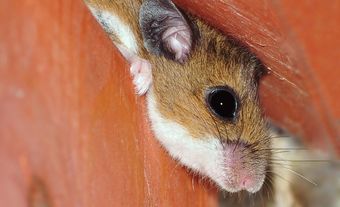
The deer mouse (Peromyscus maniculatus) is a typical mouse with a moderately long tail, large ears, prominent eyes and a pointed nose well supplied with tactile hairs. Upper parts are grey or brown, depending on age and subspecies; underside, white. Even the tail is two-toned.

Behaviour
Deer mice are strongly nocturnal. In winter, the northern deer mouse (Peromyscus maniculatus borealis) undergoes bouts of light torpor, lasting for up to several days, in which body temperature may fall several degrees, but it does not actually hibernate.
Distribution and Habitat
Deer mice occur in forests and grasslands throughout Canada, excluding Newfoundland, and down the Mackenzie Valley beyond the Arctic Circle. The large, pale-grey Cascade deer mouse (P. oreas) of the coastal range of BC may represent a distinct species.
Reproduction and Development
Deer mice breed only in summer. Females of northern populations never have more than two litters (of about five young). In southern Canada, females produce more, smaller litters; some may become sexually mature in the season of their birth. A few animals are known to have survived two winters.
Biological Importance
Deer mice are an important part of many ecosystems, as they provide food for carnivorous birds and mammals. However, deer mice may destroy stored food and carry a virus (hantavirus) that in 15–50 per cent of cases is deadly to humans. The virus is transmitted from feces and urine of deer mice deposited on food or inhaled as dust.