
Browse "Things"
-
Macleans
Throne Speech 1997
This article was originally published in Maclean's Magazine on October 6, 1997
"https://thecanadianencyclopedia.ca/images/tce_placeholder.jpg?v=e9dca980c9bdb3aa11e832e7ea94f5d9" // resources/views/front/categories/view.blade.php
https://thecanadianencyclopedia.ca/images/tce_placeholder.jpg?v=e9dca980c9bdb3aa11e832e7ea94f5d9
-
Article
Thrush
Thrushes (Muscicapidae) are a very large family comprising about 450 species of small passerines (perching birds) ranging 11-33 cm in length.
"https://thecanadianencyclopedia.ca/images/tce_placeholder.jpg?v=e9dca980c9bdb3aa11e832e7ea94f5d9" // resources/views/front/categories/view.blade.php
https://thecanadianencyclopedia.ca/images/tce_placeholder.jpg?v=e9dca980c9bdb3aa11e832e7ea94f5d9
-
Article
Early Inuit (Thule Culture)
Early Inuit groups from northern Alaska moved into the Eastern North American Arctic (i.e., Canada and Greenland) around 800 years ago (ca. 1200 CE). In roughly a century, some of these early Inuit groups rapidly migrated across what’s now the Northwest Territories, Nunavut and Greenland. By roughly the 15th century CE, early Inuit groups lived throughout the Eastern Arctic. The early Inuit are distinct from the Dorset and Pre-Dorset. Although where they lived slightly changed throughout time, these early Inuit represent the direct ancestors of Inuit today.
"https://d3d0lqu00lnqvz.cloudfront.net/media/media/1124de9a-74b2-4dfb-9f8a-f096ecccab6b.jpg" // resources/views/front/categories/view.blade.php
https://d3d0lqu00lnqvz.cloudfront.net/media/media/1124de9a-74b2-4dfb-9f8a-f096ecccab6b.jpg
-
Article
Early Inuit (Thule) Winter House
The early Inuit (Thule) were an Indigenous people who began to occupy the Arctic, from Alaska to Greenland, around 1000 CE. In the winter, the early Inuit used a house built partially into the ground to keep them warm for long periods of time. One striking feature of this structure was the roof, which was sometimes made of whalebone. (See also Architectural History of Indigenous Peoples in Canada.)
"https://d3d0lqu00lnqvz.cloudfront.net/ThuleHouse.jpg" // resources/views/front/categories/view.blade.php
https://d3d0lqu00lnqvz.cloudfront.net/ThuleHouse.jpg
-
Article
Thunderbird
Thunderbird is a supernatural creature prominent in many Indigenous traditional stories. The thunderbird plays varying roles in different Indigenous traditions. Traditional stories of the thunderbird exist in cultures from the Pacific Northwest, the plains, and the eastern regions of what is now Canada (see also Northwest Coast Indigenous Peoples in Canada; Plains Indigenous Peoples in Canada).
"https://d3d0lqu00lnqvz.cloudfront.net/media/media/0c7246ce-04d4-4027-9907-07156a5ba0d6.jpg" // resources/views/front/categories/view.blade.php
https://d3d0lqu00lnqvz.cloudfront.net/media/media/0c7246ce-04d4-4027-9907-07156a5ba0d6.jpg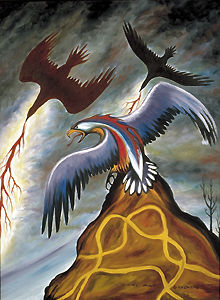
-
Article
Thunderstorm
Thunderstorms usually occur on summer afternoons. While a thunderstorm typically affects a given locality for only an hour or so during its passage overhead, the entire lifetime may be as long as 6-10 hours, along a pathway of several hundred kilometres.
"https://thecanadianencyclopedia.ca/images/tce_placeholder.jpg?v=e9dca980c9bdb3aa11e832e7ea94f5d9" // resources/views/front/categories/view.blade.php
https://thecanadianencyclopedia.ca/images/tce_placeholder.jpg?v=e9dca980c9bdb3aa11e832e7ea94f5d9
-
Article
Tick
Ticks are small, bloodsucking arachnids that live as external parasites on terrestrial mammals, birds, amphibians and reptiles. Ticks belong to the order Ixodida, a group of parasitic mites in the superorder Parasitiformes. This superorder also includes the varroa mite, a destructive parasite of honeybees. About 900 tick species are known worldwide, of which 48 have been found in Canada. Although they are most diverse in tropical regions, ticks continue to be significant pests to humans and other mammals as far north as the Canadian tundra.
"https://d3d0lqu00lnqvz.cloudfront.net/tick/Female-Black-Legged-Tick-on-Leaf.jpg" // resources/views/front/categories/view.blade.php
https://d3d0lqu00lnqvz.cloudfront.net/tick/Female-Black-Legged-Tick-on-Leaf.jpg
-
Article
Tidal Energy
Tidal energy is a largely untapped, renewable energy source based largely on lunar gravitation. While the potential of tidal hydroelectricity has long been recognized, compared to river dams, tidal power projects are expensive because massive structures must be built in difficult saltwater environments.
"https://d3d0lqu00lnqvz.cloudfront.net/media/media/20ec66d0-4579-4f2a-942d-5bb87ded61be.jpg" // resources/views/front/categories/view.blade.php
https://d3d0lqu00lnqvz.cloudfront.net/media/media/20ec66d0-4579-4f2a-942d-5bb87ded61be.jpg
-
Article
Tide
The Earth is actually not in orbit around the sun but around the centre of mass of the Earth-sun system. Since all parts of the Earth move in the same orbit, they experience the same acceleration, but only at the Earth's centre is this acceleration exactly balanced by the sun's gravitation.
"https://d3d0lqu00lnqvz.cloudfront.net/media/media/989a9feb-532c-452f-829d-b5fecf83d434.jpg" // resources/views/front/categories/view.blade.php
https://d3d0lqu00lnqvz.cloudfront.net/media/media/989a9feb-532c-452f-829d-b5fecf83d434.jpg
-
Article
Tiktaalik
Tiktaalik is a genus of lobe-finned (sarcopterygian) fish from the Devonian Period found on Ellesmere Island, Nunavut, in Canada’s Arctic Archipelago. A single species is known of Tiktaalik, T. roseae, which lived approximately 385 million years ago. The species was named in 2006 in two articles that described several articulated specimens. These articles set off a storm in the popular press. Titkaalik represents a clear and important evolutionary step in the journey of animals onto land. Click here for definitions of key terms used in this article.
"https://d3d0lqu00lnqvz.cloudfront.net/tiktaalik/Tiktaalik-Model.jpg" // resources/views/front/categories/view.blade.php
https://d3d0lqu00lnqvz.cloudfront.net/tiktaalik/Tiktaalik-Model.jpg
-
Memory Project Archive
Tilmon Arsenault (Primary Source)
Tilmon Arsenault served during the Second World War. Please be advised that Memory Project primary sources may deal with personal testimony that reflect the speaker’s recollections and interpretations of events. Individual testimony does not necessarily reflect the views of the Memory Project and Historica Canada.
"https://d3d0lqu00lnqvz.cloudfront.net/TilmonArsenault/Arsenault_T_5b (1 sur 1).jpg" // resources/views/front/categories/view.blade.php
https://d3d0lqu00lnqvz.cloudfront.net/TilmonArsenault/Arsenault_T_5b (1 sur 1).jpg.jpg)
-
Article
Tim Hortons
Tim Hortons is a Canadian restaurant chain known for its coffee, doughnuts and connection to Canada’s national identity. Its namesake, Toronto Maple Leafs defenceman Tim Horton (1930–74), founded the business with Montreal businessman Jim Charade. The first Tim Hortons doughnut franchise opened in Hamilton, Ontario, in May 1964. Since then, Tim Hortons has become Canada’s largest restaurant chain. As of September 2023, it operates 3,874 stores across the country and 1,827 stores internationally. In 1995, American fast-food chain Wendy’s bought Tim Hortons in a partnership that lasted until 2006. In 2014, the chain was again purchased by a foreign company, this time by Brazilian firm 3G Capital, known for its ownership of Burger King. Despite foreign ownership, Tim Hortons remains a Canadian cultural phenomenon.
"https://d3d0lqu00lnqvz.cloudfront.net/media/media/60daff5b-d059-488d-8b82-bddb82e54a10.jpg" // resources/views/front/categories/view.blade.php
https://d3d0lqu00lnqvz.cloudfront.net/media/media/60daff5b-d059-488d-8b82-bddb82e54a10.jpg
-
Macleans
Tim Hortons Investors Awaiting U.S. Market
To its most devoted fans, grabbing a Tim Hortons double-double on the way to work is almost a religious experience. The Church of Tim's, as it's only-somewhat-jokingly called, has such a firm grip on the Canadian psyche even the clergy are prone to bouts of envy.This article was originally published in Maclean's Magazine on March 24, 2008
"https://thecanadianencyclopedia.ca/images/tce_placeholder.jpg?v=e9dca980c9bdb3aa11e832e7ea94f5d9" // resources/views/front/categories/view.blade.php
https://thecanadianencyclopedia.ca/images/tce_placeholder.jpg?v=e9dca980c9bdb3aa11e832e7ea94f5d9
-
Article
Timber Axe
Two basic types of axe were used in the early 19th-century eastern forest industry. The more common poll axe had a single, fan-shaped cutting edge, a narrow head weighing 1.5-2.5 kg, and a hickory or maple handle. It was used for felling, scoring and lopping branches off fallen trees.
"https://d3d0lqu00lnqvz.cloudfront.net/media/media/cec78fec-e5dd-4380-bdb0-41072ce95e26.jpg" // resources/views/front/categories/view.blade.php
https://d3d0lqu00lnqvz.cloudfront.net/media/media/cec78fec-e5dd-4380-bdb0-41072ce95e26.jpg
-
Article
Timber Duties
Timber Duties First imposed in the 18th century to provide revenue, Britain's tariffs on imported wood were an integral component of the 19th-century British North American TIMBER TRADE.
"https://thecanadianencyclopedia.ca/images/tce_placeholder.jpg?v=e9dca980c9bdb3aa11e832e7ea94f5d9" // resources/views/front/categories/view.blade.php
https://thecanadianencyclopedia.ca/images/tce_placeholder.jpg?v=e9dca980c9bdb3aa11e832e7ea94f5d9