
Browse "History"
-
Article
Province of Quebec 1763-91
At the end of the Seven Years’ War (1756–63), Great Britain set out to organize the North American territories surrendered by France in the Treaty of Paris, 1763. By the Royal Proclamation of 1763, the Province of Quebec was created out of the inhabited portion of New France. The boundaries took on a rectangular shape on each side of the St. Lawrence River, and stretching from Lake Nipissing and the 45th parallel to the Saint John River and Ile d'Anticosti. These boundaries were modified by the Quebec Act of 1774 to include the fishing zone off Labrador and the Lower North Shore, and the fur trade area between the Ohio and Mississippi rivers and the Great Lakes. The Treaty of Paris, 1783 pushed the boundary farther north. With the Constitutional Act, 1791, Britain divided the Province of Quebec into Upper Canada (the predecessor of modern-day Ontario) and Lower Canada (whose geographical boundaries comprised the southern portion of present-day Quebec).
"https://d3d0lqu00lnqvz.cloudfront.net/media/new_article_images/PoliticsInOntario/Map_Province_of_QC_1763.jpg" // resources/views/front/categories/view.blade.php
https://d3d0lqu00lnqvz.cloudfront.net/media/new_article_images/PoliticsInOntario/Map_Province_of_QC_1763.jpg
-
Article
Quebec Act, 1774
The Quebec Act received royal assent on 22 June 1774. It revoked provisions in the Royal Proclamation of 1763 that had aimed to assimilate the French-Canadian population under English rule. The Quebec Act was put into effect on 1 May 1775. It was passed to gain the loyalty of the French-speaking majority of the Province of Quebec. Based on recommendations from Governors James Murray and Guy Carleton, the Act guaranteed the freedom of worship and restored French property rights. However, the Act was unpopular in the Thirteen American Colonies and was one of the causes of the American Revolutionary War (1775–83). It was followed by the Constitutional Act in 1791. This is the full-length entry about the Quebec Act of 1774. For a plain language summary, please see The Quebec Act, 1774 (Plain-Language Summary).
"https://d3d0lqu00lnqvz.cloudfront.net/media/media/bcf0dcc3-ce34-4098-8543-00bcccbaabe0.jpg" // resources/views/front/categories/view.blade.php
https://d3d0lqu00lnqvz.cloudfront.net/media/media/bcf0dcc3-ce34-4098-8543-00bcccbaabe0.jpg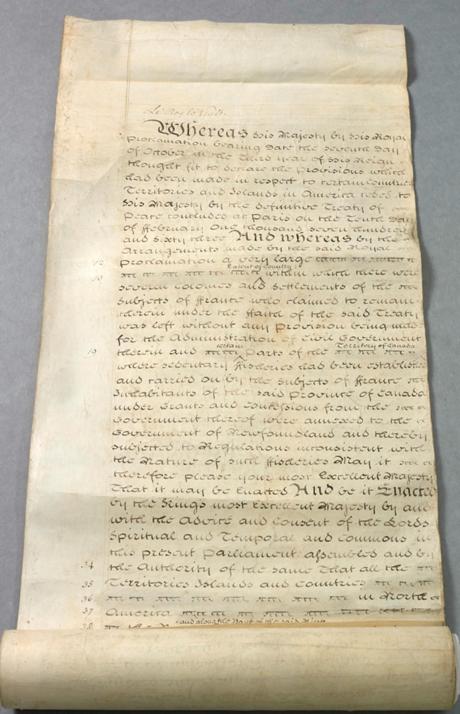
-
Article
Quebec Act 1774 Document
Selected text of the Quebec Act:An Act for making more effectual Provision for the Government of the Province of Quebec in North America.
"https://d3d0lqu00lnqvz.cloudfront.net/media/media/bcf0dcc3-ce34-4098-8543-00bcccbaabe0.jpg" // resources/views/front/categories/view.blade.php
https://d3d0lqu00lnqvz.cloudfront.net/media/media/bcf0dcc3-ce34-4098-8543-00bcccbaabe0.jpg
-
Article
Québec and Confederation
Québec became one of the founding members of the Dominion of Canada on 1 July 1867 when it joined New Brunswick, Nova Scotia and Ontario in Confederation .
"https://d3d0lqu00lnqvz.cloudfront.net/media/media/98975740-c322-469b-9fe0-d603876f072d.png" // resources/views/front/categories/view.blade.php
https://d3d0lqu00lnqvz.cloudfront.net/media/media/98975740-c322-469b-9fe0-d603876f072d.png
-
Editorial
Quebec Bridge Disaster
The following article is an editorial written by The Canadian Encyclopedia staff. Editorials are not usually updated. High above the St. Lawrence River, on a hot August day in 1907, a worker named Beauvais was driving rivets into the great southern span of the Quebec Bridge. Near the end of a long day, he noticed that a rivet that he had driven no more than an hour before had snapped clean in two. Just as he called out to his foreman to report the disquieting news, the scream of twisting metal pierced the air. The giant cantilever dropped out from under them, crashing into the river with such force that people in the city of Quebec, 10 km away, believed that an earthquake had struck.
"https://d3d0lqu00lnqvz.cloudfront.net/media/media/fbaea59f-792e-4866-9bbf-05641728ca4f.jpg" // resources/views/front/categories/view.blade.php
https://d3d0lqu00lnqvz.cloudfront.net/media/media/fbaea59f-792e-4866-9bbf-05641728ca4f.jpg
-
Article
Quebec City in the War of 1812
Quebec City's strategic location on the ST LAWRENCE RIVER determined the nature of its development. In the age of sail, it held a dominant position as a port of entry and exit for ocean-going vessels.
"https://thecanadianencyclopedia.ca/images/tce_placeholder.jpg?v=e9dca980c9bdb3aa11e832e7ea94f5d9" // resources/views/front/categories/view.blade.php
https://thecanadianencyclopedia.ca/images/tce_placeholder.jpg?v=e9dca980c9bdb3aa11e832e7ea94f5d9
-
Article
Quebec Conference, 1864
From 10–27 October 1864, politicians from the five British North American colonies gathered in Quebec City to continue discussing their unification into a single country. These discussions began at the Charlottetown Conference the previous month. The most important issues decided in Quebec City were the structure of Parliament and the distribution of powers between the federal and provincial governments. The broad decisions from the Charlottetown and Quebec conferences were made into 72 resolutions, known as the Quebec Resolutions. These formed the basis of Confederation and of Canada’s Constitution.
"https://d3d0lqu00lnqvz.cloudfront.net/media/media/1e88decf-02d6-4b89-b522-383f360ecac4.jpg" // resources/views/front/categories/view.blade.php
https://d3d0lqu00lnqvz.cloudfront.net/media/media/1e88decf-02d6-4b89-b522-383f360ecac4.jpg
-
Article
Quebec Conference, 1864 (Plain-Language Summary)
From 10–27 October 1864, leaders from the five British North American colonies met in Quebec City. They continued to talk about merging into a single country. These talks had begun at the Charlottetown Conference the month before. At Quebec City, the Fathers of Confederation chose how the new Parliament would be structured. They also worked out the division of powers between the federal and provincial governments. The decisions that were made in Charlottetown and Quebec formed 72 resolutions. They were known as the Quebec Resolutions. They formed the basis of Confederation and of Canada’s Constitution. This article is a plain-language summary of the Quebec Conference, 1864. If you would like to read about this topic in more depth, please see our full-length entry: Quebec Conference, 1864.
"https://d3d0lqu00lnqvz.cloudfront.net/media/media/9c333485-1e08-4272-be36-0eae7a34dcf5.jpg" // resources/views/front/categories/view.blade.php
https://d3d0lqu00lnqvz.cloudfront.net/media/media/9c333485-1e08-4272-be36-0eae7a34dcf5.jpg
-
Editorial
Quebec Conference of 1864
The following article is an editorial written by The Canadian Encyclopedia staff. Editorials are not usually updated. There was no media circus surrounding the conference. The press was banned from the discussions, so the newspaper reports said a great deal about the miserable October weather, but precious little about what was discussed in the meetings.
"https://d3d0lqu00lnqvz.cloudfront.net/media/media/1eda021b-6ecb-4d9c-99cc-7cc3a1cee783.jpg" // resources/views/front/categories/view.blade.php
https://d3d0lqu00lnqvz.cloudfront.net/media/media/1eda021b-6ecb-4d9c-99cc-7cc3a1cee783.jpg
-
Article
Québec Conferences 1943, 1944
King himself was most comfortable playing host to the conferences in Québec, and he was amply photographed and filmed with Churchill and Roosevelt.
"https://d3d0lqu00lnqvz.cloudfront.net/media/media/0e3038c4-afb4-4a8b-acdb-3ece6a061304.jpg" // resources/views/front/categories/view.blade.php
https://d3d0lqu00lnqvz.cloudfront.net/media/media/0e3038c4-afb4-4a8b-acdb-3ece6a061304.jpg
-
Article
Quebec Film History: 1970 to 1989
This entry presents an overview of Québec cinema, from the burgeoning of a distinctly Québec cinema in the 1970s, to the production explosion that followed Denys Arcand’s Le déclin de l’empire américain (1986). It highlights the most important films, whether in terms of box office success or international acclaim, and covers both narrative features and documentaries. It also draws attention to an aspect of filmmaking that still has difficulty finding its place: women's cinema.
"https://d3d0lqu00lnqvz.cloudfront.net/media/media/aa8cc00a-320d-4447-bb88-20c45fede6e0.jpg" // resources/views/front/categories/view.blade.php
https://d3d0lqu00lnqvz.cloudfront.net/media/media/aa8cc00a-320d-4447-bb88-20c45fede6e0.jpg
-
Article
Québec Referendum (1980)
The Québec referendum of 1980, on the Parti Québécois government’s plans for sovereignty-association, was held in fulfilment of a promise that the party had made to do so, during the 1976 election campaign that brought it to power. In this referendum, the government asked the people of Québec to give it a mandate to “negotiate a new constitutional agreement with the rest of Canada, based on the equality of nations.” When the votes were counted, nearly 60% of Quebecers had voted against this plan, and it was thereby rejected. If the “Yes” side had won, the results of the negotiations would have been submitted to a second referendum. The 1980 referendum was followed by constitutional negotiations that have left an indelible mark on the Canadian political scene.
"https://d3d0lqu00lnqvz.cloudfront.net/media/media/45169da4-a3a7-41ba-ad97-65c511d23411.jpg" // resources/views/front/categories/view.blade.php
https://d3d0lqu00lnqvz.cloudfront.net/media/media/45169da4-a3a7-41ba-ad97-65c511d23411.jpg
-
Article
Quebec Resolutions
The Quebec Resolutions are a list of 72 policy directives that formed the basis of Canada’s Constitution. They emerged from the Charlottetown Conference (1–9 September 1864) and the Quebec Conference (10–27 October 1864). Those meetings were held by politicians from the five British North American colonies to work out the details of how they would unite into a single country. (See also: Confederation.) The Quebec Resolutions were finalized at the London Conference (4 December 1866 to March 1867). They formed the basis of the British North America Act — the first building block of Canada’s Constitution — which established the Dominion of Canada on 1 July 1867.
"https://d3d0lqu00lnqvz.cloudfront.net/media/media/3bac7236-85c5-44fe-8cea-2d0c2948c5df.jpg" // resources/views/front/categories/view.blade.php
https://d3d0lqu00lnqvz.cloudfront.net/media/media/3bac7236-85c5-44fe-8cea-2d0c2948c5df.jpg
-
Article
Reference re Secession of Quebec
The Reference re Secession of Quebec was a reference case of the Supreme Court of Canada. It came after the 1995 Quebec referendum. The Court was faced with the question of whether Quebec could decide on its own to secede from Canada.
"https://d3d0lqu00lnqvz.cloudfront.net/media/media/7ac02b0f-118b-4ccb-b6dc-81f218b68954.jpg" // resources/views/front/categories/view.blade.php
https://d3d0lqu00lnqvz.cloudfront.net/media/media/7ac02b0f-118b-4ccb-b6dc-81f218b68954.jpg
-
Article
Québec Since Confederation
When the Canadian Confederation was established in 1867, provisions were made for the creation of a provincial government in Québec, the only region with a majority French-speaking population. This distinctive identity has exerted a profound influence on all facets of Québec’s history and continues to fuel debate about the province’s future.
"https://d3d0lqu00lnqvz.cloudfront.net/media/media/26cf09fc-e503-45c3-ae5a-f30684869e3c.jpg" // resources/views/front/categories/view.blade.php
https://d3d0lqu00lnqvz.cloudfront.net/media/media/26cf09fc-e503-45c3-ae5a-f30684869e3c.jpg