
Browse "Communities & Sociology"
-
Article
Inuit Art
The history of Inuit cultures and the art of the various regions and times can only be understood if the myth of a homogeneous Inuit culture is discarded altogether. Though it has not been possible to determine the exact origin(s) of the Inuit, nor of the various Inuit cultures, five distinct cultures have been established in the Canadian area: Pre-Dorset , Dorset , Thule, Historic and Contemporary.
"https://d3d0lqu00lnqvz.cloudfront.net/media/media/4d37de3c-41d6-48db-bf9f-070d0882d77d.jpg" // resources/views/front/categories/view.blade.php
https://d3d0lqu00lnqvz.cloudfront.net/media/media/4d37de3c-41d6-48db-bf9f-070d0882d77d.jpg
-
Article
Inuit Co-operatives
Beginning in the mid-1950s, Inuit were encouraged to move into the trading posts to be near schools and medical services.
"https://d3d0lqu00lnqvz.cloudfront.net/media/media/57a518c7-0e95-4505-b0ca-fd75cda6b879.jpg" // resources/views/front/categories/view.blade.php
https://d3d0lqu00lnqvz.cloudfront.net/media/media/57a518c7-0e95-4505-b0ca-fd75cda6b879.jpg
-
Macleans
Inuit Culture All the Rage in France
IN PARIS'S GRAND OLD Musée de l'Homme, near the Eiffel Tower, the flow of fascinated visitors these days is steady.This article was originally published in Maclean's Magazine on February 14, 2005
"https://thecanadianencyclopedia.ca/images/tce_placeholder.jpg?v=e9dca980c9bdb3aa11e832e7ea94f5d9" // resources/views/front/categories/view.blade.php
https://thecanadianencyclopedia.ca/images/tce_placeholder.jpg?v=e9dca980c9bdb3aa11e832e7ea94f5d9
-
Collection
Inuit
Inuit are one of three groupings of Indigenous peoples in Canada, the other two being Métis and First Nations. Inuit traditional territory includes land in the northern portions of the Northwest Territories, Nunavut, Quebec and Labrador — an area collectively known as Inuit Nunangat. This collection brings together resources on The Canadian Encyclopedia related to Inuit, including articles, timelines, education guides, quizzes and videos. For other collections related to Indigenous peoples, see Métis, First Nations ...
"https://d3d0lqu00lnqvz.cloudfront.net/media/homepage_features/Inuit2.jpg" // resources/views/front/categories/view.blade.php
https://d3d0lqu00lnqvz.cloudfront.net/media/homepage_features/Inuit2.jpg
-
Article
Inuit Printmaking
While carving is a viable enterprise in most Inuit communities, printmaking requires special skills and sophisticated equipment to compete in an international market.
"https://d3d0lqu00lnqvz.cloudfront.net/media/media/b8f059b1-3755-477f-a3c1-ba8420091091.jpg" // resources/views/front/categories/view.blade.php
https://d3d0lqu00lnqvz.cloudfront.net/media/media/b8f059b1-3755-477f-a3c1-ba8420091091.jpg
-
Article
Inuit Vocal Games
Inuit vocal games describe central Canadian Arctic practices that are both musical and ludic (spontaneous or playful). According to regional differences, these can be divided into several genres with different names.
"https://d3d0lqu00lnqvz.cloudfront.net/media/media/68cae00c-f728-459d-bb87-2162d08774fa.jpg" // resources/views/front/categories/view.blade.php
https://d3d0lqu00lnqvz.cloudfront.net/media/media/68cae00c-f728-459d-bb87-2162d08774fa.jpg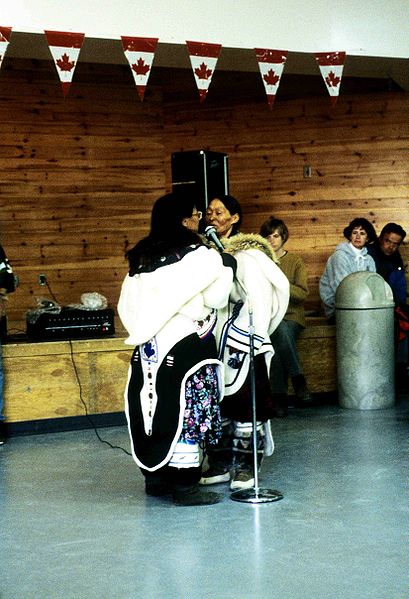
-
Article
Inuksuk (Inukshuk)
Inuksuk (also spelled inukshuk, plural inuksuit) is a figure made of piled stones or boulders constructed to communicate with humans throughout the Arctic. Traditionally constructed by the Inuit, inuksuit are integral to Inuit culture and are often intertwined with representations of Canada and the North. A red inuksuk is found on the flag of Nunavut. In Inuktitut, the term inuksuk means "to act in the capacity of a human." It is an extension of the word inuk meaning "a human being." Inuksuit have been found close to archaeological sites dating from 2400 to 1800 BCE in the Mingo Lake region of southwest Baffin Island. (See also Prehistory.) While stone figures resembling human forms are often referred to as inuksuk, such figures are actually known as inunnguaq.
"https://d3d0lqu00lnqvz.cloudfront.net/media/media/fda0c3a3-c613-4196-ba0a-690925ca6c04.jpg" // resources/views/front/categories/view.blade.php
https://d3d0lqu00lnqvz.cloudfront.net/media/media/fda0c3a3-c613-4196-ba0a-690925ca6c04.jpg
-
Article
Inuktitut Words for Snow and Ice
It is often said that the Inuit have dozens of words to refer to snow and ice. Anthropologist John Steckley, in his book White Lies about the Inuit (2007), notes that many often cite 52 as the number of different terms in Inuktitut. This belief in a high number of words for snow and ice has been sharply criticized by a large number of linguists and anthropologists.
"https://d3d0lqu00lnqvz.cloudfront.net/media/media/1c4db935-fcf6-4b0d-a8f4-7ab6c8a30a3c.jpg" // resources/views/front/categories/view.blade.php
https://d3d0lqu00lnqvz.cloudfront.net/media/media/1c4db935-fcf6-4b0d-a8f4-7ab6c8a30a3c.jpg
-
Macleans
Iran to Investigate Journalist's Death
Zahra Kazemi was not the first journalist to die for her job in Iran. Nor is she the first to die of beatings while in state custody.This article was originally published in Maclean's Magazine on July 28, 2003
"https://thecanadianencyclopedia.ca/images/tce_placeholder.jpg?v=e9dca980c9bdb3aa11e832e7ea94f5d9" // resources/views/front/categories/view.blade.php
https://thecanadianencyclopedia.ca/images/tce_placeholder.jpg?v=e9dca980c9bdb3aa11e832e7ea94f5d9
-
Article
Irish Music in Canada
The Irish component in the population of Canada is the fourth largest (after English, French, and Scottish) and one of the oldest. Irish fishermen settled in Newfoundland in the early 17th century. By the mid-18th century that island had some 5000 Roman Catholic Irish inhabitants - about one-third of its population. There were Irish among those who founded Halifax in 1749. The United Empire Loyalists who moved to Nova Scotia and New Brunswick after 1776 included many of Irish descent. The famine in Ireland during the early 19th century sent thousands of Irish farmers to Upper Canada (Ontario). By 1871 the Irish were the second largest ethnic group in Canada (after the French); in 1950 there were 1,500,000 Irish, catholic and protestant. In the 1986 census there were 699,685 Canadians of single Irish descent and a further 2,922,605 with some Irish ancestry.
"https://d3d0lqu00lnqvz.cloudfront.net/dreamstime_xxl_22459850.jpg" // resources/views/front/categories/view.blade.php
https://d3d0lqu00lnqvz.cloudfront.net/dreamstime_xxl_22459850.jpg
-
Editorial
Irene Parlby and the United Farmers of Alberta
The following article is an editorial written by The Canadian Encyclopedia staff. Editorials are not usually updated. Most Canadians, if they have heard of Irene Parlby, know her as one of the “Famous Five.” This group of five Alberta women were plaintiffs in a court case that argued women were indeed persons under the British North America Act (now the Constitution Act, 1867) and thus entitled to be named to the Senate. It was a landmark case in the long struggle by women to achieve political and legal equality in Canada. But Parlby’s historical significance rests on much more than just the Persons Case.
"https://d3d0lqu00lnqvz.cloudfront.net/media/new_article_images/IreneParlby/UFA_caucus.jpg" // resources/views/front/categories/view.blade.php
https://d3d0lqu00lnqvz.cloudfront.net/media/new_article_images/IreneParlby/UFA_caucus.jpg
-
Article
Irish Canadians
The Irish have played an important role in the history of Canada. From their early settlements in Newfoundland, to the larger waves of migrations in the 19th century and the present, the Irish have been ever-present in the Canadian landscape. Irish Canadians have contributed to Canadian society and its economy, and the Irish-Canadian identity continues to be expressed and celebrated. According to the 2021 census, 4,413,120 Canadians reported having Irish origins.
"https://d3d0lqu00lnqvz.cloudfront.net/media/media/1354ebca-0c98-466e-88d2-cbb9b2cabab1.jpg" // resources/views/front/categories/view.blade.php
https://d3d0lqu00lnqvz.cloudfront.net/media/media/1354ebca-0c98-466e-88d2-cbb9b2cabab1.jpg
-
Infographic
Irish Culture in Canada
"https://d3d0lqu00lnqvz.cloudfront.net/media/media/5e849981-e780-4c58-b1e4-9b2879b6056c.png" // resources/views/front/categories/view.blade.php
https://d3d0lqu00lnqvz.cloudfront.net/media/media/5e849981-e780-4c58-b1e4-9b2879b6056c.png
-
Article
Haudenosaunee (Iroquois)
The Haudenosaunee, or “people of the longhouse,” commonly referred to as Iroquois or Six Nations, are members of a confederacy of Indigenous nations known as the Haudenosaunee Confederacy. Originally a confederacy of five nations inhabiting the northern part of New York state, the Haudenosaunee consisted of the Seneca, Cayuga, Oneida, Onondaga and Kanyen’kehà:ka (Mohawk). When the Tuscarora joined the confederacy early in the 18th century, it became known as the Six Nations. Today, Haudenosaunee live on well-populated reserves — known as reservations in the United States — as well as in off-reserve communities.
"https://d3d0lqu00lnqvz.cloudfront.net/media/media/c78ecb73-d7ac-4834-bc1e-a6d6bf206331.jpg" // resources/views/front/categories/view.blade.php
https://d3d0lqu00lnqvz.cloudfront.net/media/media/c78ecb73-d7ac-4834-bc1e-a6d6bf206331.jpg
-
Macleans
Irshad Manji Challenges Islam
LIKE THOUSANDS of Muslims originally from South Asia, Irshad Manji's parents fled Uganda in the early 1970s to escape the wrath of dictator Idi Amin.This article was originally published in Maclean's Magazine on September 29, 2003
"https://thecanadianencyclopedia.ca/images/tce_placeholder.jpg?v=e9dca980c9bdb3aa11e832e7ea94f5d9" // resources/views/front/categories/view.blade.php
https://thecanadianencyclopedia.ca/images/tce_placeholder.jpg?v=e9dca980c9bdb3aa11e832e7ea94f5d9